
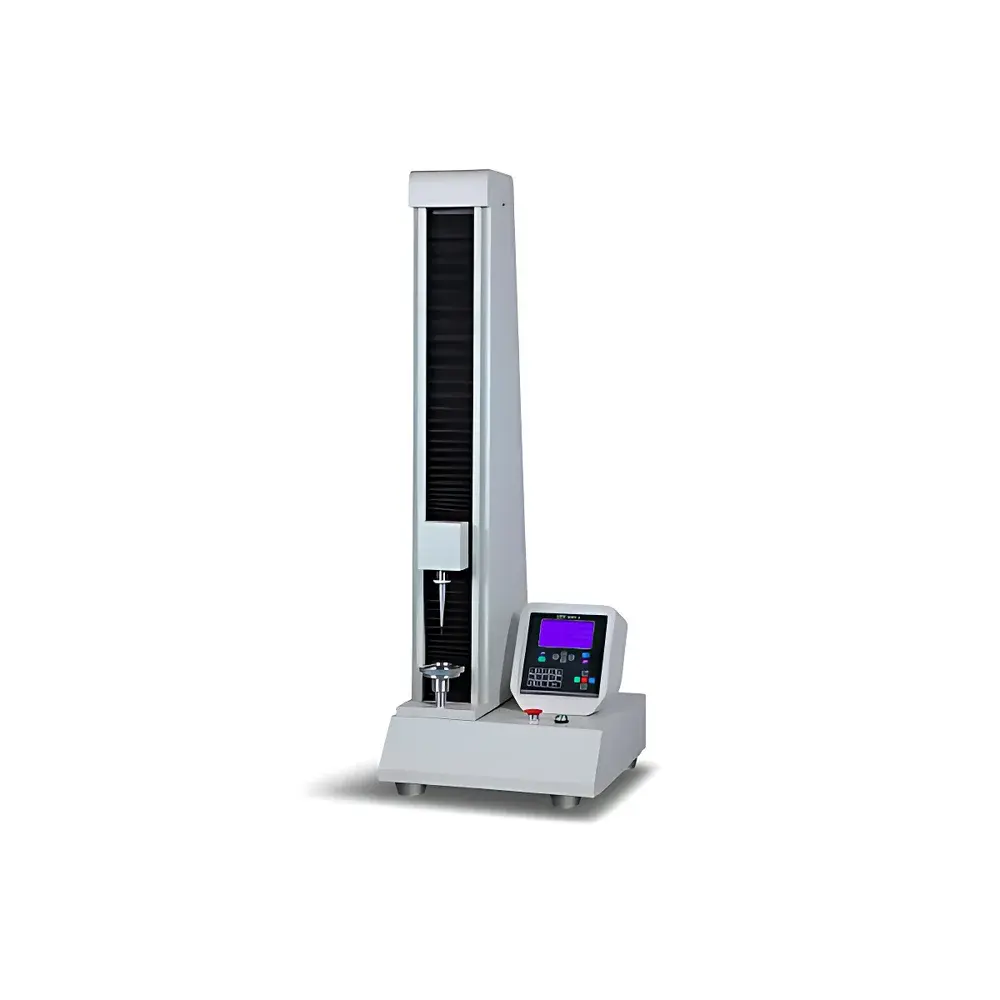
GBPI GBH-1F Desktop Single-Column Electronic Tensile Testing Machine
| Brand | GBPI |
|---|---|
| Origin | Guangdong, China |
| Manufacturer Type | Direct Manufacturer |
| Model | GBH-1F |
| Max Test Load | 1.5 kN |
| Force Range | 0–500 N (optional 0–1500 N) |
| Extension Capacity | up to 1400% |
| Force Accuracy | ±0.5% of reading (Class 0.5) |
| Crosshead Travel | 750 mm |
| Displacement Resolution | ±0.5% of reading |
| Effective Sample Width | 30 mm (customizable to 50 mm) |
| Test Speed | 0–500 mm/min, continuously variable |
| Power Supply | AC 220 V, 50 Hz |
| Power Consumption | 1000 W |
| Dimensions (W×D×H) | 600 × 600 × 1300 mm |
| Weight | 70 kg |
| Sampling Rate | 100 Hz |
| Compliance | ASTM D882, ASTM D1938, ASTM F88, ISO 37, GB/T 1040, GB/T 8808, YY/T 0681, YBB pharmaceutical packaging standards, JJG 139 |
Overview
The GBPI GBH-1F is a precision-engineered desktop single-column electronic tensile testing machine designed for high-reproducibility mechanical characterization of thin, flexible materials commonly used in packaging, medical device, and consumer product industries. It operates on the principle of controlled uniaxial force application via a servo-driven crosshead, enabling quantitative measurement of tensile strength, elongation at break, Young’s modulus, peel adhesion, tear resistance, puncture force, heat seal strength, compression, and flexural properties. Its modular architecture supports standardized test protocols across regulatory frameworks including FDA-regulated packaging validation (21 CFR Part 211), ISO 11607 for sterile barrier systems, and USP for container closure integrity. The system complies with Class 0.5 force accuracy per ISO 7500-1 and displacement linearity per ISO 2041, ensuring metrological traceability for GLP/GMP-aligned laboratories.
Key Features
- High-stiffness dual-post tabletop frame with optimized load path geometry minimizes deflection and ensures long-term mechanical stability.
- Digital closed-loop control system integrating imported AC servo motor and precision ground ball screw transmission delivers smooth, low-drift motion across the full speed range (0–500 mm/min).
- Multi-channel data acquisition at 100 Hz sampling rate captures transient mechanical responses—including yield points, necking onset, and failure propagation—with sub-millisecond temporal resolution.
- Modular sensor interface supports up to three simultaneous load cell configurations (e.g., 500 N and 1500 N), enabling seamless range switching without recalibration.
- Configurable clamping options include manual vise-type grips (standard 30 mm width, optional 50 mm), pneumatic clamps (optional), and application-specific fixtures for ASTM D882 film tensile, ASTM F88 seal strength, or ISO 37 rubber tear tests.
- Integrated safety architecture includes hardware-based overload cutoff, mechanical end-stop limit switches, emergency stop circuitry compliant with IEC 60204-1, and software-enforced travel boundaries.
- Two deployment modes: embedded controller (compact, space-saving) or external control unit (enabling standalone operation and future firmware/hardware upgrades independent of host PC).
Sample Compatibility & Compliance
The GBH-1F is validated for use with polymeric films (LDPE, PET, BOPP, CPP), laminates (aluminum foil/paper/plastic composites), medical-grade nonwovens, hydrogel sheets, elastomeric tubing, pressure-sensitive adhesives, and pharmaceutical blister lidding materials. All test methods adhere to international standards referenced in the device’s type approval—specifically ASTM E4 (load verification), ASTM D828 (peel strength), ASTM D3330 (adhesive tack), ISO 1133 (melt flow index correlation), and Chinese pharmacopoeial standards YBB00112003 (PVC/PVDC rigid blisters) and YBB00202004 (aluminum-plastic composite foils). Data audit trails meet FDA 21 CFR Part 11 requirements when paired with validated software configuration and user access controls.
Software & Data Management
The GBH-1F is operated via GBPI’s proprietary Windows-based TensilePro software, which provides real-time force-displacement curve visualization, automatic peak detection, and multi-curve overlay for comparative analysis. Raw data export is supported in CSV, XLSX, and XML formats; all metadata—including operator ID, calibration certificate number, environmental conditions (optional humidity/temperature input), and test parameter history—is embedded in each dataset. Custom report templates can be authored using drag-and-drop fields, with direct integration into LIMS environments via ODBC drivers. Software validation documentation (IQ/OQ/PQ protocols) and electronic signature support are available upon request for regulated users.
Applications
- Quality assurance of flexible packaging: seal strength verification for pouches and sachets per ASTM F88, delamination resistance of laminated structures per GB/T 10004, and puncture resistance of medical device pouches per ISO 11607-2.
- Pharmaceutical packaging compliance: tensile evaluation of child-resistant closures (ASTM D3475), peel force of aluminum foil seals (YBB00102003), and burst testing of IV bags (ISO 15223).
- Material development labs: stress-strain profiling of biodegradable films (PLA, PHA), creep behavior of hydrogels under sustained load, and anisotropic modulus mapping of extruded polymer webs.
- Educational institutions: hands-on instruction in mechanical property fundamentals (Hooke’s law, Poisson’s ratio, ductile vs. brittle failure modes) aligned with ASTM E251 and ISO 527 syllabi.
FAQ
What calibration standards does the GBH-1F support?
The system is compatible with certified reference load cells traceable to NIM (China National Institute of Metrology) and supports periodic verification per JJG 139–2014 and ISO/IEC 17025 requirements.
Can the GBH-1F perform cyclic loading or fatigue tests?
No—it is configured for static and quasi-static monotonic testing only. For dynamic or fatigue applications, GBPI recommends the GHF series servo-hydraulic systems.
Is third-party certification available for GMP audits?
Yes. Upon request, GBPI provides Factory Acceptance Test (FAT) reports, installation qualification (IQ), operational qualification (OQ), and software validation packages compliant with Annex 11 and ALCOA+ principles.
What maintenance intervals are recommended?
Lubrication of the ball screw assembly every 6 months and annual load cell recalibration are advised. Preventive maintenance kits and OEM technical bulletins are supplied with each unit.
Does the system support networked data transfer to enterprise systems?
Yes—via Ethernet-enabled controller option (not standard), supporting Modbus TCP and RESTful API endpoints for integration with MES or SAP QM modules.
Related Products



