
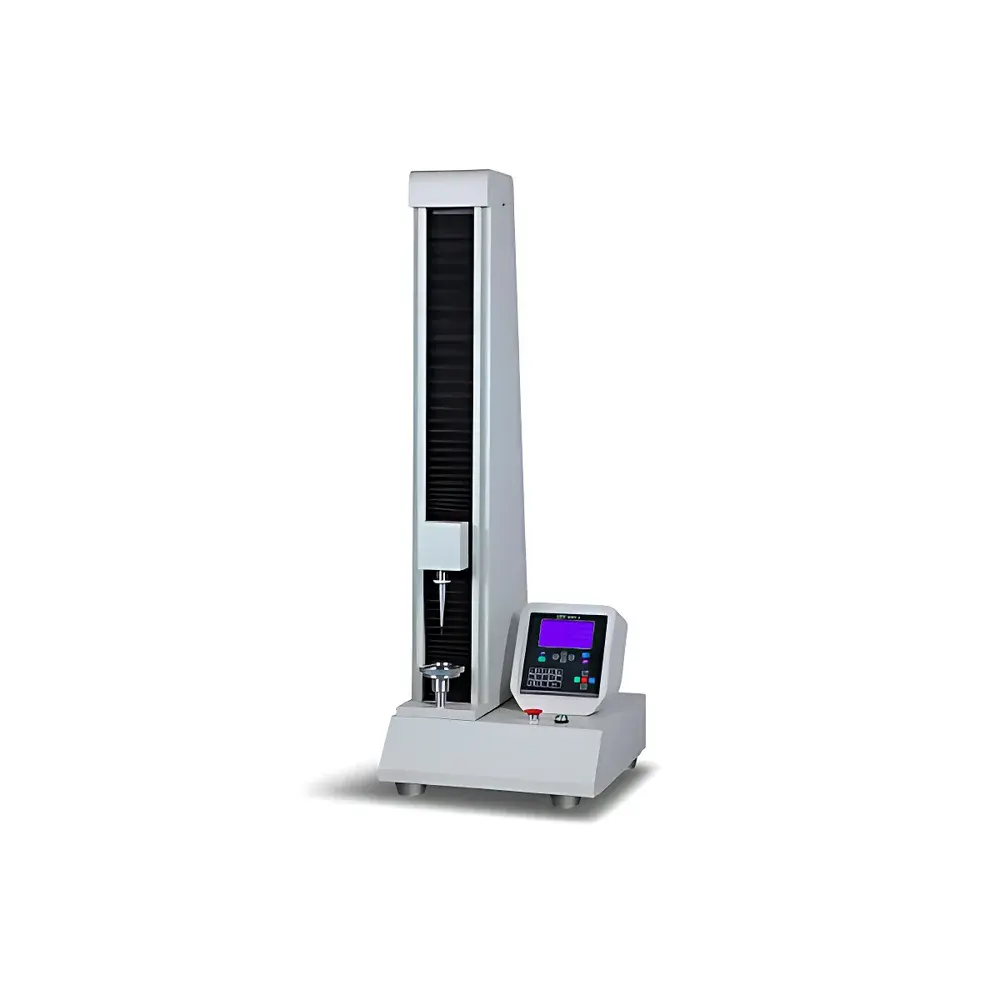
GBPI GBH-1G Single-Column Electronic Tensile Testing Machine
| Brand | GBPI |
|---|---|
| Model | GBH-1G |
| Type | Electronic Tensile Testing Machine |
| Max Test Load | 1.5 kN |
| Force Range | 0–500 N (optional 0–1500 N) |
| Force Accuracy | ±0.5% of reading (Class 0.5) |
| Elongation Capacity | up to 1400% |
| Crosshead Travel | 750 mm |
| Displacement Resolution | ±0.5% of reading |
| Effective Specimen Width | 30 mm (customizable to 50 mm) |
| Test Speed | 0–500 mm/min, continuously variable |
| Power Supply | AC 220 V, 50 Hz |
| Power Consumption | 1000 W |
| Dimensions (W×D×H) | 600 × 600 × 1300 mm |
| Weight | 70 kg |
Overview
The GBPI GBH-1G is a precision-engineered single-column electronic tensile testing machine designed for high-reproducibility mechanical characterization of thin, flexible materials in research laboratories, quality control departments, and regulatory-compliant production environments. It operates on the principle of controlled uniaxial force application via a digitally regulated servo-driven crosshead system, enabling accurate measurement of tensile strength, elongation at break, modulus, yield point, peel strength, tear resistance, puncture force, seal integrity, compression, and bending properties. Its modular architecture supports standardized test protocols across packaging, polymer, pharmaceutical, and paper industries—particularly where compliance with ISO, ASTM, and Chinese national standards (e.g., GB/T 1040, GB/T 8808, YY/T 0681, YBB series) is mandatory. The instrument’s rigid dual-column tabletop frame ensures minimal deflection under load, while its high-resolution load cell and real-time 100 Hz sampling rate deliver robust data fidelity across low-force (<1 N) and mid-range (up to 1500 N) applications.
Key Features
- Class 0.5 force accuracy per ISO 7500-1 and JJG 139, validated across the full 0–500 N operating range (extendable to 0–1500 N with optional load cell)
- Continuous speed control from 0.01 to 500 mm/min, enabling precise strain-rate-dependent testing per ASTM D882 and ISO 37
- Dual-mode control architecture: integrated embedded controller (space-saving, standalone operation) or PC-synchronized mode with real-time feedback
- High-stiffness ball-screw drive system with imported AC servo motor, ensuring zero positional drift and long-term mechanical stability
- Multi-channel analog input supporting simultaneous acquisition from up to four transducers (e.g., load cell, extensometer, environmental sensor)
- Comprehensive safety suite: hardware-based overload cutoff, mechanical limit switches, emergency stop button, and software-enforced travel boundaries
- Open data structure compliant with ASTM E1434; all raw time-series data—including force, displacement, and time stamps—are exportable in CSV/ASCII format
- Configurable test parameters: gauge length (adjustable), specimen width (standard 30 mm, optional 50 mm), pre-load threshold, break detection logic, and auto-return positioning
- Support for pneumatic clamping (optional) to ensure uniform stress distribution across low-modulus films and nonwovens
Sample Compatibility & Compliance
The GBH-1G is validated for use with polymeric films (LDPE, PET, BOPP), laminates (Alu/PET/PE), coated papers, medical-grade nonwovens, elastomeric sheets, pressure-sensitive adhesives, and pharmaceutical blister foils. Its 750 mm vertical travel accommodates extended elongation tests required by GB/T 16578.1 (plastic film toughness) and ASTM D1938 (propagation tear). All firmware and calibration routines are traceable to national metrological standards (CNAS-accredited verification available upon request). The system meets essential requirements of ISO/IEC 17025 for testing laboratories and supports audit-ready documentation per FDA 21 CFR Part 11 when paired with validated software configuration and electronic signature modules.
Software & Data Management
The included Windows-based control and analysis software provides full GLP/GMP-aligned functionality: user-level access control, audit trail logging (operator, timestamp, parameter changes), electronic signatures, and report templates aligned with GB/T 2790 (peel adhesion) and GB/T 2792 (bond strength). Real-time curve overlay allows comparative analysis of multiple specimens or batches. Data interpolation, derivative calculation (e.g., tangent modulus), and statistical summaries (mean, SD, CV%) are automated. Export options include Excel-compatible .csv, PDF reports with embedded graphs, and XML for LIMS integration. Raw data files retain full 100 Hz resolution without interpolation or smoothing—critical for failure mode analysis in brittle or viscoelastic materials.
Applications
- Tensile property mapping of multilayer food packaging films per GB/T 1040.3 and ASTM D882
- Hot-tack and seal strength evaluation of thermoformed trays and pouches (GB/T 2792, ASTM F88)
- Puncture resistance of medical packaging per YY/T 0681.4 and ISO 11607-2
- Peel adhesion testing of pressure-sensitive labels and tapes (GB/T 7122, ASTM D3330)
- Tear propagation analysis of woven/nonwoven substrates (GB/T 2791, ASTM D1938)
- Compression behavior of foam cushions and corrugated board (GB/T 6543)
- Educational mechanics labs requiring repeatable, standards-aligned experiments
FAQ
What standards does the GBH-1G support out-of-the-box?
The system includes preconfigured test methods for 28+ national and international standards, including GB/T 1040, GB/T 8808, ASTM D882, ISO 37, and YY/T 0681 series. Custom method creation is supported via editable parameter sets.
Is calibration traceable to national standards?
Yes—factory calibration uses CNAS-certified reference load cells. Optional on-site recalibration with certificate traceable to China NIM or internationally recognized NMIs is available.
Can the system operate without a PC?
Yes. The embedded controller enables full test execution, result display, and basic statistics independently. PC connectivity is required only for advanced analysis, reporting, and data archival.
What is the maximum specimen thickness it accommodates?
Standard mechanical grips accept specimens up to 5 mm thick; pneumatic clamps (optional) extend compatibility to 10 mm for soft foams and gels.
Does it support extensometer integration?
Yes—the analog input channel accepts LVDT or video-based extensometers (e.g., ISO 9513-compliant) for true strain measurement, especially critical for low-elongation materials like metallized films.



