
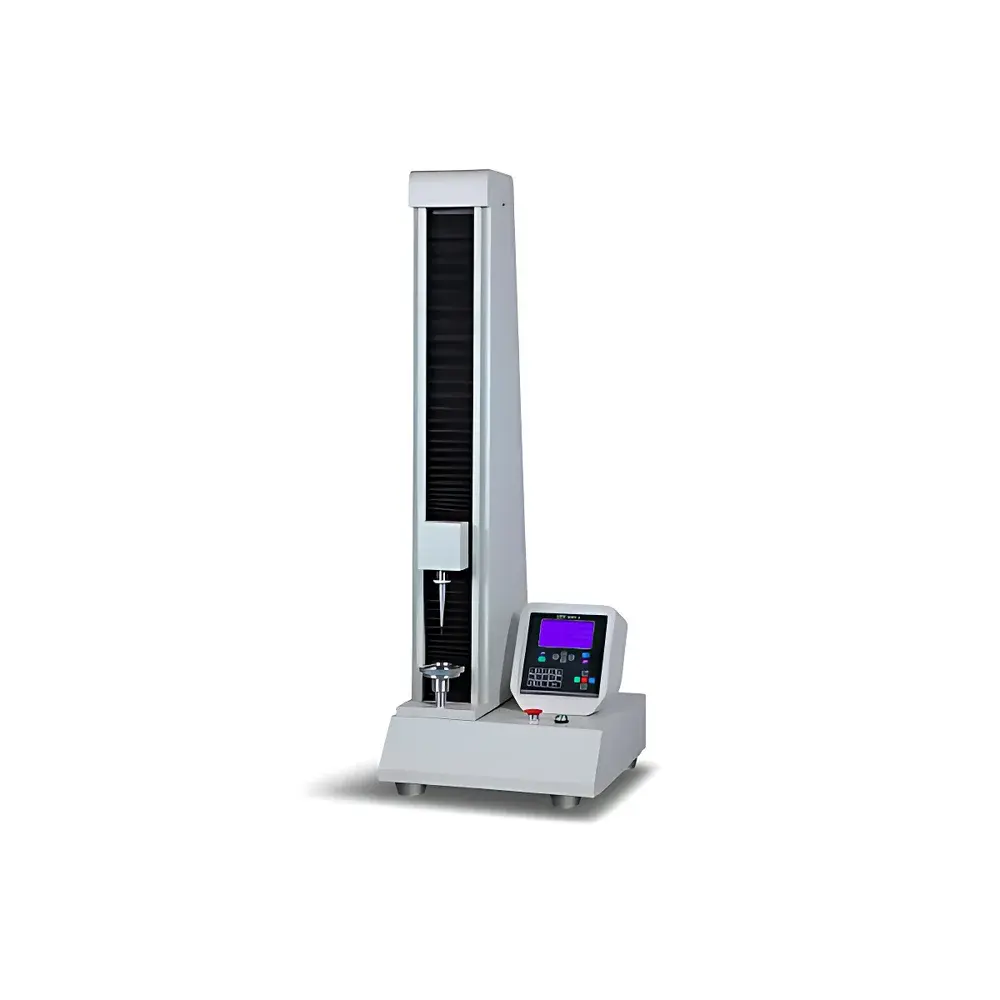
GBPI GBH-1K Pharmaceutical Packaging Mechanical Tester for GMP-Compliant Quality Control
| Brand | GBPI |
|---|---|
| Origin | Guangdong, China |
| Manufacturer Type | Direct Manufacturer |
| Origin Category | Domestic |
| Model | GBH-1K |
| Instrument Type | Electromechanical Tensile Testing Machine |
| Max Test Load | 1.5 kN |
| Force Range | 0–500 N (optional 0–1500 N) |
| Elongation Capacity | up to 1400% |
| Force Accuracy | ±0.5% of reading (Class 0.5) |
| Crosshead Travel | 750 mm |
| Displacement Resolution | ±0.5% of reading |
| Effective Sample Width | 30 mm (customizable to 50 mm) |
| Test Speed | 0–500 mm/min, infinitely variable |
| Power Supply | AC 220 V, 50 Hz |
| Rated Power | 1000 W |
| Dimensions (W×D×H) | 600 × 600 × 1300 mm |
| Weight | 70 kg |
Overview
The GBPI GBH-1K Pharmaceutical Packaging Mechanical Tester is a precision-engineered electromechanical tensile testing system designed specifically for compliance-driven quality assurance in regulated pharmaceutical packaging environments. Built upon the fundamental principles of uniaxial force-displacement transduction and calibrated load-cell measurement, the instrument delivers traceable, repeatable mechanical property data essential for validating packaging integrity under Good Manufacturing Practice (GMP) frameworks. It operates in strict accordance with pharmacopoeial and regulatory test methods—including YBB series standards (e.g., YBB00112003 for peel strength of aluminum-plastic blister packs, YBB00102003 for heat seal strength), ISO 37 (rubber tensile properties), ASTM F88 (seal strength of flexible barrier materials), and ASTM D882 (tensile properties of thin plastic sheeting). Its dual-column desktop architecture ensures structural rigidity and minimal deflection during high-precision loading cycles, while the closed-loop servo control system maintains consistent strain rates across the full speed range—critical for simulating real-world handling, transportation, and sterilization stresses on primary and secondary packaging.
Key Features
- Modular multi-test capability: Configurable for tensile, peel (90°/180°), heat seal strength, tear (Elmendorf, trouser, tongue), puncture, compression, flexural, and shear tests—all executed under identical environmental and calibration conditions.
- Class 0.5 force accuracy per JJG 139 and ISO 7500-1: Achieved via temperature-compensated, high-stability S-beam load cells with digital signal conditioning and 100 Hz real-time sampling.
- Full-range displacement fidelity: High-resolution optical encoder coupled with preloaded ground ball screw drive ensures ±0.5% displacement linearity over 750 mm travel—enabling reliable measurement of elongation at break for elastic films and brittle laminates alike.
- GMP-aligned software architecture: Supports 21 CFR Part 11-compliant user access control, electronic signatures, audit trails, and immutable data logging—fully compatible with laboratory information management systems (LIMS).
- Flexible hardware integration: Optional pneumatic clamping system (ISO 2439 compliant), customizable jaw faces (textured, rubber-coated, serrated), and expandable sensor channels for simultaneous multi-parameter acquisition (e.g., force + temperature + humidity).
- Robust safety framework: Dual hardware limit switches, overload cutoff, emergency stop circuitry, and software-enforced operational boundaries ensure operator and specimen protection during automated test sequences.
Sample Compatibility & Compliance
The GBH-1K accommodates a broad spectrum of pharmaceutical packaging substrates, including but not limited to: cold-forming aluminum foils, PVC/PVDC blisters, polyester-aluminum-paper laminates, Tyvek®-based sterile barrier systems, silicone-coated release liners, and medical-grade polyolefin films. All test configurations adhere to material-specific validation requirements outlined in USP , Ph. Eur. 3.2.1, and ISO 11607-1/2. The system’s mechanical design satisfies mechanical safety standards EN ISO 12100 and electrical safety standard IEC 61000-6-3. Calibration certificates are traceable to NIM (National Institute of Metrology, China) or equivalent national metrology institutes, and routine verification follows ASTM E4 protocols using certified reference load cells and displacement gauges.
Software & Data Management
GBPI’s proprietary GBTest v4.2 software provides a validated, configurable platform for method development, execution, and reporting. It supports GLP/GMP audit readiness through time-stamped, user-locked test records; automatic generation of raw data files (CSV, XML), stress-strain curves, and summary reports compliant with ISO/IEC 17025 documentation requirements. Data export is fully interoperable with Microsoft Excel, MATLAB, and statistical process control (SPC) tools. The software permits creation of SOP-linked test templates—predefined parameter sets for YBB00202004 (peel strength of aluminum-plastic composite film) or ASTM F904 (adhesive bond strength)—reducing operator variability and ensuring inter-laboratory reproducibility. Optional network licensing enables centralized administration across multiple instruments in QC labs.
Applications
- Validation of heat seal integrity for blister packs and sachets under accelerated aging conditions.
- Quantification of delamination resistance in multi-layer pouches exposed to gamma irradiation or ethylene oxide sterilization.
- Assessment of puncture resistance for IV bag films per USP requirements.
- Measurement of peel strength between foil and paperboard in carton sealing applications.
- Comparative evaluation of tensile modulus and yield point across polymer grades used in prefilled syringe barrels.
- Supporting stability studies by tracking mechanical property drift over 24-month storage intervals at controlled temperature/humidity.
FAQ
Does the GBH-1K meet FDA requirements for use in pharmaceutical quality control laboratories?
Yes—the system complies with 21 CFR Part 11 when deployed with validated GBTest software, proper access controls, and documented change management procedures.
Can the instrument be integrated into an existing LIMS environment?
Yes—via standardized ODBC and HL7 interfaces; custom API integration is supported under NDA.
Is third-party calibration certification available?
Yes—GBPI partners with CNAS-accredited calibration providers offering on-site or return-to-factory services with NIST-traceable certificates.
What is the recommended maintenance schedule?
Quarterly verification of force and displacement accuracy using certified reference standards; annual full calibration and mechanical inspection.
Are test methods pre-loaded for common pharmacopoeial standards?
Yes—preconfigured methods for all YBB, ASTM F88/F904, ISO 37, and GB/T 1040 series standards are included out-of-the-box.



