
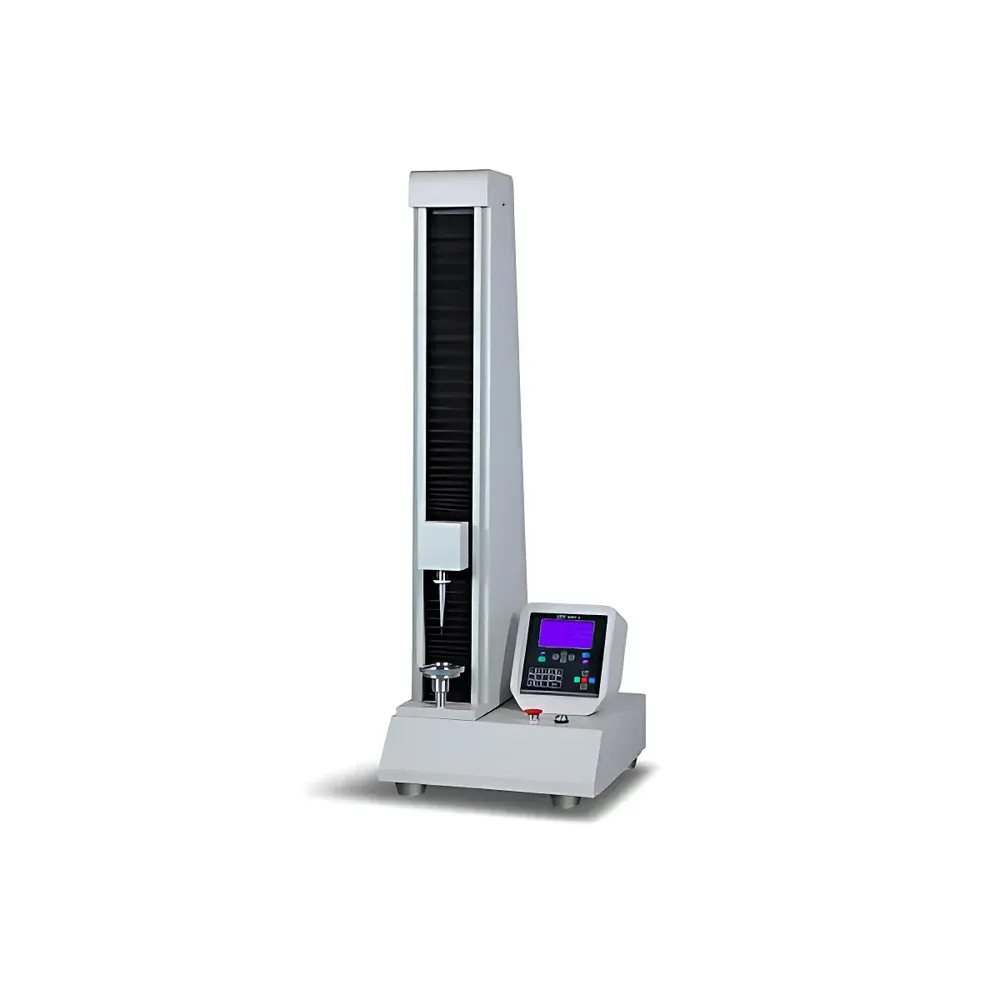
GBPI GBH-1U Pharmaceutical Packaging Mechanical Tester for GMP Compliance
| Brand | GBPI |
|---|---|
| Model | GBH-1U |
| Type | Single-Column Electromechanical Tensile Testing Machine |
| Max Load Capacity | 1.5 kN |
| Force Range | 0–500 N (optional 0–1500 N) |
| Force Accuracy | ±0.5% of reading (Class 0.5) |
| Elongation Range | up to 1400% |
| Crosshead Travel | 750 mm |
| Displacement Resolution | ±0.5% of reading |
| Test Speed | 0–500 mm/min, continuously variable |
| Effective Specimen Width | 30 mm (customizable to 50 mm) |
| Power Supply | AC 220 V, 50 Hz |
| Weight | 70 kg |
| Dimensions (W×D×H) | 600 × 600 × 1300 mm |
| Motor & Drive | Imported AC servo system with precision ball screw loading mechanism |
| Data Acquisition Rate | 100 Hz |
| Safety Features | Overload protection, mechanical limit switches, emergency stop, software-based load/displacement safeguards |
Overview
The GBPI GBH-1U Pharmaceutical Packaging Mechanical Tester is a single-column, electromechanical tensile testing system engineered for precise, repeatable mechanical characterization of primary and secondary packaging materials used in regulated pharmaceutical manufacturing environments. Designed in strict alignment with Good Manufacturing Practice (GMP) requirements, the instrument implements standardized force-displacement measurement principles based on Hooke’s law and controlled uniaxial loading—enabling quantitative evaluation of tensile strength, elongation at break, peel adhesion, heat seal integrity, puncture resistance, tear propagation, and compressive deformation. Its modular architecture supports multi-test protocol execution without hardware reconfiguration, making it suitable for routine quality control (QC), incoming material verification, stability study support, and method development within ISO 13485– or FDA 21 CFR Part 211–compliant facilities.
Key Features
- Class 0.5 force measurement accuracy per ISO 7500-1 and ASTM E4, validated across full 0–500 N range (extendable to 0–1500 N with optional load cell)
- High-resolution displacement sensing with ±0.5% fidelity over 750 mm travel, enabling reliable detection of micro-deformations during seal failure or film yielding
- Continuous speed control from 0.1 to 500 mm/min, supporting both quasi-static (e.g., ASTM D882) and dynamic (e.g., ASTM F88 heat seal peel) test profiles
- Dual-mode control architecture: embedded microprocessor unit allows standalone operation; optional PC-integrated mode enables advanced scripting, real-time curve overlay, and audit-trail-compliant data logging
- Modular fixture interface compatible with standard GB/T, YBB, ASTM, and ISO-compliant grips—including pneumatic clamping kits (optional) for consistent jaw pressure across low-modulus films and laminates
- 100 Hz high-speed data acquisition ensures accurate capture of transient events such as seal burst, tear initiation, or adhesive debonding
- Structural rigidity optimized via dual-column tabletop frame design and preloaded ball-screw actuation, minimizing frame deflection and enhancing long-term calibration stability
- Comprehensive safety suite including hardware interlocks, programmable force/displacement limits, and emergency stop circuitry compliant with IEC 61800-5-2
Sample Compatibility & Compliance
The GBH-1U accommodates a broad spectrum of pharmaceutical packaging substrates: plastic films (e.g., PET/AL/PE, CPP, BOPP), aluminum foil laminates, blister foils (PVC/PVDC), paperboard cartons, Tyvek® pouches, rubber stoppers, and elastomeric closures. It supports all major pharmacopoeial and regulatory test methods, including but not limited to: YBB00112003 (heat seal strength), YBB00102003 (peel strength), YBB00132002 (puncture force), ASTM F88 (seal strength), ASTM F904 (coefficient of friction), ISO 37 (tensile properties of vulcanized rubber), and GB/T 1040.1 (plastics tensile testing). All firmware and software modules are designed to meet ALCOA+ data integrity principles and support 21 CFR Part 11–compliant electronic records when deployed with qualified computer systems.
Software & Data Management
The GBH-1U operates with GBPI’s proprietary WinTest v4.x software, a Windows-based platform supporting GLP/GMP-aligned workflows. Key capabilities include: customizable test method templates with parameter locking (e.g., pre-set jaw spacing, crosshead speed, trigger thresholds); real-time graphical display of stress-strain, force-time, and peel-load curves; automated calculation of ASTM/ISO-defined metrics (e.g., average peel force, ultimate tensile strength, % elongation); statistical reporting (mean, SD, CV%, min/max) across batched specimens; export to CSV, PDF, or native Excel formats; and secure user access levels (operator, supervisor, administrator) with password-protected method editing and result modification logs. Raw data files are stored with embedded metadata (operator ID, timestamp, instrument serial number, calibration certificate expiry), ensuring full traceability for internal audits or regulatory inspections.
Applications
- Quantitative validation of heat seal process parameters during packaging line qualification (IQ/OQ/PQ)
- Comparative assessment of seal integrity across different sealing temperatures, dwell times, and pressure settings
- Tensile property monitoring of barrier films subjected to accelerated aging (ICH Q1A)
- Peel strength verification of child-resistant closures per ISO 8317
- Puncture resistance testing of vial stoppers per USP
- Mechanical durability evaluation of pouch laminates under simulated distribution conditions (ASTM D4169)
- Teaching and method development in university pharmaceutical sciences laboratories
- Third-party contract testing labs performing compendial compliance testing for API and finished dosage form manufacturers
FAQ
Does the GBH-1U comply with FDA 21 CFR Part 11 requirements?
Yes—when configured with validated WinTest software, user access controls, electronic signatures, and audit trail functionality enabled, the system meets Part 11 criteria for electronic records and signatures.
Can the instrument be calibrated in-house using NIST-traceable standards?
Yes—GBPI provides calibration procedures and certified reference load cells; however, initial factory calibration and periodic third-party verification are recommended to maintain ISO/IEC 17025 accreditation.
Is thermal chamber integration supported for temperature-controlled testing?
The base model does not include environmental conditioning, but the open mechanical interface allows integration with external temperature-controlled chambers (e.g., -40°C to +80°C) via custom mounting brackets and synchronized I/O triggers.
What documentation is supplied for GMP validation?
Standard delivery includes Factory Acceptance Test (FAT) report, Installation Qualification (IQ) checklist, Operation Qualification (OQ) protocol template, and calibration certificate traceable to CNAS-accredited laboratories.
How is firmware updated, and is version history maintained?
Firmware updates are delivered via encrypted USB key with version-signed release notes; all installed versions are logged in the system event registry with timestamps and operator IDs.



