
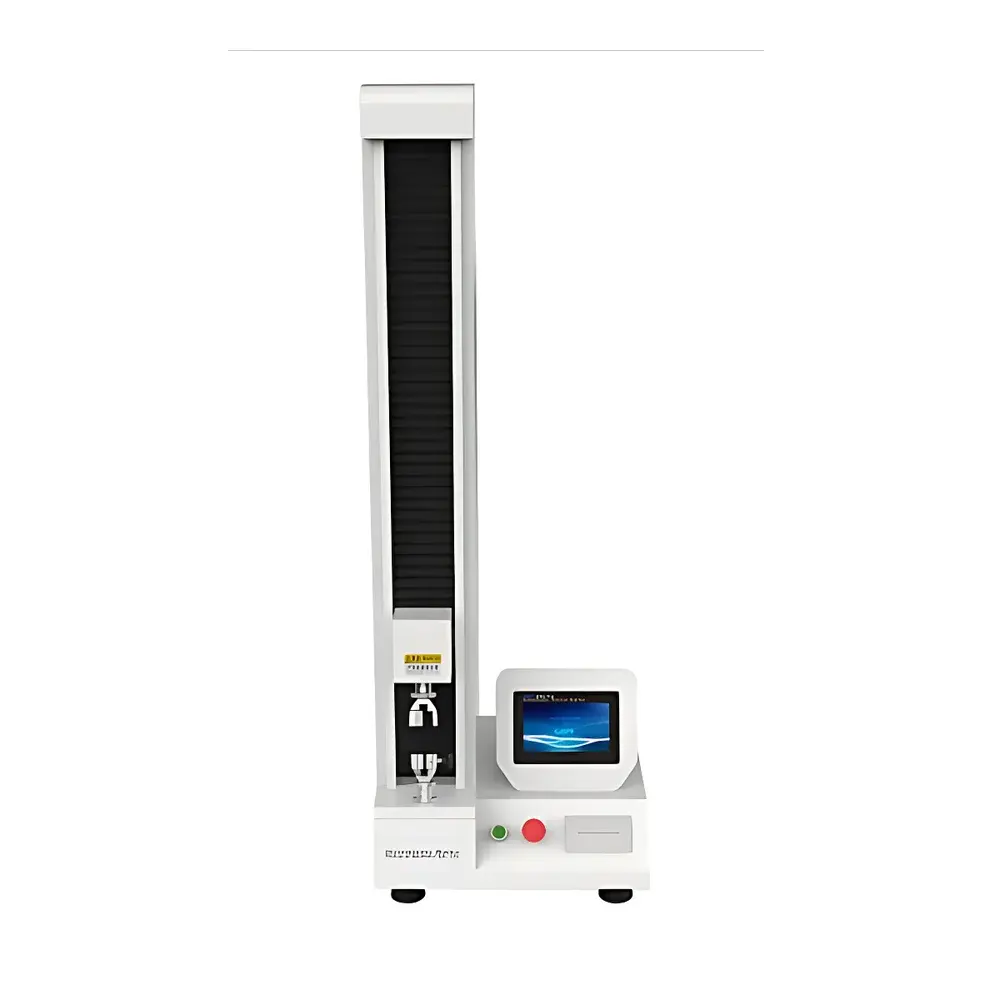
GBPI GBH-2 Advanced Single-Column Electronic Tensile Testing Machine
| Brand | GBPI |
|---|---|
| Origin | Guangdong, China |
| Manufacturer Type | Direct Manufacturer |
| Model | GBH-2 |
| Max. Test Load | 1.5 kN |
| Force Range | 0–500 N (optional up to 1500 N) |
| Force Accuracy | ±0.5 % of full scale (Class 0.5) |
| Extension Capacity | up to 1400 % |
| Crosshead Travel | 750 mm (customizable to 1000/1200 mm) |
| Displacement Resolution | ±0.5 % of reading |
| Force Resolution | 0.001 N |
| Displacement Resolution | 0.001 mm |
| Speed Range | 0–500 mm/min (infinitely variable) |
| Effective Test Width | 30 mm (customizable to 50/60 mm) |
| Dimensions (L×W×H) | 460 × 525 × 1430 mm |
| Weight | 86 kg |
| Power Supply | 220 V, 50 Hz / 500 W |
Overview
The GBPI GBH-2 Advanced Single-Column Electronic Tensile Testing Machine is a precision-engineered mechanical testing system designed for static tensile, compression, flexure, peel, tear, puncture, and shear measurements across diverse material classes. It operates on the principle of controlled uniaxial loading via a high-accuracy ball-screw-driven crosshead, coupled with real-time force acquisition through a calibrated load cell and displacement tracking via an integrated linear encoder. The system complies with core international mechanical testing standards—including ASTM E4 (load verification), ASTM D882 (tensile properties of thin plastic sheeting), ISO 37 (rubber vulcanized—determination of tensile stress-strain properties), ISO 527-3 (plastics—determination of tensile properties—Part 3: Thin plastic films and sheets), and GB/T 16491 (Chinese national standard for electronic universal testing machines). Its architecture supports both routine QC verification and method development in regulated environments, delivering traceable, reproducible mechanical data essential for material qualification, process validation, and regulatory submissions.
Key Features
- Class 0.5 force accuracy per ISO 7500-1 and JJG 139, with force resolution of 0.001 N and displacement resolution of 0.001 mm
- High-stability ball-screw actuation system enabling smooth, low-vibration loading and extended service life under repeated duty cycles
- 100 Hz data sampling rate ensures high-fidelity capture of transient mechanical events such as yield onset, necking, or brittle fracture
- Integrated safety architecture including programmable limit switches, overload cutoff, emergency stop circuitry, and automatic return-to-initial-position functionality
- Color capacitive touchscreen HMI with real-time graphical display of stress–strain curves, peak load, elongation at break, modulus, and other derived parameters
- Modular hardware design supporting dual-channel sensor input for simultaneous force and extensometer measurement; compatible with optional clip-on extensometers for strain-controlled testing
- Compliance-ready software architecture featuring user role management, audit trail logging, electronic signatures, and 21 CFR Part 11–aligned data integrity controls
Sample Compatibility & Compliance
The GBH-2 accommodates specimens ranging from ultra-thin polymer films (≥12 µm) to rigid metallic foils and laminated pharmaceutical packaging. Standard test widths (30 mm) meet requirements for ASTM D828 (peel strength of coated fabrics), ASTM F904 (bond strength of flexible barrier materials), and YBB 00112003 (pharmaceutical packaging—aluminum-plastic blister packs). Customizable jaw widths (up to 60 mm), pneumatic grips, and application-specific fixtures—including syringe plunger friction testers, vial cap pull-off fixtures, pre-filled syringe barrel seal integrity rigs, and needle-shield retention testers—enable full alignment with USP , ISO 11607-2, and EU Annex 1. All mechanical test protocols are fully documentable and support GLP/GMP audit readiness.
Software & Data Management
The embedded GBPI TestMaster™ software provides ISO/IEC 17025–compatible test method definition, parameter scripting, and automated report generation compliant with ASTM E1447 and ISO/IEC 17025 Clause 7.8. Data export options include CSV, PDF, XML, and database-compatible formats (ODBC). Local storage retains ≥10,000 test records with time-stamped metadata, while optional Ethernet/Wi-Fi connectivity enables integration into laboratory information management systems (LIMS) and centralized IoT platforms for remote diagnostics, firmware updates, and multi-site data aggregation. Software validation documentation (IQ/OQ/PQ templates) and raw data archiving utilities are provided for regulated users.
Applications
- Plastic & Flexible Packaging: Tensile strength and elongation of BOPP, PET, PE, and metallized films per GB/T 1040 and ASTM D882; heat-seal strength per ASTM F88 and GB/T 2792; tear resistance per ASTM D1938 and GB/T 16578.1
- Pharmaceutical Packaging: Syringe plunger glide force (YBB 00102003), container closure integrity (YBB 00132002), aluminum cap removal torque simulation, and pre-filled syringe needle–hub bond strength per ISO 11040-4
- Paper & Board: Tensile index, burst strength, and folding endurance of kraft paper, tissue, and corrugated board per ISO 1924 and GB/T 453
- Adhesives & Tapes: 90° and 180° peel adhesion per ASTM D3330 and GB/T 7122; tack and holding power per PSTC-101 and GB/T 4851
- Medical Devices: Catheter push-pull force, IV bag drop impact simulation, wound dressing tensile retention, and transdermal patch peel adhesion per ISO 22867
FAQ
What standards does the GBH-2 comply with for pharmaceutical packaging testing?
It supports YBB 00112003 (blister pack seal strength), YBB 00102003 (syringe plunger glide), YBB 00132002 (vial closure integrity), and ISO 11607-2 for packaging validation.
Can the GBH-2 perform tests requiring strain control instead of crosshead displacement?
Yes—when equipped with an optional non-contact video extensometer or clip-on mechanical extensometer, the system supports true strain-controlled ramp-hold testing per ISO 527-1.
Is the software compliant with FDA 21 CFR Part 11 requirements?
Yes—the TestMaster™ software includes electronic signature workflows, immutable audit trails, and role-based access control aligned with Part 11 Subpart B.
What is the maximum specimen thickness the standard grips can accommodate?
Standard manual wedge grips accept specimens up to 5 mm thick; pneumatic or custom fixtures extend this to 15 mm depending on jaw geometry.
Does the system support automated batch testing with pass/fail criteria?
Yes—test sequences can be programmed with configurable acceptance limits, auto-flagging of outliers, and conditional branching based on intermediate results.



