
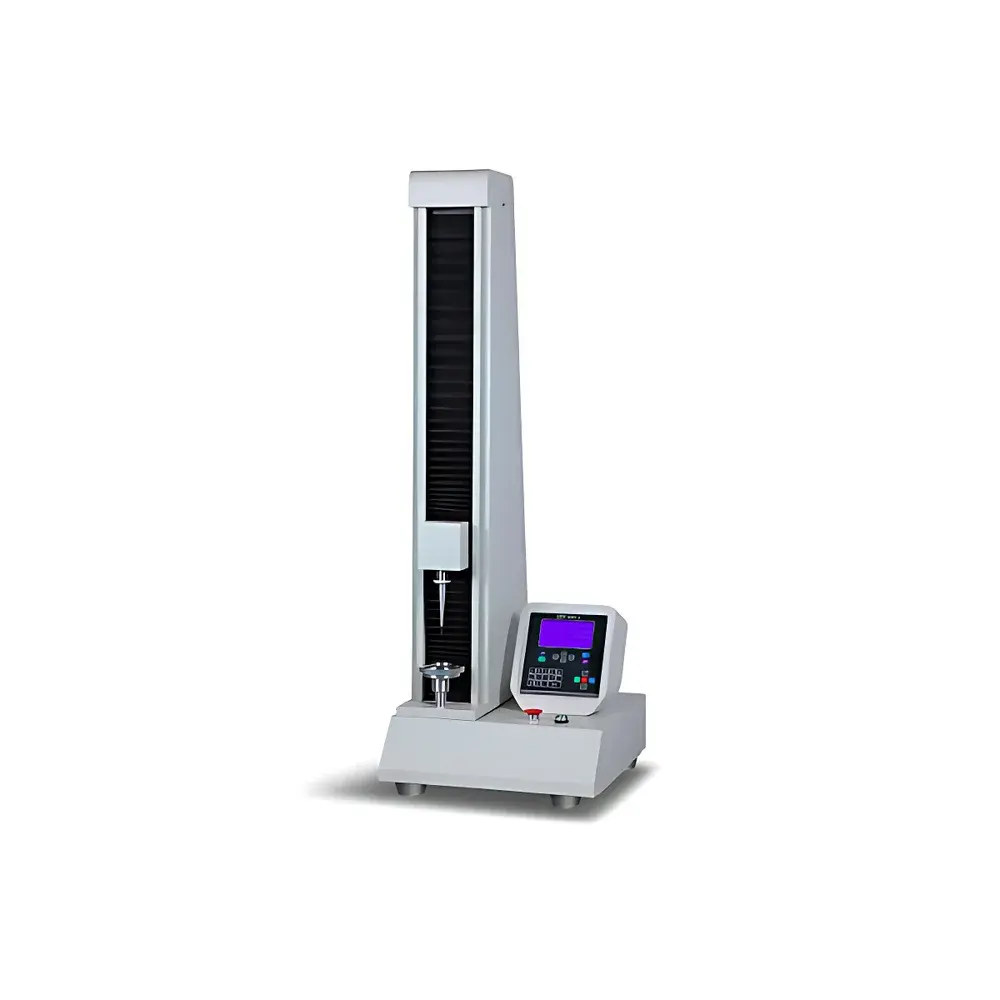
GBPI GBH-3 Mask Strap Tensile Testing Machine
| Brand | GBPI |
|---|---|
| Origin | Guangdong, China |
| Manufacturer Type | Direct Manufacturer |
| Model | GBH-3 |
| Instrument Type | Electromechanical Tensile Testing Machine |
| Max Test Load | 1.5 kN |
| Force Range | 0–500 N (optional 0–1500 N) |
| Elongation Capacity | up to 1400% |
| Force Accuracy | ±0.5% of reading (Class 0.5) |
| Travel Distance | 750 mm |
| Displacement Resolution | ±0.5% of reading |
| Effective Sample Width | 30 mm (customizable to 50 mm) |
| Speed Range | 0–500 mm/min, continuously variable |
| Power Supply | AC 220 V, 50 Hz |
| Power Consumption | 1000 W |
| Dimensions (W×D×H) | 600 × 600 × 1300 mm |
| Weight | 70 kg |
Overview
The GBPI GBH-3 Mask Strap Tensile Testing Machine is a precision electromechanical testing system engineered for quantitative mechanical evaluation of face mask earloop attachments, elastic straps, nonwoven bonding interfaces, and related medical packaging materials. It operates on the fundamental principle of uniaxial tensile loading under controlled displacement rate, measuring force response as a function of extension to determine breaking strength, elongation at break, yield point, and load–extension profile characteristics. Designed specifically to address regulatory and quality assurance requirements in medical device manufacturing, the GBH-3 complies with ISO 13485-aligned test protocols and supports full traceability for GLP/GMP environments. Its dual-column, tabletop architecture ensures structural rigidity and minimal deflection during high-force cyclic or static tests—critical for reproducible results across batch validation, supplier qualification, and R&D material screening.
Key Features
- Class 0.5 force measurement accuracy per ISO 7500-1 and ASTM E4, verified across the full 0–500 N range (extendable to 0–1500 N with optional load cell)
- High-resolution displacement sensing with ±0.5% linearity and 100 Hz real-time data acquisition for precise strain capture during rapid failure events
- Continuous speed control from 0.01 to 500 mm/min, enabling compliance with both low-speed creep assessments (e.g., ASTM D882) and dynamic rupture tests
- Modular fixture interface supporting standardized tensile grips (30 mm standard, 50 mm optional), puncture probes, peel jigs, and pneumatic clamping systems for operator-independent sample alignment
- Fully digital closed-loop control using imported AC servo motor and preloaded ball-screw actuation—ensuring zero positional drift and long-term calibration stability
- Integrated safety architecture including hardware-based emergency stop, over-travel limit switches, overload cutoff, and software-enforced force ceiling constraints
- Configurable control unit: available in embedded (compact, space-saving) or external (field-upgradable, standalone operation capable) configurations
Sample Compatibility & Compliance
The GBH-3 accommodates a broad spectrum of mask-related substrates including spunbond-meltblown-spunbond (SMS) nonwovens, elastic polyurethane or spandex earloops, thermoplastic polyolefin (TPO) laminates, and ultrasonically bonded seam interfaces. It meets or exceeds the mechanical test requirements defined in GB/T 8946 (plastic woven sacks), GB/T 13022 (plastic film tensile properties), YY/T 0969–2013 (single-use medical masks), and ISO 18184 (antiviral activity on textile surfaces—where mechanical integrity precedes functional testing). All test methods are fully traceable to national metrological standards (JJG 139) and internationally recognized reference frameworks including ASTM D828 (tensile properties of paper), ASTM F88 (seal strength of flexible barrier materials), and ISO 37 (vulcanized rubber tensile testing).
Software & Data Management
The GBH-3 is supplied with GBPI TestMaster™ v4.2—a Windows-based control and analysis suite compliant with FDA 21 CFR Part 11 for electronic records and signatures. The software provides audit trail logging, user role-based access control, customizable test templates, and automated report generation in PDF/Excel formats. Raw load–displacement curves are stored in open ASCII format; all metadata—including operator ID, environmental conditions (optional sensor input), calibration certificate IDs, and instrument firmware version—are embedded in each dataset. Data export supports direct import into statistical process control (SPC) platforms and LIMS integration via ODBC. Optional GMP-compliant modules include electronic signature workflows, deviation tracking, and periodic verification reminders synchronized with internal QA schedules.
Applications
- Quantitative assessment of earloop attachment strength per YY/T 0969–2013 Clause 4.3.2 and ISO 13485 production release criteria
- Evaluation of weld/bond integrity between mask body and strap anchoring points under simulated wear conditions
- Comparative tensile analysis of alternative strap materials (e.g., latex-free elastomers vs. traditional rubber)
- Validation of sterilization-induced embrittlement in ethylene oxide (EO) or gamma-processed mask assemblies
- Supporting accelerated aging studies per ISO 11607–2 through sequential mechanical property trending
- Research-grade characterization of novel nonwoven composites for ASTM D1709 impact resistance correlation
FAQ
Does the GBH-3 meet ISO/IEC 17025 calibration requirements?
Yes—the system supports third-party accredited calibration per ISO/IEC 17025:2017, with documented uncertainty budgets traceable to NIM (National Institute of Metrology, China) or equivalent national metrology institutes.
Can it perform cyclic fatigue testing on elastic straps?
While primarily configured for static tensile and break testing, the GBH-3’s programmable waveform engine enables limited sinusoidal or trapezoidal loading profiles when paired with optional dynamic control firmware.
Is ASTM D3330 peel testing supported out-of-the-box?
Yes—standard peel fixtures (90° and 180°) are included in the base configuration, and test parameters align with ASTM D3330 Section 7 for pressure-sensitive tape adhesion quantification.
What documentation is provided for regulatory submissions?
A complete IQ/OQ package, factory calibration certificate (with as-found/as-left data), software validation summary, and electrical safety test report (IEC 61010-1) are delivered with each unit.
How is thermal drift compensated during extended testing sessions?
The GBH-3 employs temperature-stabilized strain gauge signal conditioning and automatic zero-tracking algorithms that recalibrate baseline offset every 30 minutes during continuous operation.



