
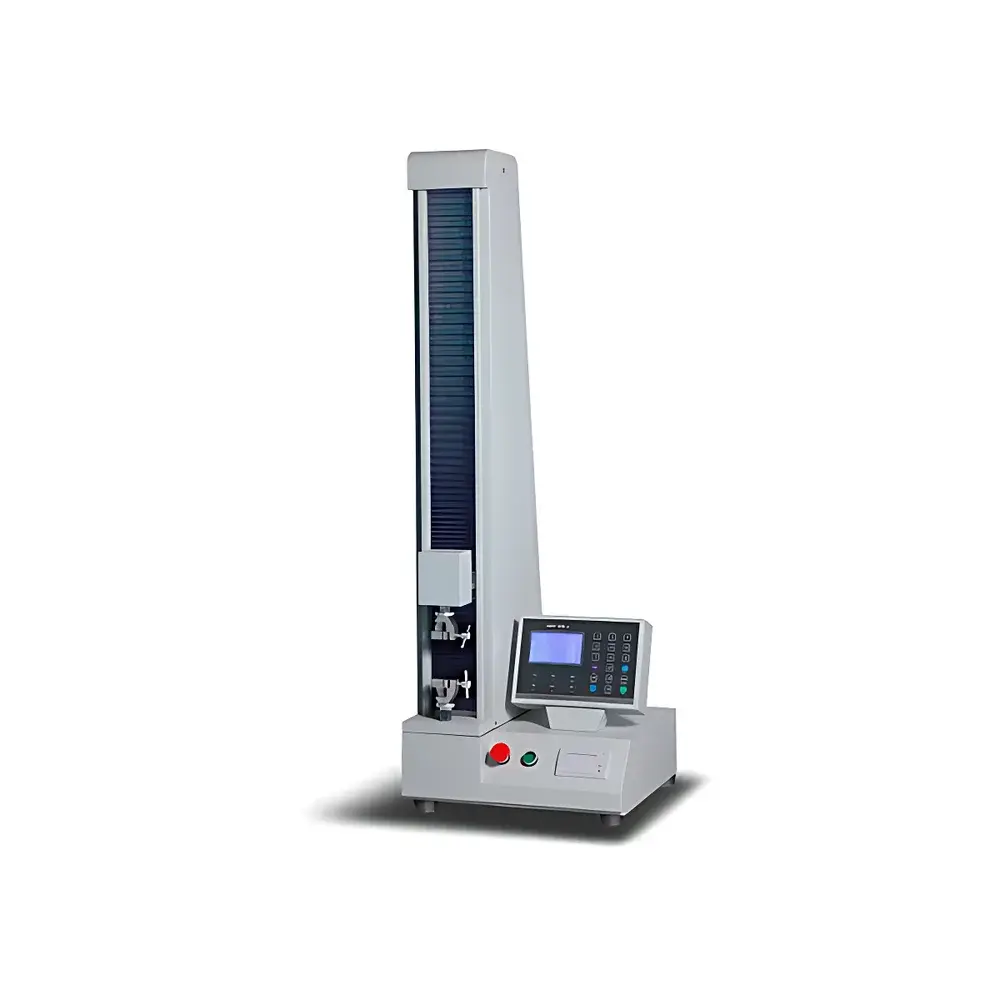
GBPI GBL-H Desktop Single-Column Electronic Tensile Testing Machine
| Brand | GBPI |
|---|---|
| Model | GBL-H |
| Type | Electronic Tensile Testing Machine |
| Max Test Load | 0.5 kN |
| Force Range | 0–300 N (optional 0–500 N) |
| Elongation Capacity | up to 1400% |
| Force Accuracy | ±1% of reading (Class 1) |
| Crosshead Travel | 700 mm |
| Displacement Resolution | ±1% of reading |
| Effective Sample Width | 30 mm (customizable to 50 mm) |
| Test Speed | 0–500 mm/min, infinitely variable |
| Sampling Rate | 50 Hz |
| Safety | Triple-level protection with emergency stop |
| Power Supply | AC 220 V, 50 Hz, 300 W |
| Dimensions (W×D×H) | 600 × 500 × 1300 mm |
| Weight | 65 kg |
Overview
The GBPI GBL-H is a precision-engineered desktop single-column electronic tensile testing machine designed for routine and regulatory-compliant mechanical property evaluation of thin, flexible packaging materials and soft polymeric specimens. It operates on the fundamental principle of uniaxial force application under controlled displacement rate, measuring load vs. extension response in accordance with standardized tensile, peel, tear, seal strength, and puncture protocols. Its rigid yet compact column architecture ensures minimal deflection during high-speed or high-elongation tests—critical for maintaining measurement fidelity across low-force regimes typical of plastic films (e.g., PET, PE, BOPP), laminates, foils, nonwovens, and elastomeric sheets. The system complies with ISO 7500-1 (static calibration of force-measuring systems), ASTM E4 (load verification procedures), and meets Class 1 accuracy per ISO 376, making it suitable for GLP environments and internal quality assurance workflows where traceable, repeatable data are mandatory.
Key Features
- Modular multi-function testing capability: pre-configured test modes include tensile strength & elongation at break (per ASTM D882, GB/T 1040), 90°/180° peel (ASTM D3330, GB/T 2790), heat seal strength (ASTM F88, GB/T 2792), trouser tear (ASTM D1938, GB/T 2791), and puncture resistance (GB/T 453).
- High-fidelity load sensing: utilizes imported strain-gauge-based load cell with full-scale range selection (0–300 N standard; optional 0–500 N), calibrated to ±1% accuracy across the entire force span—validated against certified deadweight standards.
- Real-time digital control: microprocessor-driven servo system enables smooth, jitter-free crosshead motion from 0.1 to 500 mm/min with <±0.5% speed deviation, supporting both constant-rate-of-extension (CRE) and constant-rate-of-load (CRL) profiles.
- Integrated human-machine interface: 5.7-inch backlit LCD display shows real-time load, displacement, strain, and test status; built-in thermal printer outputs compliant test reports with date/time stamp, sample ID, operator name, and statistical summary (mean, SD, CV%).
- Robust safety architecture: triple-redundant protection includes hardware-based emergency stop button, software-defined upper/lower travel limits, and automatic overload cutoff—fully documented in the CE-compliant risk assessment file.
- High-speed data acquisition: 50 Hz sampling rate captures transient events such as yield point onset, necking initiation, and seal failure propagation—enabling accurate derivation of modulus, toughness, and energy-to-break parameters.
Sample Compatibility & Compliance
The GBL-H accommodates specimens up to 30 mm wide (extendable to 50 mm upon request) and 700 mm active travel length—sufficient for full-stroke elongation testing of highly extensible films (up to 1400% strain). Clamping options include manual screw-type grips (standard), pneumatic clamps (optional), and specialized fixtures for tear, seal, and puncture geometries (e.g., right-angle tear blade per ASTM D1922, heat-seal test jaw per ASTM F2054). All test methods align with internationally recognized standards including ASTM D828 (tensile properties of paper), JIS P8113 (plastic film tensile), QB/T 2358 (heat seal strength), and pharmaceutical packaging specifications YBB00112003 (composite film tensile) and YBB00202004 (aluminum foil tensile). Device validation documentation supports IQ/OQ execution per FDA 21 CFR Part 11 requirements when paired with optional PC-based software.
Software & Data Management
The included Windows-compatible software (supplied on 4 GB USB drive) provides full test method definition, automated result calculation (e.g., tensile strength in MPa, elongation %, peel adhesion in N/15 mm), and export to CSV, PDF, or Excel formats. Audit trail functionality logs all user actions—including method edits, calibration events, and result modifications—with timestamp and operator ID. Raw data files retain original 50 Hz time-series records for retrospective analysis. Optional computer integration enables remote operation, batch reporting, and LIMS connectivity via RS232 serial interface (DB9 connector). Software conforms to Annex 11 principles for electronic records and signatures when deployed in regulated environments.
Applications
This instrument serves as a primary mechanical characterization tool in packaging R&D labs (film formulation optimization), QC laboratories (incoming raw material inspection per GB/T 10004), pharmaceutical packaging validation (blister lidding strength, pouch seal integrity), food packaging compliance (shelf-life mechanical stability per GB 10808), and adhesive development (peel adhesion kinetics). It is routinely deployed by national metrology institutes for inter-laboratory comparison studies and by third-party certification bodies (e.g., SGS, BV) performing CNAS-accredited testing per GB/T 16578.1 (plastic film tear resistance) and ISO 11843 (detection limit estimation for mechanical properties).
FAQ
What standards does the GBL-H support out-of-the-box?
It natively supports over 25 national and international standards—including GB/T 1040, ASTM D882, ASTM F88, ISO 11843, and YBB series—via preloaded test templates.
Can the system be used for dynamic fatigue testing?
No—the GBL-H is a static CRE tester optimized for single-cycle monotonic loading; cyclic or creep testing requires a dedicated electromechanical fatigue system.
Is calibration traceability provided?
Yes—each unit ships with a factory calibration certificate traceable to NIM (National Institute of Metrology, China) or equivalent national metrology institute.
What is the minimum measurable force resolution?
At 0–300 N range, the effective resolution is ≤0.3 N (0.1% FS), sufficient for detecting subtle differences in seal strength or thin-film tensile onset.
Does the software meet FDA 21 CFR Part 11 requirements?
The base software supports audit trails and electronic signatures; full Part 11 compliance requires validated installation, SOPs, and periodic re-verification per organizational IT policy.
Related Products



