
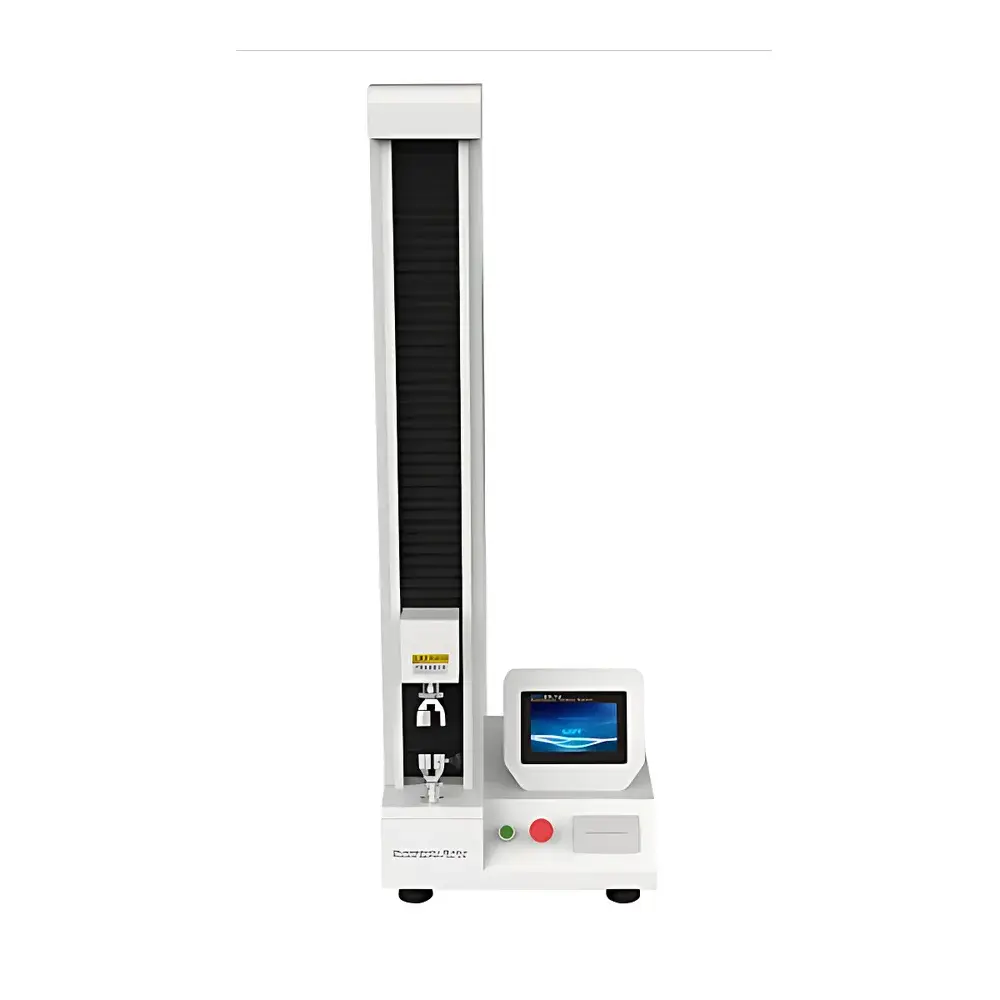
GBPI GBL-H2 Electronic Tensile Testing Machine
| Brand | GBPI |
|---|---|
| Origin | Guangdong, China |
| Manufacturer Type | Direct Manufacturer |
| Model | GBL-H2 |
| Maximum Test Force | 0.5 kN |
| Force Range | 0–300 N (optional 0–500 N) |
| Force Accuracy | ±0.5% of full scale (Class 0.5) |
| Elongation Capacity | up to 1400% |
| Crosshead Travel | 750 mm (customizable to 1000 mm or 1200 mm) |
| Displacement Resolution | ±0.5% of reading |
| Test Speed | 0–500 mm/min (infinitely variable) |
| Effective Test Width | 30 mm (customizable to 50 mm or 60 mm) |
| Dimensions (L×W×H) | 600 × 500 × 1300 mm |
| Weight | 65 kg |
| Power Supply | AC 220 V, 50 Hz |
Overview
The GBPI GBL-H2 Electronic Tensile Testing Machine is a single-column, benchtop universal testing system engineered for high-reproducibility mechanical property evaluation of thin, flexible materials. It operates on the fundamental principle of uniaxial force application: two precision-aligned grips move relative to one another under controlled displacement, while a calibrated load cell (mounted on the moving crosshead) measures tensile, peel, tear, puncture, and heat-seal forces in real time. Simultaneously, an integrated high-resolution encoder captures displacement data, enabling accurate calculation of stress–strain curves, modulus, yield point, elongation at break, and other ASTM/ISO-defined mechanical parameters. Designed to meet stringent regulatory expectations for laboratory instrumentation, the GBL-H2 complies with over 35 national and international standards—including GB 8808, GB/T 1040, ASTM D882, ASTM D1938, ASTM F904, JIS P8113, and YBB pharmaceutical packaging specifications—making it suitable for routine QC in regulated environments.
Key Features
- Class 0.5 force accuracy (±0.5% FS), validated per ISO 7500-1 and ASTM E4, ensuring metrological traceability for audit-ready results.
- Infinitely variable test speed (0–500 mm/min) with closed-loop servo control, supporting both quasi-static and dynamic rate-dependent measurements.
- High-speed data acquisition at 100 Hz sampling rate, minimizing signal aliasing and preserving waveform fidelity during rapid failure events.
- Triple-layer mechanical safety architecture: hardware-based emergency stop button, programmable upper/lower limit switches, and automatic overload cutoff at 110% of selected range.
- Integrated thermal printer and 5.7-inch LCD touchscreen interface—enabling fully standalone operation without external PC; all test parameters, curves, and summary reports are stored locally and printable on demand.
- User management with role-based access control (RBAC), electronic signatures, and audit trail functionality compliant with FDA 21 CFR Part 11 and EU Annex 11 requirements.
Sample Compatibility & Compliance
The GBL-H2 accommodates specimens up to 30 mm wide (expandable to 60 mm upon request) and supports standardized specimen geometries defined in GB/T 1040.1, ASTM D882, and ISO 527-3. Its optimized grip design minimizes slippage and edge damage for low-modulus films (e.g., BOPP, PET, PE laminates), paper products (tissue, kraft, filter paper), pressure-sensitive adhesives (medical tapes, surgical drapes), and pharmaceutical blister foils. All test methods implemented in firmware align with GLP/GMP documentation practices: each report includes timestamped operator ID, instrument serial number, calibration certificate reference, environmental conditions (if logged externally), and raw data export in CSV format. The system is routinely deployed in accredited labs meeting CNAS-CL01 (equivalent to ISO/IEC 17025) and supports validation protocols per IQ/OQ/PQ frameworks.
Software & Data Management
Built-in embedded software provides intuitive test method configuration—users define pre-test parameters (grip separation, speed, trigger threshold, auto-stop condition) via guided workflow menus. Real-time plotting displays force vs. displacement, stress vs. strain, and derivative metrics (e.g., secant modulus). Post-test analysis tools include peak detection, offset yield calculation (0.2% strain), area-under-curve integration for toughness quantification, and batch statistical reporting (mean, SD, CV%, min/max). Data files are stored in encrypted internal memory with optional USB export. When connected to a Windows 10 (64-bit) host PC via RS-232 or USB, the optional GBPI LabSuite™ software enables advanced curve overlay, multi-method comparative analysis, LIMS integration via HL7 or ASTM E1384, and automated PDF report generation with digital signature fields.
Applications
- Flexible Packaging: Tensile strength and elongation of plastic films (e.g., LDPE sealant layers), peel adhesion of laminated pouches, heat-seal strength of retortable pouches per ASTM F88.
- Pharmaceutical Packaging: Delamination resistance of aluminum foil–polymer laminates (YBB 00132002), puncture force of blister cavity lids (YBB 00202004), and peel strength of cold-form foil blisters.
- Paper & Board: Tensile index and breaking length of kraft linerboard (GB/T 12914), wet/dry tensile ratio of tissue paper (GB/T 24328.3), and burst strength correlation via Mullen tester calibration.
- Medical Adhesives: 180° peel adhesion of silicone-coated release liners (ASTM D3330), tack and shear holding time of hydrocolloid wound dressings (ISO 20743).
- Quality Assurance Labs: Routine conformance testing against internal specifications, stability studies across shelf-life intervals, and supplier qualification audits.
FAQ
What calibration standards does the GBL-H2 support?
The system accepts certified reference load cells traceable to NIM (China National Institute of Metrology) or NIST-equivalent bodies; factory calibration certificates comply with JJG 139 and ISO/IEC 17025 requirements.
Can the GBL-H2 perform creep or stress-relaxation tests?
Yes—via custom method scripting in LabSuite™ software, users can define dwell periods at specified loads or displacements to evaluate time-dependent viscoelastic behavior.
Is third-party validation support available?
GBPI provides IQ/OQ documentation templates, calibration SOPs, and on-site PQ assistance through authorized service partners in APAC and EMEA regions.
How is data integrity ensured during power interruption?
All active test sessions are auto-saved to non-volatile memory every 5 seconds; recovery resumes from last valid data point upon reboot.
Does the system meet FDA 21 CFR Part 11 requirements out-of-the-box?
Yes—the embedded OS implements electronic signatures, immutable audit trails, and role-based permissions without requiring additional middleware or license keys.
Related Products



