
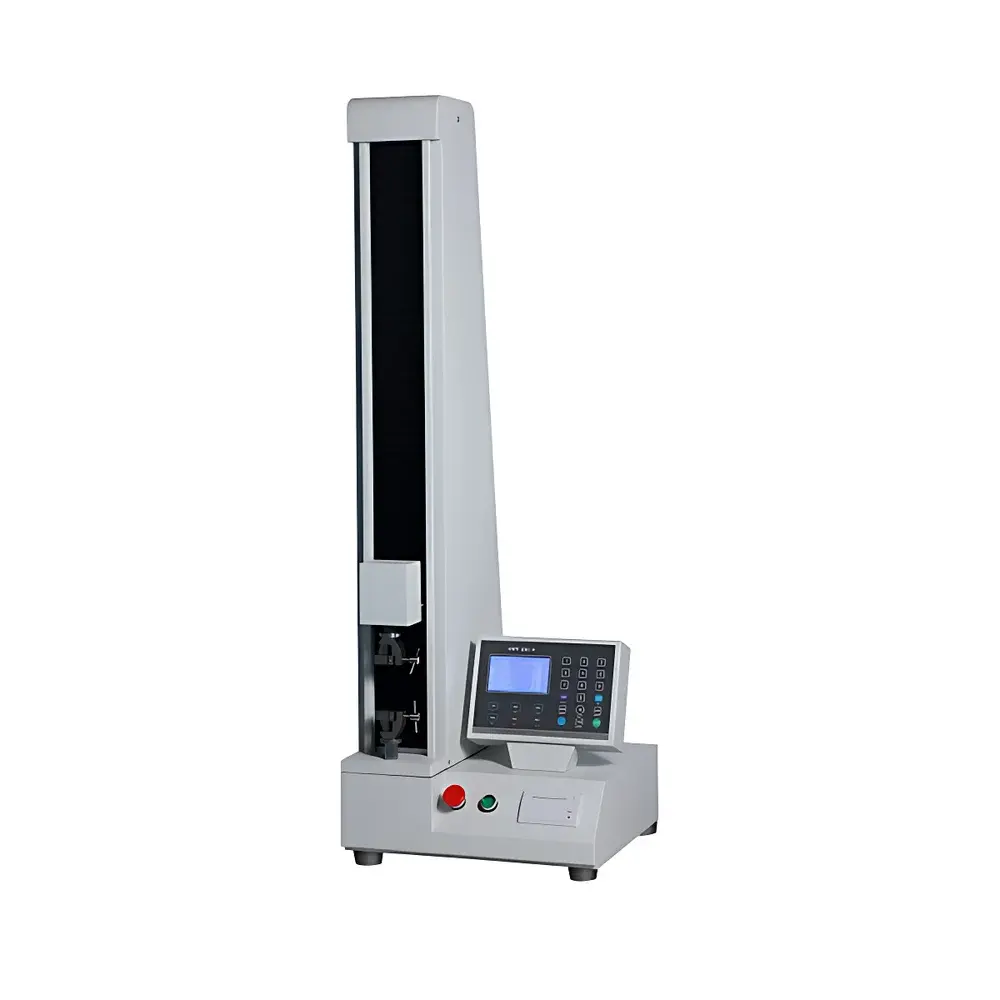
GBPI GBL-L Series Single-Column Electronic Tensile Tester
| Brand | GBPI |
|---|---|
| Origin | Guangdong, China |
| Manufacturer Type | Direct Manufacturer |
| Country of Origin | China |
| Model | GBL-L-aa |
| Pricing | Available Upon Request |
| Force Range | 0–300 N (optional 0–500 N) |
| Elongation Capacity | up to 1400% |
| Accuracy | ±1% of reading (Class 1) |
| Test Speed | 1–500 mm/min, continuously variable |
| Displacement Accuracy | ±1% of reading |
| Effective Specimen Width | 30 mm (customizable to 50 mm) |
| Effective Travel Distance | 700 mm |
| Dimensions (W×D×H) | 475 × 460 × 1430 mm |
| Power Consumption | 300 W |
| Supply Voltage | AC 220 V, 50 Hz |
| Weight | 76.5 kg |
Overview
The GBPI GBL-L Series Single-Column Electronic Tensile Tester is a precision-engineered mechanical testing system designed specifically for routine and regulatory-compliant mechanical property evaluation of flexible packaging materials. Built upon a robust, desktop-mounted column architecture, it operates on the fundamental principle of uniaxial force application under controlled displacement—measuring tensile strength, elongation at break, peel resistance, seal strength, tear propagation, and puncture performance in accordance with standardized load-cell-based transduction. Its modular design supports rapid configuration for ASTM, ISO, GB, YBB, and JIS test methods, making it a core instrument in quality control laboratories serving pharmaceutical packaging, food-grade laminates, medical device pouches, and functional barrier films. The system complies with metrological traceability requirements defined in JJG 139 (Chinese National Verification Regulation for Universal Testing Machines) and meets mechanical accuracy class 1 per ISO 7500-1 and ASTM E4.
Key Features
- Single-column rigid frame with high-stiffness aluminum alloy uprights and precision-ground lead screws, ensuring minimal deflection during high-load testing.
- Imported load cell with digital signal conditioning and 50 Hz real-time sampling rate—enabling accurate capture of peak forces, yield points, and nonlinear deformation behavior.
- Intuitive 5.7-inch monochrome LCD interface with on-screen parameter input, real-time curve display (force vs. displacement), and status diagnostics—no external PC required for basic operation.
- Integrated thermal printer supporting immediate hard-copy output of test reports including sample ID, test method, peak load, elongation, modulus, and pass/fail flags.
- Three-tier mechanical and electronic safety system: hardware emergency stop button, software-defined upper/lower travel limits, and automatic overload cutoff at 110% of full-scale capacity.
- Full motorized speed control (1–500 mm/min) with closed-loop feedback—guaranteeing consistent strain rates across low-force film testing and high-force composite laminate evaluation.
- Modular grip configurations—including pneumatic, manual wedge, and specialized seal-peel fixtures—support rapid changeover between ASTM F88 (seal strength), ASTM D1938 (tear resistance), and GB/T 2792 (peel adhesion) protocols.
Sample Compatibility & Compliance
The GBL-L accommodates a broad spectrum of thin-film and sheet-like specimens used across regulated packaging supply chains: biaxially oriented polypropylene (BOPP), cast polypropylene (CPP), polyester (PET), aluminum foil laminates, paperboard composites, nonwovens, hydrocolloid dressings, and heat-sealable polymer-coated substrates. It satisfies mandatory mechanical testing requirements outlined in Chinese Pharmacopoeia (YBB standards), GB/T 10004 (flexible composite packaging), GB/T 16578.1 (plastic film tensile properties), and international benchmarks including ASTM D882 (thin plastic sheeting), ASTM D3330 (adhesive tape peel), and JIS P8113 (paper tensile strength). All measurement data are traceable to national standards via CNAS-accredited internal calibration procedures conducted per ISO/IEC 17025.
Software & Data Management
While functional as a standalone instrument, the GBL-L supports optional PC-based software (GBPI TestSuite v3.x) for advanced data governance in GLP- and GMP-aligned environments. The software provides audit-trail-enabled user management, electronic signatures compliant with FDA 21 CFR Part 11, automated report generation in PDF/XLS formats, multi-curve overlay comparison, statistical process control (SPC) charts, and raw data export for third-party analysis. Calibration records, maintenance logs, and method templates are stored with time-stamped metadata, facilitating internal audits and regulatory inspections by NMPA, CFDA, or EU Notified Bodies.
Applications
- Pharmaceutical packaging: Quantitative assessment of peel strength for blister lidding foils (YBB00112003), seal integrity of sterile barrier systems (ISO 11607), and tensile durability of pouch films under accelerated aging.
- Food packaging R&D: Evaluation of hot-tack performance, cold-seal adhesion, and delamination resistance in multilayer structures subjected to thermal cycling.
- Quality assurance labs: Routine verification of incoming raw material specifications per GB/T 453 (paper tensile) or QB/T 2358 (heat seal strength).
- Contract testing organizations: Generation of accredited test reports for ISO/IEC 17025 certification scopes covering mechanical performance of flexible packaging.
- Academic research: Investigation of structure–property relationships in biodegradable films, nanocomposite reinforcements, and stimuli-responsive sealants.
FAQ
What standards does the GBL-L support out-of-the-box?
It natively implements all test parameters and reporting formats required by GB8808, GB13022, ASTM D882, ASTM F88, and JIS P8113—no firmware modification needed.
Can the system be integrated into a LIMS environment?
Yes—via RS232 or USB virtual COM port, enabling bidirectional data exchange with laboratory information management systems using ASCII-based command protocols.
Is calibration documentation provided with shipment?
Each unit ships with a factory calibration certificate traceable to NIM (National Institute of Metrology, China), valid for 12 months under normal operating conditions.
What maintenance intervals are recommended?
Load cell verification every 6 months; mechanical alignment check and lubrication of lead screw annually; full recalibration recommended every 24 months or after 10,000 test cycles.
Does GBPI offer IQ/OQ documentation packages?
Yes—validated installation qualification (IQ) and operational qualification (OQ) protocols are available upon request for pharmaceutical and medical device customers requiring compliance with Annex 11 and EU GMP guidelines.






