
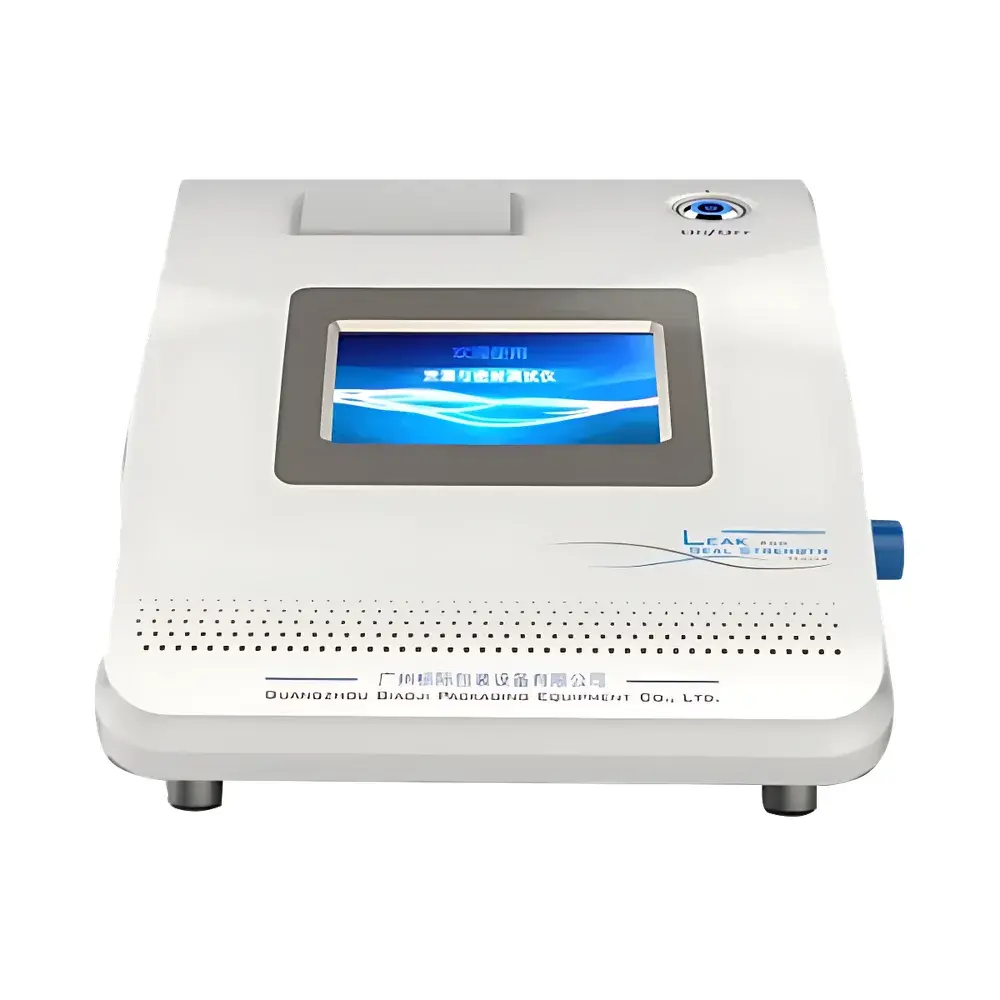
GBPI GBM-D1 Leak and Seal Strength Tester
| Brand | GBPI |
|---|---|
| Model | GBM-D1 |
| Origin | Guangdong, China |
| Manufacturer Type | Direct Manufacturer |
| Country of Origin | China |
| Test Volume Range | 0–90,000 mL |
| Pressure Range | 1–1000 kPa |
| Pressure Resolution | 0.1 kPa |
| Pressure Accuracy | ±0.5% FS |
| Test Duration | 1–1000 s |
| Dimensions (L×W×H) | 400 × 415 × 272 mm |
| Weight | ≤5 kg |
| Operating Temperature | +2 °C to +25 °C |
| Storage Temperature | −20 °C to +60 °C |
| Relative Humidity (operating) | 10–90% RH (+2–25 °C), 10–70% RH (+25–30 °C), 10–50% RH (+30–35 °C, non-condensing) |
| Ambient Pressure | 90.0–105.0 kPa |
| Power Supply | 100–240 VAC, 47–63 Hz |
| Max. Power Consumption | 140 W |
| Input Gas Pressure | 50–1000 kPa |
| Gas Inlet Connection | 6/4 mm OD tubing |
| Gas Flow Control | Main path (auto-regulated, 0–10 L/min), Bypass (manual, 0–100 L/min) |
| Interface | 1 × USB 2.0 Type-A port |
| Compliance | ASTM F1140, ASTM F2054, ASTM F2095, ASTM F2096, ISO 11607-1, YY/T 0681.3, YY/T 0681.5, YY/T 0681.9, GB/T 17876 |
Overview
The GBPI GBM-D1 Leak and Seal Strength Tester is an engineered solution for quantitative evaluation of package integrity and seal performance across flexible, rigid, laminated, and porous packaging systems. It operates on the principle of controlled internal pressurization—applying calibrated pneumatic pressure to sealed packages while monitoring pressure decay, structural response, or physical failure modes. Unlike passive visual inspection or subjective manual assessment, this instrument delivers objective, repeatable, and traceable metrics aligned with internationally recognized test protocols. Its design supports both destructive (e.g., burst, creep-to-failure) and non-destructive (e.g., pressure decay, bubble emission) methodologies, enabling laboratories to validate packaging robustness under simulated distribution, sterilization, or shelf-life conditions. The system is purpose-built for regulated environments where documentation integrity, measurement uncertainty control, and audit readiness are mandatory—particularly in pharmaceutical primary packaging, sterile medical device pouches, and extended-shelf-life food formats.
Key Features
- Multi-mode testing capability: Burst (ASTM F1140/F2054), pressure decay leak detection (ASTM F2095), creep resistance (ASTM F1140/YY/T 0681.3), constrained inflation burst (YY/T 0681.9), and submerged bubble emission (ASTM F2096/YY/T 0681.5).
- Wide volumetric capacity: Supports specimens up to 90,000 mL, accommodating large-format pouches, trays, and barrier-laminated containers without sample segmentation.
- Precision pressure control: Digital regulation with 0.1 kPa resolution and ±0.5% full-scale accuracy across 1–1000 kPa range, ensuring compliance with tolerance requirements in ISO 11607-1 Annex A and USP <1207> guidance.
- Configurable test head options: Interchangeable needle-type and handheld probes facilitate rapid adaptation to varying seal geometries—including fin seals, lap seals, and form-fill-seal configurations.
- Integrated timing and event logging: Programmable dwell times (1–1000 s), real-time pressure curve capture, and automatic annotation of burst pressure, leak onset, and seal rupture location.
- Regulatory-ready interface: USB 2.0 connectivity enables direct data export to LIMS or validated electronic lab notebooks; optional barcode scanning and label printing support 21 CFR Part 11-compliant workflows when paired with compliant software.
Sample Compatibility & Compliance
The GBM-D1 accommodates a broad spectrum of packaging substrates—including aluminum foil laminates, PET/PE coextrusions, Tyvek®-based medical pouches, thermoformed blisters, and multi-layer barrier films used in aseptic and vacuum-packed applications. Its mechanical architecture permits testing of both flat and three-dimensional packages, with or without external constraint plates, per ASTM F2054 and YY/T 0681.9 requirements. All test methods implemented align with current editions of ISO 11607-1 (Packaging for terminally sterilized medical devices), ASTM standards referenced in FDA guidance documents for container closure integrity testing (CCIT), and Chinese national standards GB/T 17876 and YY/T 0681 series. The instrument’s pressure calibration traceability follows ISO/IEC 17025 principles, and its operational parameters meet environmental specifications defined in ICH Q5C for stability-indicating test equipment.
Software & Data Management
The GBM-D1 operates via an embedded touchscreen interface with intuitive workflow navigation and context-sensitive prompts. Test protocols are stored as editable method templates, each defining pressure ramp rate, target hold pressure, duration, pass/fail thresholds, and result annotation fields. Raw pressure-time data is logged at ≥10 Hz sampling rate and exported in CSV format for post-processing in Excel, MATLAB, or statistical process control platforms. When integrated into a validated laboratory ecosystem, the instrument supports GLP/GMP-aligned audit trails—including user login timestamps, parameter change logs, and electronic signatures—provided the host software meets 21 CFR Part 11 criteria. Optional firmware updates maintain alignment with evolving standard revisions, including recent amendments to ASTM F2095-23 and ISO 11607-1:2023.
Applications
- Pharmaceutical packaging: Verification of seal strength in blister cards, sachets, and vial stopper crimp integrity prior to lyophilization or terminal sterilization.
- Sterile medical device packaging: Validation of peel seal integrity in Tyvek®/PET pouches per ISO 11607-2, including accelerated aging correlation studies.
- Food and beverage: Assessment of modified atmosphere packaging (MAP) seal durability during cold chain transport, and detection of gross leaks in retort pouches and stand-up resealable bags.
- Consumer health products: Functional testing of mask packaging integrity (e.g., surgical masks, N95 respirators), facial sheet mask barrier efficacy, and powdered supplement pouch seal reliability.
- Quality assurance labs: Routine incoming inspection of packaging suppliers’ conformance to contractual burst strength and leak rate specifications.
FAQ
What standards does the GBM-D1 natively support?
The instrument implements test logic and reporting structures for ASTM F1140, F2054, F2095, F2096; ISO 11607-1; YY/T 0681.3, .5, and .9; and GB/T 17876—all accessible via preloaded method templates.
Can the GBM-D1 perform non-destructive leak testing only?
Yes. Pressure decay (ASTM F2095) and submerged bubble emission (ASTM F2096) are fully non-destructive when conducted below the package’s burst threshold and with appropriate dwell time selection.
Is calibration certification included with delivery?
Each unit ships with a factory-issued calibration report traceable to NIM (National Institute of Metrology, China), covering pressure transducer linearity, zero drift, and repeatability over the full 1–1000 kPa range.
How is environmental conditioning managed during testing?
The instrument specifies operating limits for temperature (2–25 °C) and humidity (≤90% RH non-condensing); users must maintain ambient conditions within these bounds to ensure pressure sensor stability and material property consistency.
Does the system support automated reporting for regulatory submissions?
Raw data export is native; generation of 21 CFR Part 11-compliant reports requires integration with third-party validated software that manages electronic signatures, audit trails, and data archival per ALCOA+ principles.






