
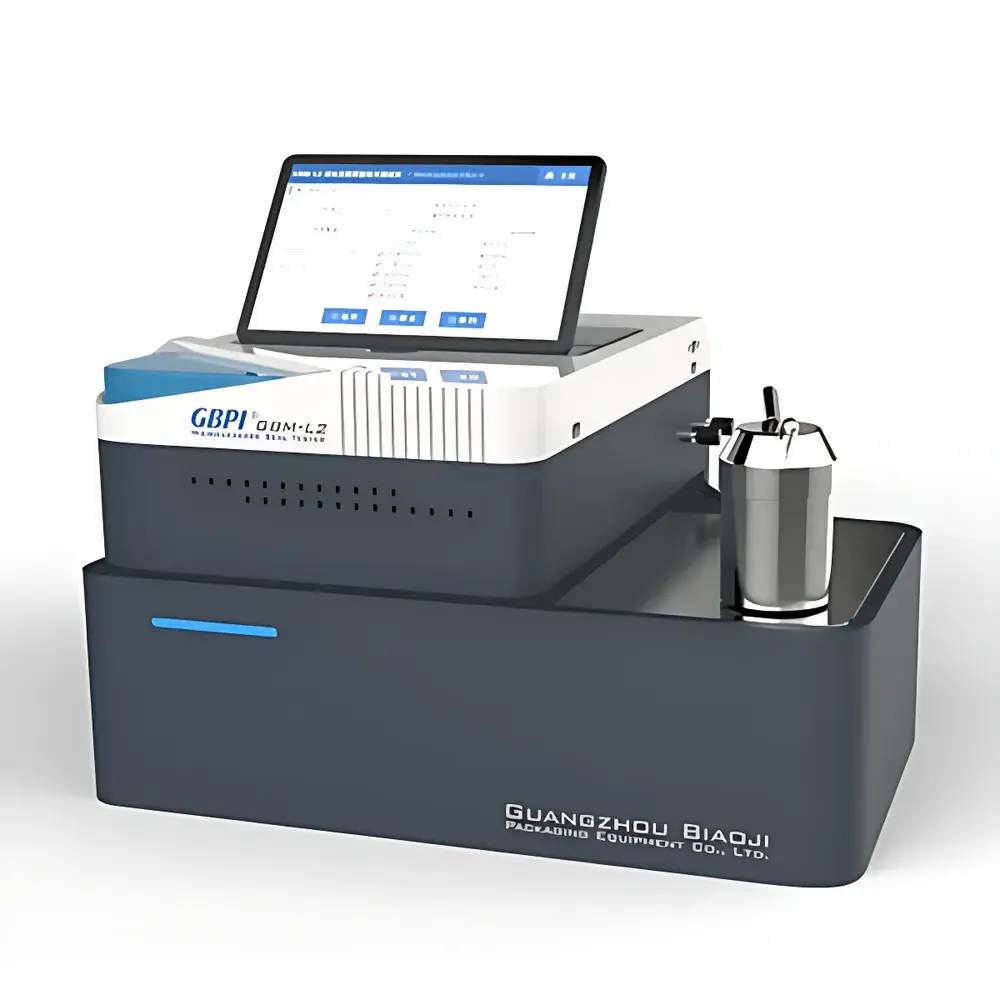
GBPI GBM-L2K Vacuum Decay & Pressure Decay Micro-Leak Seal Tester
| Brand | GBPI |
|---|---|
| Origin | Guangdong, China |
| Manufacturer Type | Manufacturer |
| Model | GBM-L2K |
| Price | USD 53,000 (FOB Guangzhou) |
| Test Principle | Vacuum Decay / Positive Pressure Decay |
| Compliance | ASTM F2338-2009(2013), YY/T 0681.18-2020, USP <1207.2>, ASTM F2095 |
| Absolute Pressure Range | 0–300 kPa |
| Differential Pressure Range | ±2 kPa |
| Detection Sensitivity | 1–3 µm (rigid containers) |
| Repeatability | ≤0.8% RSD |
| Balance/Test Time | 1–3600 s |
| Vacuum Purge Time | 1–3600 s |
| Set Flow Rate | 0–3 mL/min |
| Sensor Accuracy | ±0.1% FS (absolute & differential) |
| Vacuum Pump | Imported, 3 L/s pumping speed, ≤50 dB(A), high ultimate vacuum |
| Mass Flow Controller | UK-sourced, resolution 0.001 mL/min |
| Touch Interface | 11-inch industrial-grade capacitive touchscreen |
| Data Integrity | Audit trail, multi-level user permissions, compliant with GMP Annex “Computerized Systems” and FDA 21 CFR Part 11 expectations |
| Test Chamber | Custom-engineered per container geometry (vials, ampoules, syringes, IV bags, HDPE bottles) |
| Operating Environment | 20–30 °C, ≤80% RH non-condensing |
| Power Supply | AC 220 V, 50 Hz |
| Dimensions (W×D×H) | 495 × 455 × 280 mm |
Overview
The GBPI GBM-L2K Vacuum Decay & Pressure Decay Micro-Leak Seal Tester is an engineered solution for deterministic, non-destructive leak detection in sterile and hermetically sealed primary packaging used across pharmaceutical, biotechnology, food, and chemical industries. It operates on two complementary physical principles—vacuum decay and positive pressure decay—enabling reliable assessment of container closure integrity (CCI) without tracer gases or destructive sampling. Unlike single-mode instruments, the GBM-L2K employs dual-sensor architecture (absolute and differential pressure transducers) coupled with independent vacuum and pressurization circuits, allowing method selection based on package internal condition (e.g., vacuum-filled lyophilized vials vs. nitrogen-purged pre-filled syringes). This dual-path capability directly addresses a well-documented limitation in ASTM F2338: false-negative outcomes when testing evacuated systems using vacuum decay alone. The instrument quantifies leakage by modeling pressure change kinetics over defined stabilization and test intervals, translating observed drift into equivalent leak orifice size (1–3 µm for rigid containers), thereby supporting risk-based pass/fail decisions aligned with USP and ISO 11607-2.
Key Features
- Dual-Mode CCI Testing: Simultaneous support for vacuum decay (ASTM F2338) and pressure decay (ASTM F2095) protocols within a single platform—eliminating need for separate instruments and reducing method transfer complexity.
- High-Fidelity Dual-Sensor Architecture: Integrated absolute pressure sensor (0–300 kPa, ±0.1% FS) and differential pressure sensor (±2 kPa, ±0.1% FS) enable real-time monitoring of both chamber baseline and transient differential response, critical for distinguishing true leakage from thermal drift or adsorption artifacts.
- Validated Sensitivity & Repeatability: Demonstrated detection limit of 1 µm equivalent orifice diameter for rigid containers (e.g., glass vials, ampoules); repeatability ≤0.8% RSD under controlled environmental conditions (20–30 °C, ≤80% RH).
- Imported Critical Subsystems: High-efficiency vacuum pump (3 L/s, ≤50 dB(A), ultimate vacuum <10 Pa) ensures rapid evacuation and stable base pressure; UK-manufactured mass flow controller (0.001 mL/min resolution) enables precise synthetic leak generation for method suitability and sensitivity verification per USP .
- GMP-Ready Human-Machine Interface: 11-inch industrial capacitive touchscreen with intuitive workflow navigation, configurable test sequences, and embedded electronic signatures. Fully compliant with EU GMP Annex 11 and FDA 21 CFR Part 11 requirements via audit trail logging, role-based access control (administrator, operator, reviewer), and immutable data storage.
Sample Compatibility & Compliance
The GBM-L2K accommodates a broad spectrum of primary packaging formats through custom-designed, application-specific test chambers. Validated configurations include: 2–30 mL glass and polymer vials (lyophilized and liquid-filled), 1–10 mL ampoules, 0.5–3 mL pre-filled syringes (with and without needle shields), blow-fill-seal (BFS) ophthalmic containers, HDPE bottles, and flexible IV bags (up to 2 L). Each chamber is engineered to minimize dead volume, ensure uniform pressure distribution, and eliminate seal-induced artifacts. All test methods are traceable to international standards: ASTM F2338-2009(2013) for vacuum decay, ASTM F2095 for pressure decay, YY/T 0681.18-2020 (Chinese national standard for pharmaceutical packaging), and USP “Package Integrity Evaluation – Sterile Products”. Instrument qualification documentation supports IQ/OQ/PQ execution, and raw data files (.csv, .pdf) retain full metadata—including timestamps, operator ID, sensor readings, and environmental logs—for regulatory submission and GLP/GMP audits.
Software & Data Management
Embedded firmware delivers fully automated test execution, including vacuum purge, stabilization, pressure application (if applicable), measurement acquisition, and pass/fail evaluation per user-defined acceptance criteria. All operational parameters—including balance time, test duration, target pressure, and flow setpoints—are programmable and stored with version-controlled method templates. Data integrity safeguards include: time-stamped audit trail recording all user actions (login/logout, parameter changes, result overrides); encrypted local database with automatic backup to external USB drive; and exportable reports containing raw sensor traces, calculated leak rates, orifice size estimates, and compliance status flags. The system supports electronic signature workflows aligned with ALCOA+ principles (Attributable, Legible, Contemporaneous, Original, Accurate, Complete, Consistent, Enduring, Available), satisfying inspection readiness for FDA, EMA, PMDA, and NMPA assessments.
Applications
- Final container release testing of lyophilized products where internal vacuum prohibits reliable vacuum-decay-only assessment.
- CCI verification of pre-filled syringes post-assembly, particularly those containing sensitive biologics requiring inert headspace.
- Stability study support: longitudinal CCI monitoring at multiple timepoints under accelerated or real-time storage conditions.
- Process validation: correlation of sealing parameter changes (crimp force, stopper compression) with quantitative leak performance.
- Root cause analysis of sterility failures by identifying marginal leaks undetectable via dye ingress or microbial challenge.
- Regulatory filing support: generation of method validation reports (specificity, accuracy, precision, robustness, LOD/LOQ) per ICH Q2(R2).
FAQ
What is the difference between vacuum decay and pressure decay modes?
Vacuum decay applies negative pressure to the test chamber, drawing gas from the package interior through any leak path; it is optimal for packages with ambient or elevated internal pressure. Pressure decay applies positive pressure to the chamber, forcing gas into the package through leaks; it is essential for vacuum-filled containers where vacuum decay yields false negatives.
Can the GBM-L2K detect leaks in flexible packaging such as IV bags?
Yes—custom low-compliance chambers with adaptive sealing fixtures minimize membrane deformation artifacts, enabling quantitative CCI assessment of flexible and semi-rigid containers per ASTM F2095.
Is method validation support included?
The system includes built-in tools for sensitivity verification using calibrated micro-leak standards, repeatability assessment protocols, and comprehensive documentation templates aligned with USP and Annex 1.
Does the instrument meet FDA 21 CFR Part 11 requirements?
Yes—audit trail, electronic signatures, role-based permissions, and data immutability are natively implemented and verified during factory IQ/OQ.
What maintenance is required for long-term reliability?
Annual calibration of pressure sensors and mass flow controller is recommended; vacuum pump oil inspection/replacement is guided by onboard oil-level monitoring and usage logs.




