
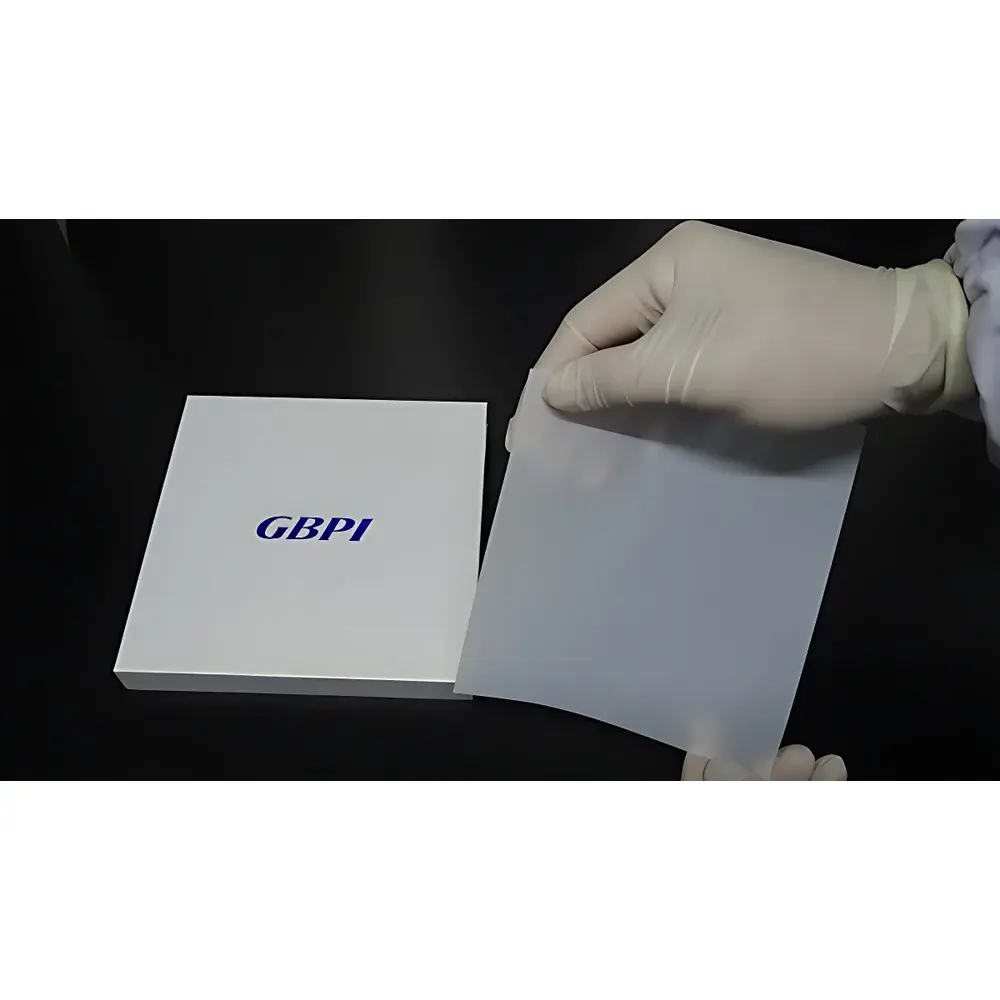
GBPI GBW(E)130541 Polyester Film Gas Permeability Standard Reference Material
| Brand | GBPI |
|---|---|
| Origin | Guangdong, China |
| Manufacturer Type | Direct Manufacturer |
| Country of Origin | China |
| Model No. | GBW(E)130541 |
| Certification | National Secondary Standard Substance (P.R. China) |
| Applicable Standards | GB/T 1038–2000 (Differential Pressure Method), ASTM D1434, ISO 2556 |
| Primary Use | Calibration, Verification & Metrological Traceability for Gas Permeability Testers |
Overview
The GBPI GBW(E)130541 Polyester Film Gas Permeability Standard Reference Material is a certified national secondary standard substance developed in strict accordance with the Technical Specifications for Standard Substances (JJF 1343–2012) and traceable to the National Institute of Metrology, China. It serves as a metrologically validated reference for quantitative calibration, verification, and periodic performance validation of gas permeability testing instruments—particularly those operating under the differential pressure method per GB/T 1038–2000, ASTM D1434, and ISO 2556. Unlike generic reference films or uncertified controls, this standard material is characterized by rigorously determined and statistically validated gas transmission rates (GTR) for nitrogen, oxygen, and air under controlled temperature (23 ± 1 °C) and relative humidity (0 % RH) conditions. Its 125 µm thickness and biaxially oriented polyethylene terephthalate (BOPET) composition ensure dimensional stability, low moisture absorption, and minimal batch-to-batch variability—critical attributes for long-term instrument traceability in regulated packaging QC laboratories.
Key Features
- Nationally certified secondary standard substance (GBW(E) designation) issued by the National Administration of Metrology, P.R. China
- Traceable to primary standards maintained at the National Institute of Metrology (NIM), with documented uncertainty budgets (k = 2)
- Manufactured from high-purity, solvent-cast biaxially oriented PET film with certified thickness uniformity (±0.8 µm across 100 mm × 100 mm area)
- Stable gas transmission rate (GTR) values established via inter-laboratory comparison among three NIM-accredited metrology institutes
- Supplied with individual Certificate of Analysis (CoA) including certified GTR value (cm³/m²·24h·0.1MPa), expanded uncertainty, homogeneity test report, and shelf-life statement (24 months when stored at 23 ± 2 °C, <40 % RH)
- Compatible with all differential-pressure-type gas permeability testers—including those compliant with GB/T 1038–2000, ASTM D1434–98(2020), and ISO 2556:2001
Sample Compatibility & Compliance
This standard reference material is specifically engineered for use with gas permeability analyzers employing the constant-pressure/varying-volume or constant-volume/varying-pressure measurement principles. It is not intended for use with coulometric (electrochemical) or infrared detection-based O₂ permeation systems—those require dedicated oxygen transmission rate (OTR) standards such as GBW(E)130497/130498. The GBW(E)130541 film meets the physical preconditioning requirements of GB/T 1038–2000: specimens are conditioned for ≥48 h at 23 ± 1 °C and 0 % RH prior to testing. Its certification supports compliance with ISO/IEC 17025:2017 (clause 5.6.3 on reference material qualification), FDA 21 CFR Part 11 (when used within validated electronic calibration workflows), and GLP audit requirements for pharmaceutical and food packaging testing laboratories.
Software & Data Management
While the standard material itself is a physical artifact, its integration into digital quality systems follows internationally recognized metrological practices. Laboratories deploying automated permeability testers (e.g., GBPI VAC-V2, MOCON Ox-Tran, or Systech 8000 series) may embed the certified GTR value and uncertainty into instrument calibration modules. Audit trails must record date of use, operator ID, instrument serial number, environmental monitoring logs (temperature/humidity), and deviation analysis against certified value. All CoA data are provided in PDF format compliant with ISO 17034:2016 Annex B; machine-readable XML metadata (per ASTM E2500-17) is available upon request for LIMS integration. Retrospective trending of calibration results over time supports statistical process control (SPC) per ISO 9001:2015 clause 8.5.1.
Applications
- Primary calibration of differential-pressure gas permeability testers prior to routine testing of flexible packaging films (e.g., PET/PE laminates, aluminum foil composites, barrier-coated papers)
- Intermediate verification between full calibrations—per ISO/IEC 17025:2017 requirement for ongoing measurement assurance
- Proficiency testing and inter-laboratory comparison schemes organized by CNAS-accredited PT providers
- Validation of new instrument installations and post-maintenance requalification
- Supporting regulatory submissions to NMPA (China), FDA (USA), or PMDA (Japan) where demonstrable metrological traceability to national standards is mandated for packaging integrity claims
- Reference for development and verification of in-house reference materials under ISO 17034:2016
FAQ
Is GBW(E)130541 suitable for calibrating water vapor transmission rate (WVTR) instruments?
No. GBW(E)130541 is certified exclusively for gas permeability (GTR) under dry conditions. For WVTR calibration, use GBW(E)130543 or GBW(E)130544, which are certified per GB/T 1037–1988 (cup method) and ISO 15106–1.
What is the recommended storage condition to maintain certified stability?
Store unopened units in a desiccator at 23 ± 2 °C and <40 % RH. Avoid UV exposure and mechanical flexing. Once opened, use within 72 hours under controlled lab conditions.
Can this standard be used for oxygen-specific permeability verification?
It provides a general gas permeability reference applicable to N₂, O₂, and air—but for O₂-specific instrument validation (e.g., coulometric sensors), GBW(E)130497 or GBW(E)130498 is required per GB/T 19789–2005.
Does the certificate include measurement uncertainty?
Yes. Each CoA reports expanded uncertainty (k = 2) for the certified GTR value, derived from type A (repeatability) and type B (reference standard, environmental, instrumentation) uncertainty components per GUM (JCGM 100:2008).
How frequently should calibration verification be performed using this standard?
Per ISO/IEC 17025:2017, verification shall occur before each testing batch, after maintenance, or at intervals defined by risk assessment—typically daily for high-throughput QC labs and weekly for R&D environments.





