
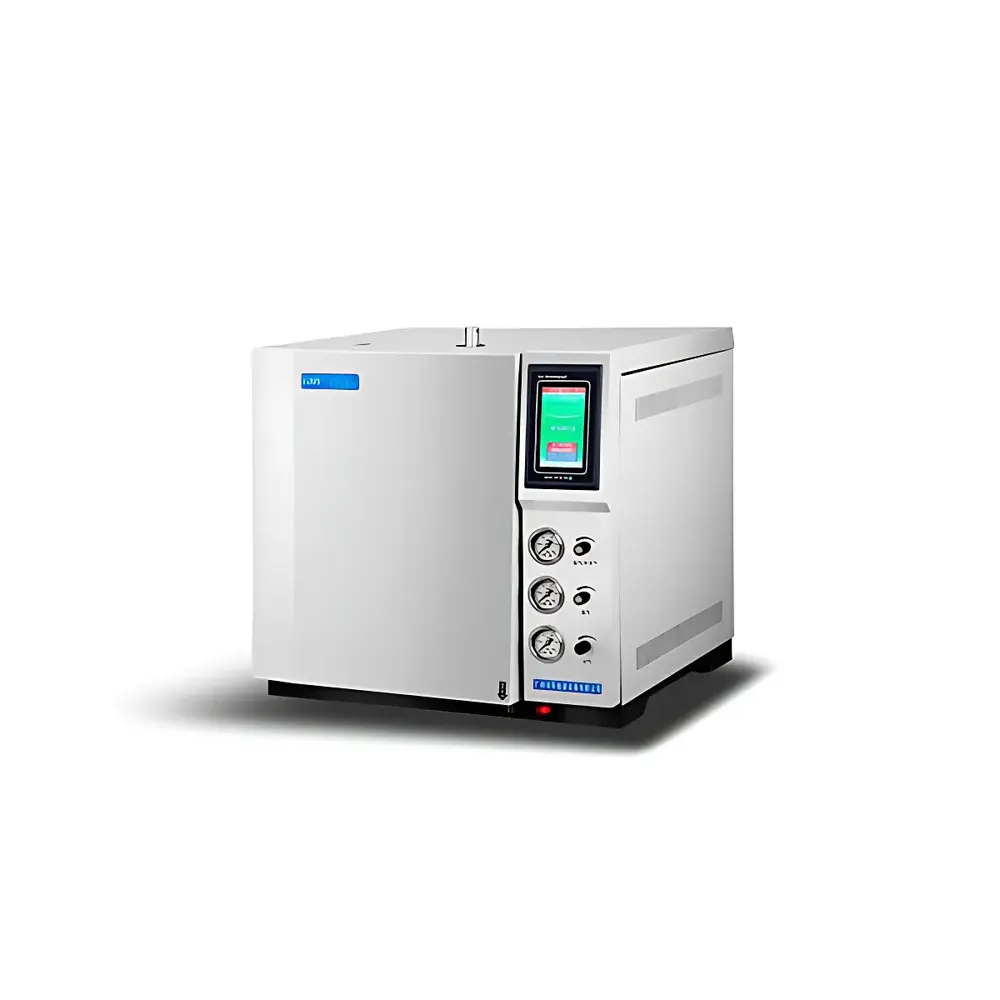
GBPI GC9802-UO Laboratory Gas Chromatograph for Ethylene Oxide Residue Testing in Medical Masks
| Brand | GBPI |
|---|---|
| Origin | Guangdong, China |
| Manufacturer Type | Direct Manufacturer |
| Regional Classification | Domestic (China) |
| Model | GC9802-UO |
| Price Range | USD 7,000 – 14,000 |
| Instrument Type | Benchtop Laboratory Gas Chromatograph |
| Primary Application Field | Environmental & Medical Device Residue Testing |
| Detector | Flame Ionization Detector (FID), optional alternative detectors available |
| Detection Limit | ≤3×10⁻¹² g/s (n-hexadecane) |
| Baseline Noise | ≤2×10⁻¹⁴ A |
| Baseline Drift | ≤1×10⁻¹³ A/30 min |
| Column | EO-specific capillary column (30 m × 0.32 mm × 0.5 µm), optional columns supported |
| Headspace Sampler | 20-position automated unit |
| Oven Dimensions | 240 × 210 × 240 mm |
| Temperature Range | 4 °C above ambient to 450 °C (1 °C increments) |
| Temperature Control Accuracy | ±0.1 °C |
| Temperature Gradient Uniformity | ±1% |
| Independent Temperature Zones | 6 |
| Programmed Temperature Ramping | Up to 16 steps |
| Ramp Rate | 0.1–60 °C/min |
| Maximum Runtime Setting | 6000 min |
| Optional Accessories | Oil-free air generator (3 L/min, with oil/water removal) |
| Injection System | Split/splitless capillary inlet with septum purge |
| Data System | Dual-channel Chinese-language chromatography workstation with instrument control, real-time chromatogram display, zoom/pan functionality, automated report generation (PDF export), and manual hardware start trigger |
Overview
The GBPI GC9802-UO is a dedicated benchtop gas chromatograph engineered for the precise quantification of residual ethylene oxide (EO) in medical face masks and other sterilized healthcare products. It operates on the fundamental principle of gas-phase separation followed by flame ionization detection (FID), enabling trace-level analysis of volatile organic compounds in complex matrices. Designed in strict alignment with regulatory testing requirements for EO residuals—particularly those outlined in YY/T 0969–2013, YY/T 0681.13–2014, GB 19083–2010, and ISO 10993–7—the system delivers high reproducibility and method robustness essential for quality control laboratories operating under GLP or ISO/IEC 17025 frameworks. Its modular architecture supports seamless integration into routine QC workflows across medical device manufacturing, third-party testing labs, and public health institutions responsible for compliance verification.
Key Features
- Six independently controlled temperature zones—including oven, injector, detector, and auxiliary modules—ensure optimal thermal management for method transferability and retention time stability.
- Programmable oven with 16-step ramp capability and sub-degree precision (±0.1 °C) enables highly resolved separation of EO from interfering volatiles such as ethanol, acetone, or residual solvents commonly found in mask packaging materials.
- FID detector optimized for low-noise operation (≤2×10⁻¹⁴ A baseline noise) and high sensitivity (≤3×10⁻¹² g/s detection limit using n-hexadecane), critical for achieving quantitation limits well below the 10 µg/g safety threshold mandated by ISO 10993–7.
- 20-position automated headspace sampler eliminates manual variability, improves throughput, and ensures consistent vial pressurization and transfer kinetics—key factors in minimizing carryover and enhancing inter-batch precision.
- Dual-channel chromatography workstation provides full instrument control, real-time signal visualization, peak integration with customizable baselines, and audit-trail-capable data storage compliant with FDA 21 CFR Part 11 when configured with user authentication and electronic signature modules.
- Integrated safety protocols include dual overtemperature protection (programmable setpoint + hardware cutoff), flame-out detection, and automatic shutdown—meeting IEC 61010-1 requirements for laboratory equipment.
Sample Compatibility & Compliance
The GC9802-UO is validated for use with solid and semi-solid samples requiring headspace extraction, including surgical masks, N95 respirators, gowns, and sterilized packaging films. Sample preparation follows standardized aqueous extraction or direct headspace equilibration per YY/T 0681.13–2014. The system meets technical specifications referenced in multiple national and industry standards: QBT 2929 (packaging solvent residues), GB/T 10004–2008 (plastic composite films), YBB 00132002 (pharmaceutical packaging), GB 2626–2006 (respiratory protective devices), and GB/T 32610–2016 (daily-use masks). All hardware components—including the EO-specific fused-silica capillary column (30 m × 0.32 mm × 0.5 µm), inert flow path, and low-bleed FID jet—are selected to minimize background interference and ensure long-term column stability during repeated EO analyses.
Software & Data Management
The embedded dual-channel workstation supports both acquisition and post-run processing without external dependencies. Chromatograms are displayed in real time with dynamic scaling, cursor-based peak identification, and adjustable integration parameters (threshold, slope, width). Quantitative analysis employs external standard calibration curves with linear or quadratic regression; results are automatically tabulated with %RSD, LOQ, and uncertainty estimates where applicable. Reports comply with ISO/IEC 17025 documentation requirements and can be exported in PDF, CSV, or XML formats. Audit trail functionality records all method modifications, sequence changes, and result approvals—enabling traceability for internal audits or regulatory inspections. Optional upgrade paths include 21 CFR Part 11-compliant e-signature modules and networked deployment via LAN/WiFi.
Applications
- Quantitative determination of EO residuals in Class I–III medical masks and respirators prior to market release.
- Stability studies tracking EO desorption kinetics under accelerated aging conditions (e.g., 55 °C/80% RH per ISO 11607).
- Verification of EO sterilization process validation, including parametric release support through correlation of chamber cycle data with residual measurements.
- Testing of packaging materials (e.g., Tyvek® pouches, aluminum-laminated foils) for EO migration potential.
- Residual solvent analysis in pharmaceutical primary packaging and printed flexible packaging films per GB/T 10004–2008 and ASTM D3960.
FAQ
What regulatory standards does the GC9802-UO support for EO testing?
It is fully aligned with YY/T 0969–2013, YY/T 0681.13–2014, GB 19083–2010, ISO 10993–7, and USP , supporting both Chinese NMPA and international regulatory submissions.
Can the system be upgraded for 21 CFR Part 11 compliance?
Yes—optional software modules provide electronic signatures, role-based access control, and immutable audit trails required for FDA-regulated environments.
Is the EO-specific column included with the base configuration?
Yes, the 30 m × 0.32 mm × 0.5 µm capillary column optimized for EO resolution is supplied as standard equipment.
What sample introduction methods are supported beyond headspace?
While headspace is recommended for EO in solid matrices, the split/splitless inlet permits direct liquid injection for standard solution analysis or alternative volatile compound screening.
Does the system require external gas cylinders for routine operation?
N₂ carrier gas must be supplied externally (99.999% purity); however, optional on-site H₂ and zero-air generators eliminate reliance on compressed gas cylinders.





