
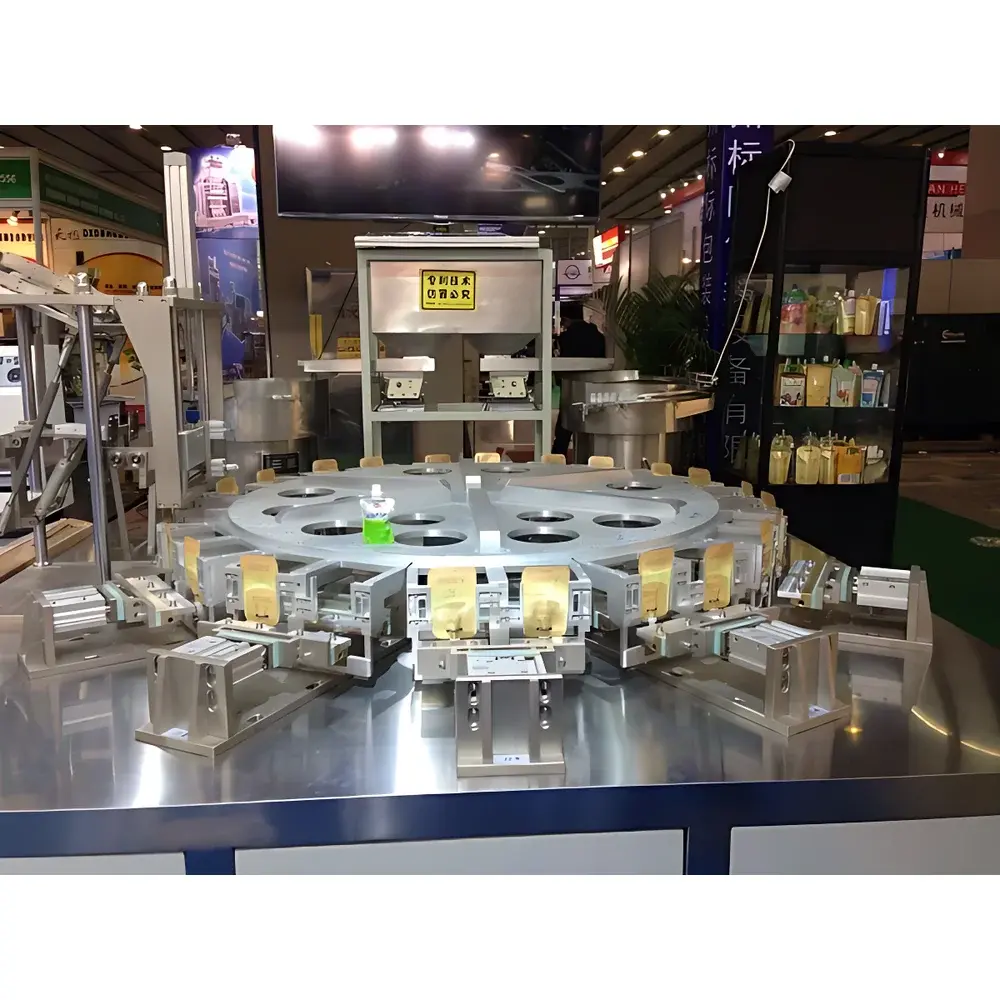
GBPI GF-1600 Automatic Spout Insertion and Heat-Sealing Machine for Stand-Up Pouches
| Brand | GBPI (Guangzhou Biaoji) |
|---|---|
| Origin | Guangdong, China |
| Manufacturer Type | Direct Manufacturer |
| Country of Origin | China |
| Model | GF-1600 |
| Pricing | Upon Request |
| Max. Pouch Width | 60–120 mm |
| Max. Pouch Length | 70–230 mm |
| Spout Diameter Compatibility | 8.5 mm (standard), 10 mm |
| Sealing Speed | 0–80 pcs/min (adjustable) |
| Sealing Temperature Range | 0–300 °C |
| Power Supply | 380 V, 50 Hz |
| Rated Power | 6 kW |
| Air Pressure Requirement | 0.8 MPa, 45 L/min |
| Machine Dimensions | Φ2120 mm × 1000 mm (H) |
| Control Cabinet Dimensions | 600 × 600 × 1500 mm (L×W×H) |
| Net Weight | 1200 kg |
| Positioning Accuracy | ≤ ±0.02 mm |
| PLC | Mitsubishi Micro-PLC |
| Temperature Controller | Omron |
| Pneumatic Components | SMC |
| HMI | LCD Touchscreen Interface |
Overview
The GBPI GF-1600 Automatic Spout Insertion and Heat-Sealing Machine is an industrial-grade packaging automation system engineered for high-precision integration of plastic spouts into flexible stand-up pouches. It operates on a rotary indexing platform with synchronized pneumatic and servo-driven subsystems to perform fully automated spout feeding, pouch orientation, thermal sealing, and finished pouch ejection. The machine implements controlled heat-sealing via multi-zone temperature-regulated sealing dies—preheating, primary sealing, secondary sealing, and cooling stages—ensuring consistent bond integrity across diverse polymer combinations (e.g., PE/PE, PP/PP, and co-extruded laminates). Designed for GMP-compliant environments, its structural frame and contact surfaces are fabricated from food-grade stainless steel and anodized aluminum, meeting hygiene requirements for pharmaceutical, nutraceutical, beverage, personal care, and ready-to-eat food applications.
Key Features
- Dual-station pouch feeding mechanism doubles throughput efficiency while maintaining positional repeatability within ±0.02 mm.
- Modular spout feed system accommodates standard (8.5 mm) and optional (10 mm) spout diameters; interchangeable sealing dies support short, medium, and long spout configurations.
- Four-stage thermal sealing architecture: one preheat station, four independent sealing zones, and one post-cooling station—enabling precise thermal profiling per material stack.
- Rotary disc layout minimizes footprint (Φ2120 mm × 1000 mm height), ideal for constrained cleanroom or production-line integration.
- Omron digital temperature controllers with PID regulation ensure stable thermal output across the full 0–300 °C range; ten independent thermocouple inputs enable real-time zone monitoring.
- Mitsubishi micro-PLC coordinates all motion, logic, and safety interlocks; SMC pneumatic actuators deliver repeatable force control for consistent seal compression.
- Touchscreen HMI supports parameter configuration (cycle speed, batch count, spout-pouch alignment offset), real-time OEE metrics, and automated fault diagnostics with error-code logging.
Sample Compatibility & Compliance
The GF-1600 processes a broad spectrum of pouch architectures—including three-side-seal pouches, gusseted stand-up pouches, accordion-fold (pleated) pouches, and custom-shaped formats such as “penguin” bags—provided pouch dimensions fall within 60–120 mm width and 70–230 mm length. Compatible spout materials include LDPE, HDPE, and PP; pouch film structures must feature thermosealable inner layers (e.g., PE or PP laminates). All wetted components conform to ISO 8573-1 Class 4 compressed air purity standards and FDA 21 CFR §177.1520 for food-contact polymers. The machine’s construction and operational logic support validation under cGMP Annex 11 (EU), USP , and ISO 13485 frameworks when integrated into regulated manufacturing workflows.
Software & Data Management
The embedded HMI runs proprietary firmware supporting full-cycle data capture: cycle count, spout insertion success rate, thermal deviation alerts, and downtime categorization (e.g., jam, sensor fault, temperature drift). Batch-level KPIs—including completion percentage, average cycles per minute, and seal failure rate—are computed in real time and stored locally in encrypted SQLite databases compliant with ALCOA+ principles (Attributable, Legible, Contemporaneous, Original, Accurate, Complete, Consistent, Enduring, Available). Audit trails record all parameter changes, operator logins, and alarm acknowledgments—meeting FDA 21 CFR Part 11 electronic record requirements when deployed with user authentication and electronic signature protocols. Remote diagnostics via Ethernet port enable predictive maintenance scheduling based on component wear trends.
Applications
This system serves quality-critical packaging lines requiring reliable spout integration without manual intervention. Typical use cases include: single-serve beverage pouches (juice, dairy alternatives), clinical nutrition sachets, topical gel dispensers in dermatology, pediatric oral suspension pouches, and premium home-care concentrates (shampoo, detergent). Its precision and repeatability make it suitable for both pilot-scale GMP batch release and high-volume commercial production—particularly where regulatory traceability, lot consistency, and low defect rates (<0.1% misaligned or unsealed spouts) are mandatory.
FAQ
What pouch types does the GF-1600 support?
It handles stand-up pouches, three-side-seal pouches, gusseted pouches, accordion-fold pouches, and custom geometries (e.g., penguin-shaped bags), provided dimensions remain within specified limits.
Can the machine be validated for pharmaceutical use?
Yes—its material certifications, programmable logic architecture, electronic audit trail, and temperature calibration traceability align with FDA 21 CFR Part 11, EU Annex 11, and ISO 13485 requirements when configured with documented IQ/OQ/PQ protocols.
Is spout size changeover tooling-free?
No—spout diameter changes require mechanical replacement of sealing dies and minor reconfiguration of the spout feed guide; however, changeover time is typically under 15 minutes with trained personnel.
Does the system support integration with upstream filling or downstream cartoning lines?
Yes—standardized I/O signals (24 V DC discrete, Modbus TCP) allow seamless communication with SCADA systems, fillers, and case packers for fully synchronized line operation.
What maintenance intervals are recommended?
Daily visual inspection of sealing dies and pneumatic lines; bi-weekly lubrication of rotary indexer bearings; quarterly calibration of temperature sensors and verification of PLC timing sequences per manufacturer’s service manual.
Related Products





