
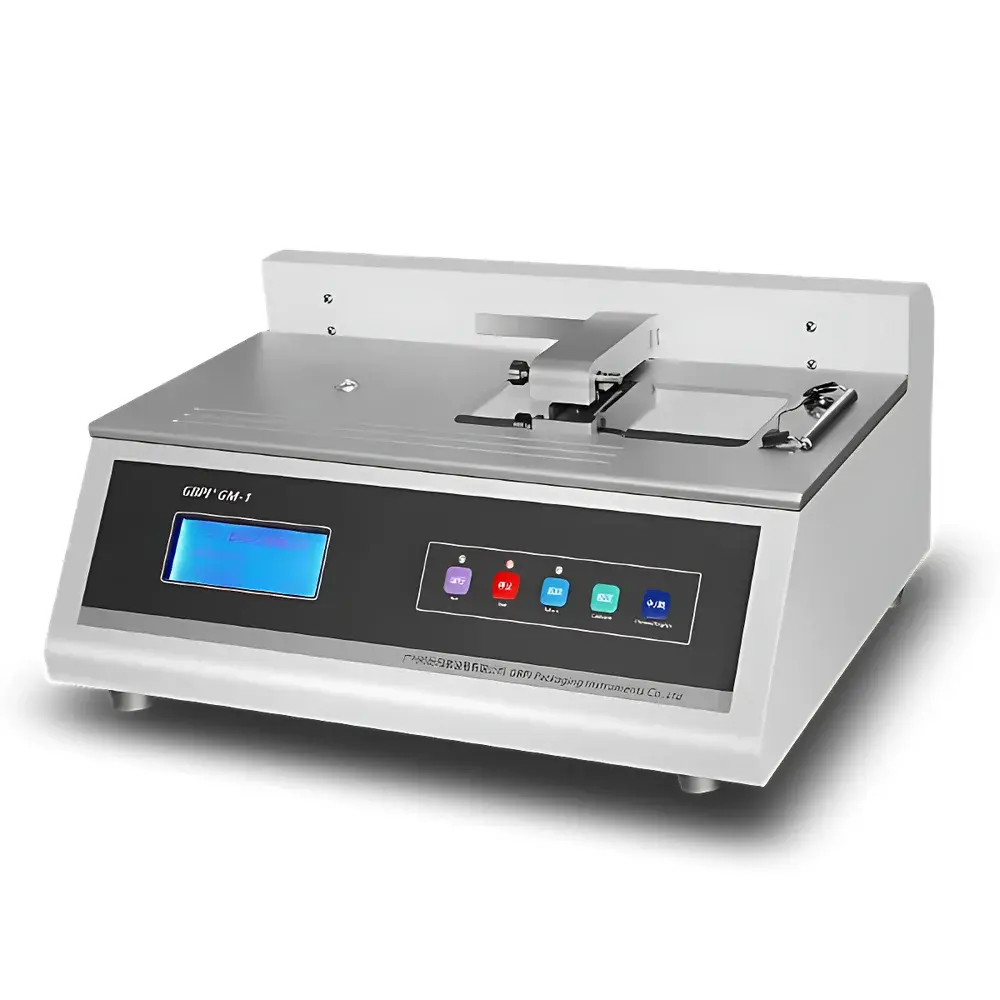
GBPI GM-1L Coefficient of Friction Tester for Packaging Materials
| Brand | GBPI |
|---|---|
| Origin | Guangdong, China |
| Manufacturer Type | Direct Manufacturer |
| Country of Origin | China |
| Model | GM-1L |
| Pricing | Upon Request |
| Friction Coefficient Range | 0.001–0.999 |
| Resolution | 0.001 |
| Force Measurement Range | 0–9.8 N |
| Slider Velocity | 100 ± 10 mm/min |
| Travel Distance | 100 ± 5 mm |
| Max Sample Thickness | ≤2 mm |
| Slider Dimensions | 63 mm × 63 mm |
| Slider Mass | 200 g ± 2 g |
| Test Platform Size | 200 mm × 470 mm |
| Overall Dimensions | 470 mm × 350 mm × 220 mm |
| Power Consumption | 100 W |
| Power Supply | AC 220 V, 50 Hz |
| Weight | 12.5 kg |
Overview
The GBPI GM-1L Coefficient of Friction Tester is a precision-engineered instrument designed specifically for static and kinetic coefficient of friction (COF) measurement in packaging and flexible material R&D, quality control, and production environments. It operates on the fundamental principle of horizontal sliding resistance measurement under controlled normal load and relative motion—compliant with standardized tribological test configurations defined in ASTM D1894, ISO 8295, GB/T 10006, and TAPPI T816. The system employs a calibrated slider assembly (200 g mass) mounted on a motor-driven conveyor belt, while the specimen is securely clamped and wrapped around the slider. As the belt moves at a regulated speed of 100 ± 10 mm/min, the force transducer captures both peak (static COF) and sustained (kinetic COF) resistance values during surface separation and sliding. This dual-phase acquisition enables quantitative evaluation of surface slipperiness, interlayer adhesion consistency, and opening performance—critical parameters for film extrusion, laminating, coating, and pouch-forming processes.
Key Features
- High-resolution force sensing (0.001 resolution) with full-scale range up to 9.8 N, ensuring traceable repeatability across low-friction polymer films and high-resistance textured substrates.
- Integrated LCD interface displaying real-time static and kinetic COF values, along with dynamic force curve visualization; zoomable waveform rendering supports qualitative trend analysis.
- Modular hardware architecture with plug-and-play sensor modules, enabling rapid field calibration using certified reference weights—no external instrumentation required.
- Overload protection circuitry automatically disables actuation when force exceeds 9.8 N, safeguarding transducer integrity and extending service life.
- Compliance-ready software architecture aligned with Annex 11 and FDA 21 CFR Part 11 requirements: role-based user access control, electronic signatures, immutable audit trails for all test parameter changes, data modifications, and report generation events.
- Expandable communication protocols (RS-232, USB, optional Ethernet) support seamless integration into enterprise LIMS or MES platforms via standardized API interfaces.
Sample Compatibility & Compliance
The GM-1L accommodates flat, flexible, and semi-rigid specimens up to 2 mm in thickness—including polyolefin films (LDPE, PP), metallized PET/AL composites, paperboard, nonwovens, woven sacks, printed labels, and ceramic-coated foils. Its 63 mm × 63 mm slider geometry ensures uniform pressure distribution over standard 15 mm wide sample strips per ISO 8295. All mechanical and electrical subsystems conform to IEC 61000-6-2 (immunity) and IEC 61000-6-4 (emission) standards. Instrument validation documentation—including as-delivered metrological verification reports and uncertainty budgets—can be supplied upon request to support GLP/GMP laboratory accreditation (e.g., ISO/IEC 17025).
Software & Data Management
The proprietary GBPI COF Control Suite provides intuitive workflow navigation, customizable test templates, and automated statistical processing—including mean, standard deviation, CV%, and outlier detection per ASTM E178. Raw force-time datasets are stored in vendor-neutral CSV and XML formats, preserving timestamped metadata (operator ID, environmental conditions, calibration status). Audit logs record every action: parameter edits, data exports, user logins, and firmware updates—with SHA-256 hashing applied to ensure immutability. Optional cloud-enabled IoT gateway allows secure TLS 1.2–encrypted remote access, centralized instrument fleet monitoring, and scheduled firmware updates without onsite intervention.
Applications
- Packaging film development: optimizing anti-block agent concentration and silicone coating uniformity.
- Quality assurance of laminated structures: detecting delamination risk from inconsistent interlayer COF profiles.
- Pharmaceutical blister packaging: verifying peel-open force compliance for child-resistant and senior-friendly designs.
- Automated filling line validation: correlating measured COF values with feed stability and jam frequency on vertical form-fill-seal machines.
- Recycled content qualification: assessing surface energy shifts in post-consumer rPET films affecting downstream printing and sealing behavior.
FAQ
What standards does the GM-1L comply with?
It fully implements test methodologies specified in ISO 8295, GB/T 10006, ASTM D1894, and TAPPI T816 for both static and kinetic COF determination.
Can the instrument measure peel strength in addition to COF?
Yes—the same force transducer and mechanical configuration support 90° and 180° peel testing per ASTM D903 when used with optional peel fixtures and adjustable clamp angles.
Is calibration traceable to national metrology institutes?
Standard calibration uses NIST-traceable reference masses; accredited calibration certificates (ISO/IEC 17025) are available upon request through GBPI’s authorized calibration partners.
Does the software support multi-user environments with permission tiers?
Yes—administrator, analyst, and reviewer roles enforce hierarchical access control, including restrictions on method editing, data deletion, and audit log viewing.
What environmental conditions are recommended for optimal accuracy?
Testing should be conducted in a temperature-controlled environment (23 ± 2 °C) with 50 ± 5% RH, per ISO 291, to minimize hygroscopic and thermal drift effects on polymer surfaces.




