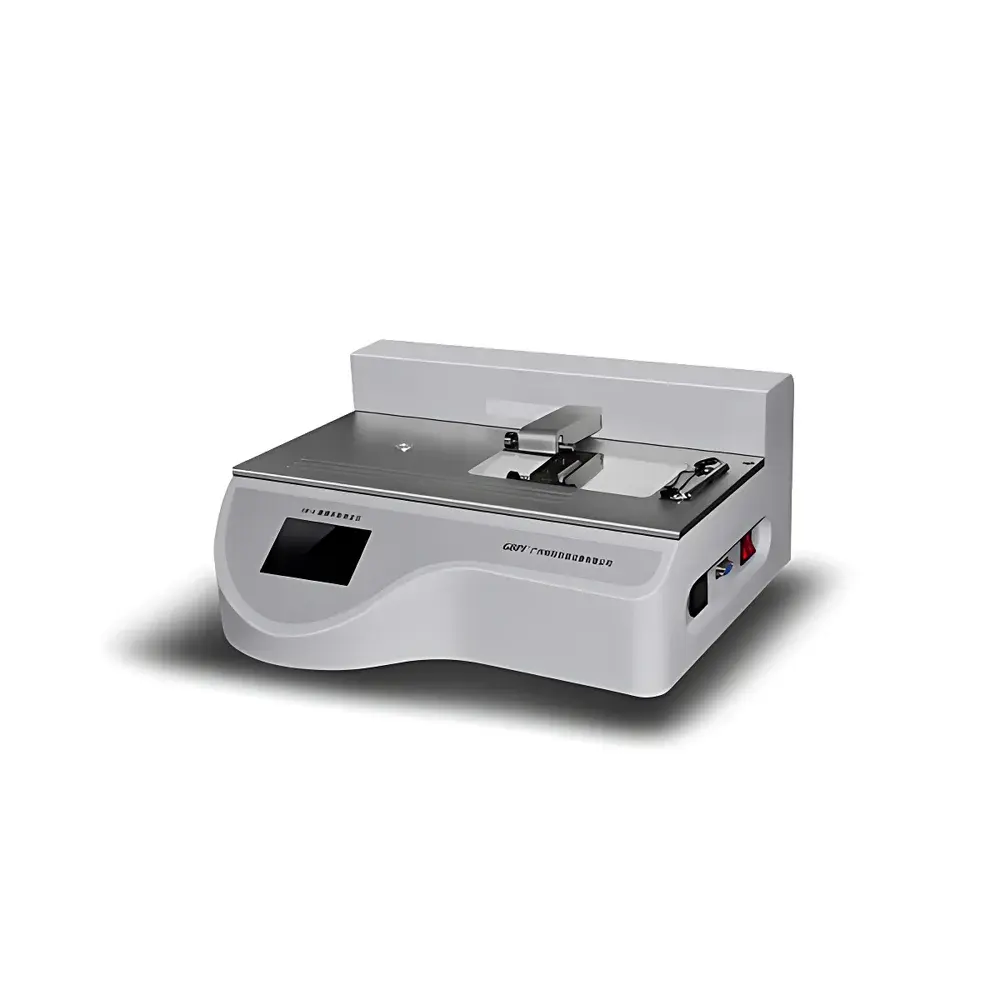
GBPI GM-4E Coefficient of Friction Tester for Plastic Films and Packaging Materials
| Brand | GBPI |
|---|---|
| Origin | Guangdong, China |
| Manufacturer Type | Direct Manufacturer |
| Country of Origin | China |
| Model | GM-4E |
| Price Range | USD 1,400 – 7,000 |
| Standard Compliance | GB/T 10006–1988, ASTM D1894–2014, ISO 8295–2004, TAPPI T816 |
| COF Range | 0.01–0.999 |
| Measurement Accuracy | ±2% |
| Force Range | 0–10 N |
| Slider Dimensions | 63 mm × 63 mm |
| Slider Mass | 200 ± 2 g |
| Test Speed | Adjustable, default 100 mm/min (stepless) |
| Temperature Control Option | Ambient to 75 °C |
| Specimen Thickness Limit | ≤2 mm |
| Base Plate Size | 200 mm × 470 mm |
| Overall Dimensions | 470 mm × 330 mm × 210 mm |
| Weight | 37 kg |
| Power | 100 W, AC 220 V ±10%, 50 Hz |
Overview
The GBPI GM-4E Coefficient of Friction Tester is a precision-engineered instrument designed for the quantitative determination of static and kinetic coefficients of friction (COF) between plastic films, thin sheets, paper, and related flexible packaging substrates. It operates on the fundamental principle of horizontal pull testing in accordance with standardized sliding interface methodology: a weighted slider moves across a fixed specimen surface at controlled velocity while a high-stability load cell measures the tangential force required to initiate (static) and sustain (kinetic) motion. This mechanical configuration conforms to the core physical model defined in ASTM D1894 and ISO 8295—where COF is calculated as the ratio of measured frictional force to the normal force applied by the slider mass. The GM-4E delivers traceable, repeatable measurements critical for quality assurance in packaging integrity evaluation, seal performance validation, and process consistency monitoring across regulated manufacturing environments.
Key Features
- High-accuracy force measurement using calibrated 10 N load cell with ±2% full-scale error tolerance, compliant with ISO/IEC 17025 calibration traceability requirements.
- Dual-mode operation: standalone functionality via integrated LCD panel displaying real-time static/kinetic COF values and test speed; optional PC-based control via RS-232 (DB9) interface.
- Stepless speed regulation from 10 mm/min to 500 mm/min, with factory-default setting at 100 mm/min per ASTM D1894–2014 Section 6.3.
- Modular hardware architecture featuring replaceable sensor modules and protected overload circuitry to prevent damage during out-of-range events.
- Quick-swap calibration system utilizing certified reference masses (200 g slider + auxiliary weight), enabling on-site verification without external metrology tools.
- Optional Peltier-based temperature-controlled test stage (ambient to 75 °C), supporting thermal stability studies for heat-sensitive polymers and laminates.
Sample Compatibility & Compliance
The GM-4E accommodates specimens up to 2 mm in thickness and 470 mm × 200 mm in planar dimension, making it suitable for standard film rolls, laminated pouches, coated papers, and pharmaceutical blister foils. Its 63 mm × 63 mm slider geometry satisfies dimensional requirements specified in GB/T 10006–1988 Clause 5.2 and ISO 8295–2004 Annex A. Instrument compliance extends to regulatory frameworks governing packaging validation: data output supports audit-ready reporting aligned with FDA 21 CFR Part 11 electronic record controls when used with validated software; raw force/time datasets are exportable in CSV format for GLP/GMP documentation workflows. All mechanical components meet RoHS Directive 2011/65/EU material restrictions.
Software & Data Management
The optional Windows-compatible control software provides synchronized acquisition of force vs. time waveforms, automatic identification of peak (static) and plateau (kinetic) friction points, and calculation of mean COF values per test cycle. Graphical user interface includes zoomable curve visualization, multi-curve overlay comparison, and customizable report templates compliant with internal QA templates or external client specifications. Software-generated reports include operator ID, timestamp, environmental conditions (if logged), calibration status, and statistical summaries (n ≥ 3 replicates). Audit trail functionality records all parameter modifications, test initiations, and data exports—supporting inspection readiness under ISO 9001:2015 Clause 8.5.2 and ICH Q5C stability protocol requirements.
Applications
- Quality control of extruded polyethylene (PE), biaxially oriented polypropylene (BOPP), and metallized polyester (PET-Al) films prior to printing or lamination.
- Evaluation of anti-block additive efficacy in food-grade packaging films per USP extractables profiling guidelines.
- Validation of hot-tack strength correlation with surface COF in form-fill-seal (FFS) line optimization.
- Comparative analysis of corona-treated versus plasma-treated surfaces for improved ink adhesion consistency.
- Research into humidity-dependent friction behavior of hydrophilic cellulose derivatives used in sustainable packaging.
- Pharmaceutical primary packaging qualification per EP 3.2.1 “Plastic Containers for Parenterals” where coefficient uniformity impacts vial capping torque and sterility maintenance.
FAQ
What standards does the GM-4E directly support?
It is configured to execute test protocols defined in GB/T 10006–1988, ASTM D1894–2014, ISO 8295–2004, and TAPPI T816 without hardware modification.
Is the instrument suitable for GMP-regulated laboratories?
Yes—when operated with validated software and documented calibration procedures, it meets data integrity expectations under EU Annex 11 and FDA guidance on computerized systems.
Can the GM-4E measure friction between two moving surfaces (e.g., film-to-film)?
Yes—the standard configuration tests film-on-steel, but user-supplied counterface specimens (e.g., duplicate film layers) can be mounted on the base plate per ISO 8295 Section 7.2.
Does the system include factory calibration certification?
A manufacturer-issued calibration certificate is available as an optional add-on (not included in base configuration); traceability to NIM (China National Institute of Metrology) is achievable upon request.
What maintenance intervals are recommended?
Load cell zero-point verification every 30 days; full mechanical inspection and slider wear assessment every 6 months; annual recalibration advised for ISO 17025-accredited use.