
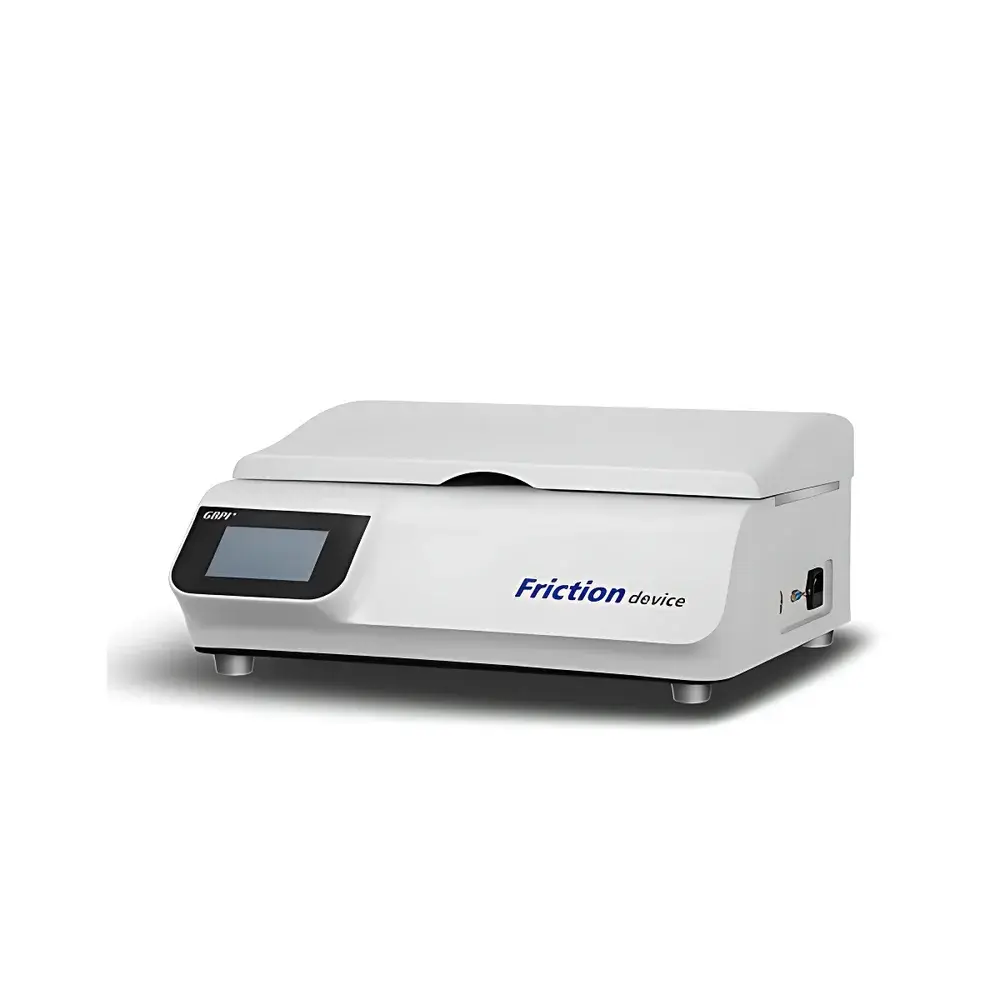
GBPI GM-6 Coefficient of Friction Tester
| Brand | GBPI |
|---|---|
| Model | GM-6 |
| Measurement Range | 0.01–0.999 (COF) |
| Accuracy | ±2% |
| Force Sensor Range | 0–10 N |
| Slider Mass | 200 ± 2 g |
| Slider Dimensions | 63 × 63 mm |
| Standard Test Speed | 100 mm/min (infinitely variable) |
| Temperature Control | Ambient to 75 °C (optional) |
| Specimen Thickness Limit | ≤ 2 mm |
| Test Platform Size | 200 × 470 mm |
| Dimensions | 470 × 330 × 210 mm |
| Weight | 37 kg |
| Power | AC 220 ± 10 V, 50 Hz, 1000 W |
Overview
The GBPI GM-6 Coefficient of Friction Tester is a precision-engineered instrument designed for quantitative determination of static and kinetic coefficients of friction (COF) between flexible packaging materials—including plastic films, foils, laminates, paper, and coated substrates—under controlled mechanical and environmental conditions. Based on the horizontal plane pull method defined in ASTM D1894, ISO 8295, and GB/T 10006, the GM-6 applies standardized tribological principles: a weighted slider is pulled across a stationary test specimen at constant velocity while a high-stability load cell measures the peak (static) and sustained (kinetic) frictional forces. The resulting COF values are calculated as the ratio of measured friction force to normal force (slider weight), enabling objective, repeatable evaluation of surface interaction critical to packaging integrity, high-speed filling line performance, and material compatibility assessment.
Key Features
- High-accuracy force measurement using a calibrated 0–10 N load cell with ±2% full-scale error tolerance, traceable via optional certified calibration standards.
- Integrated LCD interface displaying real-time test speed, static COF, and kinetic COF—enabling standalone operation without external computing hardware.
- Infinitely variable crosshead speed control (including standard 100 mm/min per ASTM/ISO), ensuring compliance with method-specific velocity requirements across diverse material systems.
- Modular mechanical architecture with protected overload circuitry: automatic sensor shutdown prevents damage during over-range events, enhancing long-term metrological stability.
- Standardized 200 g slider (63 × 63 mm contact area) manufactured to dimensional and mass tolerances per ISO 8295; includes auxiliary 200 g counterweight for verification and extended load testing.
- Optional temperature-controlled test chamber (ambient to 75 °C) supports evaluation of thermal effects on interfacial adhesion and slip behavior—critical for hot-fill or sterilization process validation.
Sample Compatibility & Compliance
The GM-6 accommodates specimens up to 2 mm in thickness and 470 mm in length, supporting flat, non-porous, and low-extensibility substrates typical of primary and secondary packaging. It meets essential regulatory and quality system requirements: data acquisition supports GLP-compliant audit trails when paired with GBPI’s optional software; instrument design aligns with mechanical safety provisions of IEC 61010-1; and test methodology satisfies mandatory specifications for pharmaceutical blister lidding (USP ), food packaging slip performance (FDA 21 CFR Part 177), and medical device pouch seal evaluation (ISO 11607-2). All firmware and calibration routines are documented per ISO/IEC 17025 traceability frameworks.
Software & Data Management
The optional GBPI COF Analysis Suite provides USB/RS-232 connectivity for real-time curve visualization, multi-test comparison, statistical reporting (mean, SD, CV%), and export to CSV or PDF formats. Software features include configurable pass/fail thresholds, automatic outlier detection, timestamped metadata logging (operator ID, ambient RH/temp, calibration date), and electronic signature support compliant with FDA 21 CFR Part 11 Annex 11 requirements. Raw force–displacement data is retained with 10 ms sampling resolution, enabling post-hoc analysis of transient stick-slip phenomena or viscoelastic relaxation effects.
Applications
- Quality control of roll-to-roll extruded films for coefficient consistency across production batches.
- Evaluation of anti-block additive efficacy in polyolefin packaging films.
- Validation of heat-seal layer lubricity in sterile barrier systems for Class II/III medical devices.
- Comparative testing of ink-coated versus uncoated paperboard for high-speed carton erecting line feed reliability.
- Regulatory submission support for packaging component qualification under ICH Q5C and PQRI guidelines.
- Research into polymer blend morphology effects on surface energy and macroscopic friction response.
FAQ
Does the GM-6 comply with international pharmacopeial standards for packaging friction testing?
Yes—the instrument implements the horizontal plane method specified in USP Annex 2 and EP 2.9.26, and its measurement uncertainty profile has been validated against NIST-traceable reference materials.
Can the GM-6 measure friction between two moving surfaces (e.g., film-on-film dynamic interfaces)?
No—it follows the fixed-specimen / moving-slider configuration per ASTM D1894; for dual-motion tribology, a custom fixture or rotational rheometer platform is required.
Is firmware upgrade capability supported remotely?
Yes—firmware updates are delivered via encrypted USB key with version-locked checksum verification and rollback functionality.
What documentation is provided for IQ/OQ/PQ validation?
GBPI supplies a complete validation package including URS, FAT/SAT protocols, calibration certificates (NIST-traceable weights and force standards), and installation qualification checklists aligned with ISO 13485 and GMP Annex 15.
How often must the load cell be recalibrated?
Annual recalibration is recommended; however, daily verification using the included 200 g standard mass and zero-balance routine ensures ongoing measurement fidelity between formal calibrations.





