
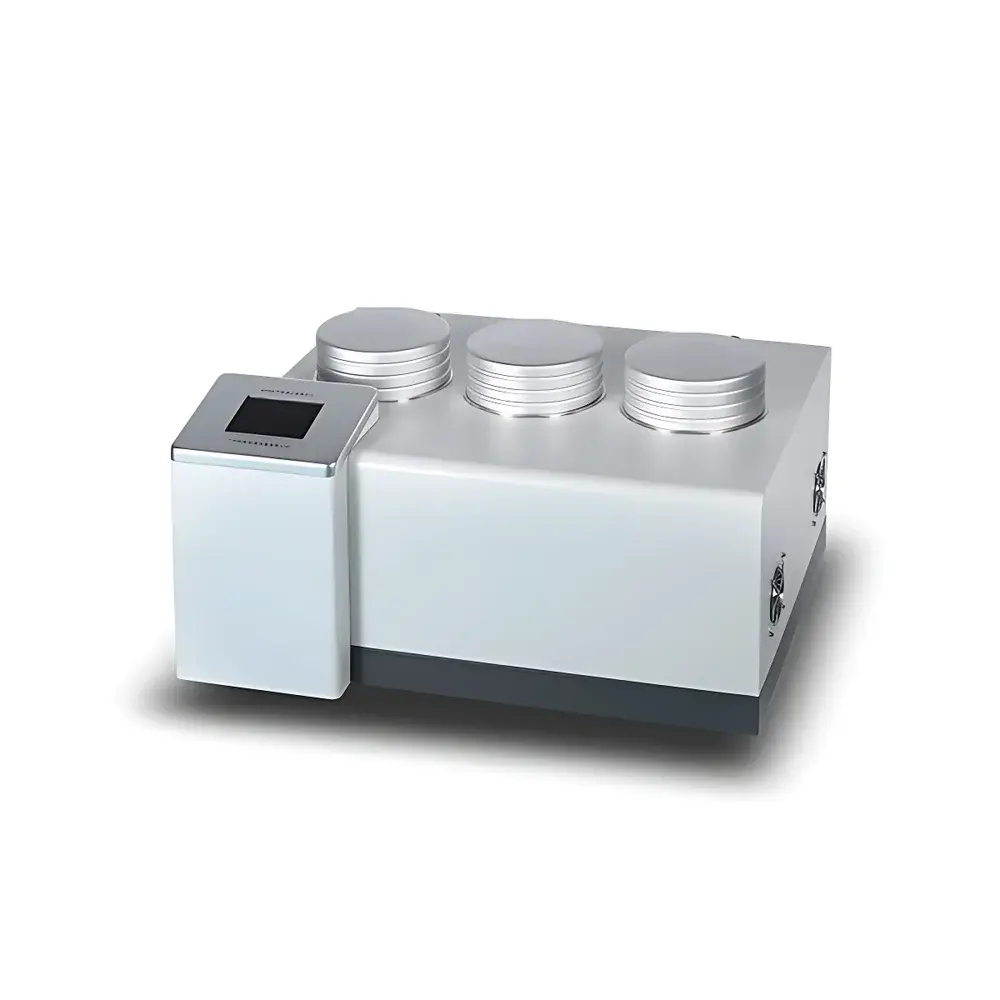
GBPI N530-1G Differential Pressure Gas Permeability Analyzer
| Brand | GBPI |
|---|---|
| Origin | Guangdong, China |
| Manufacturer Type | Direct Manufacturer |
| Country of Origin | China |
| Model | N530-1G |
| Price Range | USD 14,000 – 70,000 |
| Test Gases | O₂, CO₂, N₂ |
| Measurement Principle | Differential Pressure (Manometric) Method |
| Test Range | 0.02–500,000 cm³/(m²·24h·0.1 MPa) |
| Resolution | 0.001 cm³/(m²·24h·0.1 MPa) |
| Temperature Control | 15–60 °C ±0.1 °C |
| Vacuum Level | <20 Pa |
| Vacuum Resolution | 0.01 Pa |
| Test Pressure Range | −0.1 to +0.1 MPa |
| Gas Supply Pressure | 0.2–0.8 MPa |
| Sample Area | 50.24 cm² |
| Sample Diameter | Φ110 mm |
| Max Sample Thickness | ≤2 mm |
| Test Chambers | 3 independent chambers |
| Dimensions | 800 × 560 × 400 mm |
| Weight | 100 kg |
| Power | 1000 W, AC 220 V, 50 Hz |
Overview
The GBPI N530-1G Differential Pressure Gas Permeability Analyzer is an engineered solution for precise quantification of gas transmission rates (GTR) through polymeric films, laminates, foils, and rigid packaging structures under controlled temperature and pressure differentials. It operates on the standardized differential pressure (manometric) principle defined in ISO 2556, ASTM D1434, and GB/T 1038—where a known partial pressure gradient is established across a sealed test specimen, and the time-dependent accumulation of permeant gas in a calibrated measurement chamber is monitored via high-resolution pressure transducers. This method delivers traceable, reproducible results for oxygen (O₂), carbon dioxide (CO₂), and nitrogen (N₂) permeation—critical parameters for shelf-life prediction, barrier integrity validation, and regulatory compliance in pharmaceutical, food, medical device, and electronics packaging applications.
Key Features
- Triple independent test chambers with individual temperature and pressure control—enabling concurrent testing of three distinct samples or gases, each generating a separate, auditable dataset.
- High-fidelity vacuum system with <20 Pa base pressure and 0.01 Pa resolution, ensuring accurate low-flux measurements for ultra-high-barrier materials such as aluminum foil and SiOₓ-coated PET.
- Electromagnetic programmable thermal control (15–60 °C, ±0.1 °C stability) with rapid thermal equilibration and minimal drift—validated per ISO 15105-1 Annex B protocols.
- ARM-based embedded controller supporting standalone operation; no external PC required for routine testing—reducing system dependencies and improving operational continuity.
- Automatic pressure-differential maintenance during test cycles, with user-defined setpoints across the full −0.1 to +0.1 MPa range—ensuring consistent driving force regardless of material resistance.
- Integrated 7-inch color touchscreen HMI with real-time visualization of pressure, differential pressure, temperature, and cumulative gas transmission curves—including toggle-enabled curve overlays and zoomable data previews.
- Modular hardware architecture with plug-in sensor modules, field-replaceable vacuum components, and over-range protection circuits—minimizing downtime and simplifying preventive maintenance.
Sample Compatibility & Compliance
The N530-1G accommodates flat specimens up to Φ110 mm and ≤2 mm thick—including monolayer plastics (e.g., LDPE, PP), coextruded films, metallized substrates, ceramic-coated barriers, and elastomeric sheets. Optional fixtures extend capability to rigid and semi-rigid containers (bottles, trays, pouches) per ASTM F2622 and ISO 15105-2 methodologies. All hardware and software comply with international regulatory frameworks: calibration traceability to NIST-traceable standard reference materials (SRMs), mechanical validation per ISO/IEC 17025, and design alignment with EU Annex 11 and FDA 21 CFR Part 11 requirements for electronic records and signatures. The instrument meets the essential performance criteria of Chinese Pharmacopoeia YBB 00082003-2015 and Japanese Industrial Standard JIS K7126-1:2006.
Software & Data Management
The proprietary GBPI PermeaSoft™ platform implements role-based access control (RBAC) with configurable user tiers—Administrator, Operator, and Viewer—each assigned granular permissions over method editing, report generation, audit log access, and system configuration. Full audit trail functionality logs all critical events: user login/logout, method parameter changes, calibration actions, result modifications, and report exports—with immutable timestamps and operator IDs. Data is stored in encrypted SQLite databases compliant with ALCOA+ principles (Attributable, Legible, Contemporaneous, Original, Accurate, Complete, Consistent, Enduring, Available). Reports are exportable in PDF, Excel, and CSV formats, including metadata headers (test ID, operator, environmental conditions, calibration status, uncertainty estimates), and support automated integration into LIMS environments via configurable ODBC drivers.
Applications
This analyzer serves as a primary tool for quality assurance laboratories validating barrier performance across regulated supply chains. In pharmaceutical packaging, it verifies O₂ transmission rates (OTR) of blister lidding foils and cold-forming aluminum strips against USP specifications. Food manufacturers use it to benchmark CO₂ permeability of modified atmosphere packaging (MAP) films for meat and dairy products. Electronics firms assess moisture vapor transmission (MVT) surrogates using N₂ under dry conditions for OLED encapsulation films. Medical device producers apply it to evaluate gas exchange characteristics of transdermal patch backing layers and surgical drape laminates. Research institutions employ its extended range mode (up to 600,000 cm³/(m²·24h·0.1 MPa)) for accelerated aging studies and novel nanocomposite barrier development.
FAQ
What gas standards are supported for calibration?
The system supports dual-mode calibration: certified gas-permeable reference films (e.g., 125 µm HDPE traceable to GBW(E)130541/2) and primary pressure standards—both documented in the integrated calibration log.
Can the instrument validate container-level permeation?
Yes—when equipped with optional container test fixtures (sold separately), it measures headspace gas ingress/egress in bottles, cups, and flexible pouches per ASTM F2622 Annex A2.
Is remote monitoring or network integration possible?
The embedded Ethernet port enables secure HTTP-based status polling and firmware updates; full SCADA integration requires optional OPC UA gateway licensing.
How is temperature uniformity verified across chambers?
Each chamber contains a dedicated PT100 sensor; thermal mapping reports (per ISO 15105-1 Section 7.3) are generated during IQ/OQ qualification using calibrated handheld probes.
Does the system meet GLP audit requirements?
Yes—audit trail configuration, electronic signature enforcement, and method version control align with OECD GLP Principles and EU Commission Directive 2004/10/EC Annex II.





