
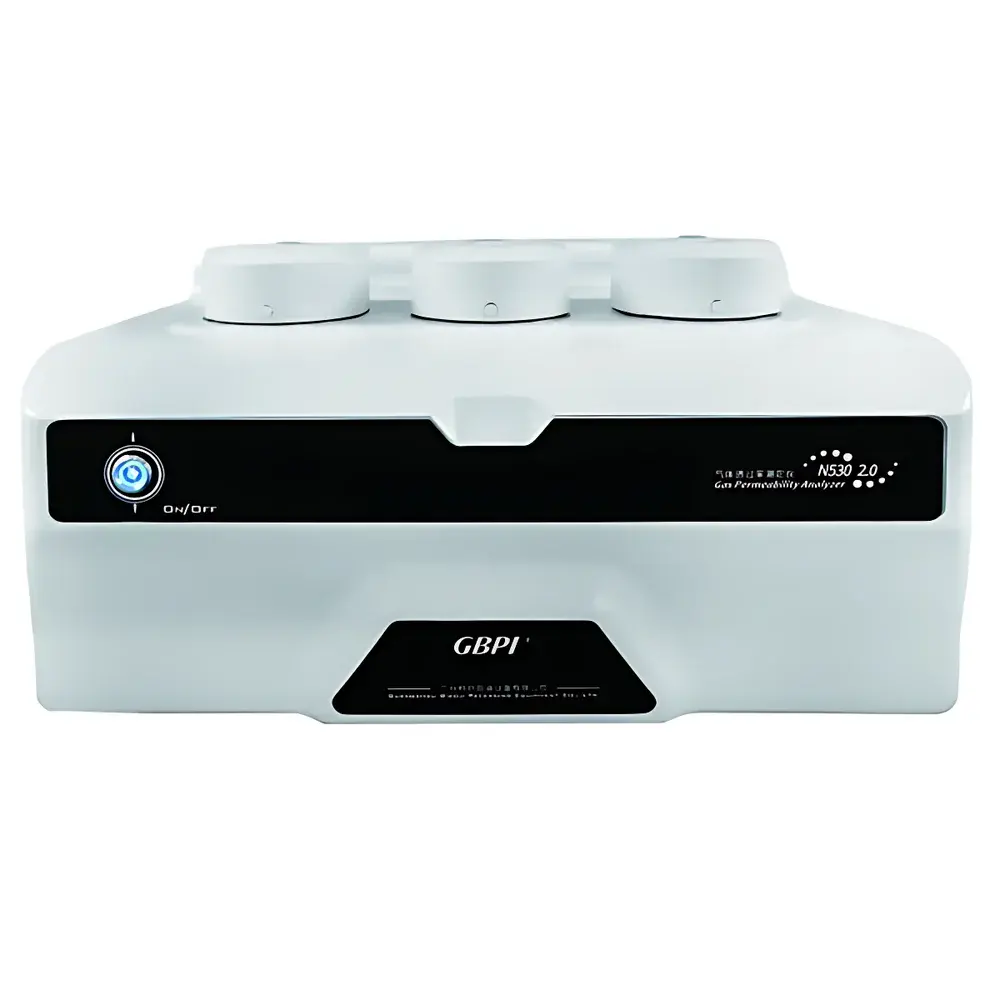
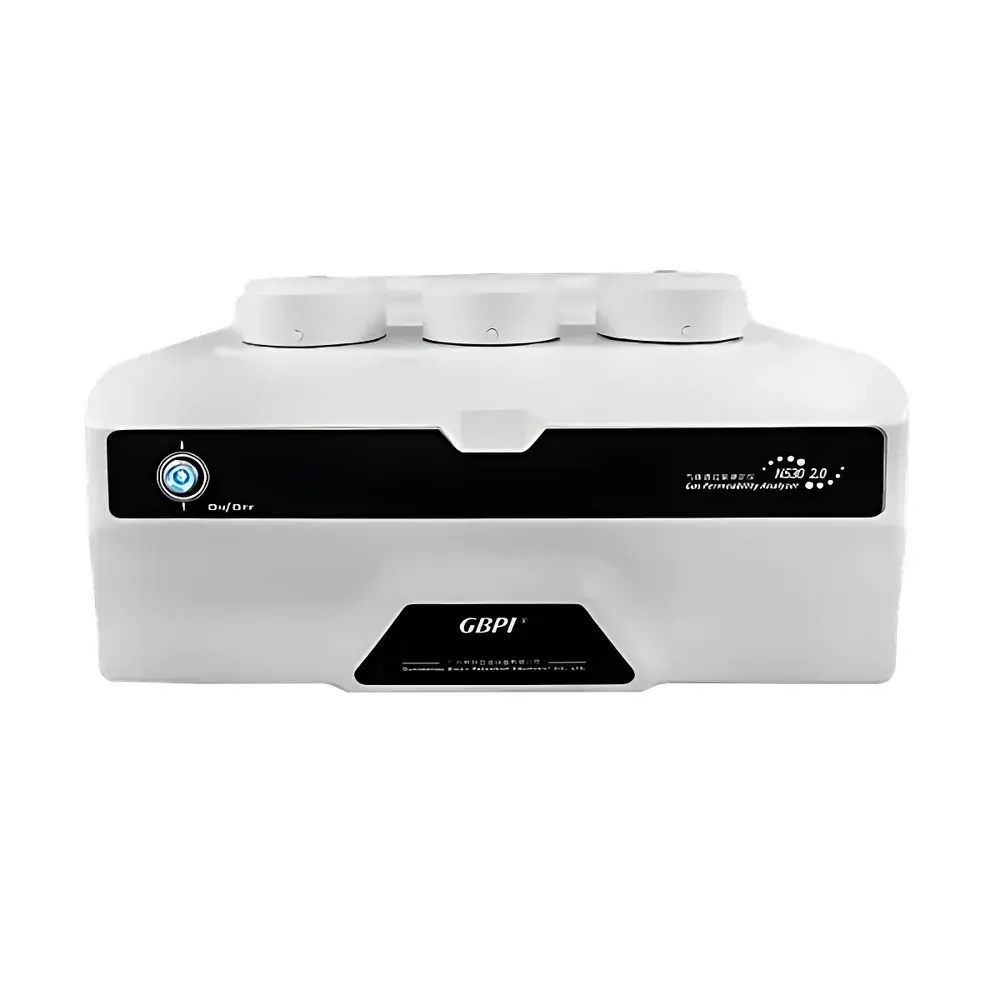
GBPI N530 2.0 Differential Pressure Gas Permeability Analyzer
| Brand | GBPI |
|---|---|
| Origin | Guangdong, China |
| Manufacturer Type | Direct Manufacturer |
| Origin Category | Domestic (China) |
| Model | N530 2.0 |
| Test Gases | O₂, CO₂, N₂, Air, He |
| Measurement Range | 0.02–50000 cm³/(m²·24 h·0.1 MPa), expandable to 600000 cm³/(m²·24 h·0.1 MPa) |
| Resolution | 0.0001 cm³/(m²·24 h·0.1 MPa) |
| Temperature Control | 15–60 °C, ±0.1 °C accuracy |
| Vacuum Level | <10 Pa, resolution 0.01 Pa |
| Test Pressure | 0.1 MPa |
| Test Area | 50.24 cm² |
| Specimen Size | Ø110 mm, thickness ≤2 mm |
| Chamber Count | 3 independent test chambers |
| Dimensions | 690 × 620 × 390 mm |
| Weight | 55 kg |
| Power | 750 W, AC 220 V, 50 Hz |
Overview
The GBPI N530 2.0 Differential Pressure Gas Permeability Analyzer is an engineered solution for quantitative determination of gas transmission rates (GTR) through polymeric, laminated, and composite packaging materials under controlled pressure gradient conditions. It operates on the differential pressure (manometric) principle defined in ISO 2556, ISO 15105-1, ASTM D1434, JIS K7126-1, GB/T 1038.1, and the Chinese Pharmacopoeia 2025 Edition Chapter 4007 “Gas Permeation Testing of Pharmaceutical Packaging Materials.” In this method, a conditioned specimen is sealed between two isolated chambers. The downstream (lower) chamber is evacuated to high vacuum (<10 Pa), while the upstream (upper) chamber is pressurized with test gas (e.g., O₂, CO₂, or N₂) at 0.1 MPa. The resulting constant pressure differential drives gas permeation across the sample. Real-time monitoring of downstream pressure rise—via ultra-stable, 0.01 Pa-resolution piezoresistive sensors—enables calculation of gas permeability coefficient (P), diffusion coefficient (D), solubility coefficient (S), and gas transmission rate (GTR) according to Fick’s first law and the solution-diffusion model. This principle ensures traceable, reproducible results for both low- and high-barrier materials without reliance on carrier gas flow calibration.
Key Features
- Triple independent test chambers enable concurrent analysis of three identical or dissimilar specimens, each with fully autonomous parameter control and data acquisition—enhancing throughput without cross-contamination or signal interference.
- Patented active pressure-differential maintenance system dynamically regulates upstream and downstream pressures to sustain a stable 0.1 MPa gradient throughout the test cycle; pressure setpoints are user-adjustable for non-standard protocols (e.g., elevated pressure up to 300 kPa).
- High-fidelity vacuum architecture features a certified oil-free scroll vacuum pump (ultimate vacuum ≤0.05 Pa), integrated dual-stage filtration, and real-time vacuum stability monitoring—ensuring minimal baseline drift and rapid system equilibration.
- Bi-directional semiconductor temperature control delivers uniform thermal conditioning across the entire test zone (15–60 °C), with ±0.1 °C stability verified per ISO 17751 and ASTM E29.
- Pneumatically actuated clamping mechanism provides consistent 250 N sealing force, validated for leak integrity <1×10⁻⁸ Pa·m³/s per ASTM F2338—critical for low-permeability films (e.g., AlOx-coated PET or SiOx-deposited PP).
- Full-spectrum gas compatibility: configurable for O₂, CO₂, N₂, air, He, and custom gas mixtures; optional gas purity verification module supports pharmacopeial compliance (≥99.999% O₂).
Sample Compatibility & Compliance
The N530 2.0 accommodates flat specimens up to Ø110 mm and 2 mm thickness—including monolayer films (PE, PP, PET, PVC), coextrusions (BOPP/CPP, PE/EVOH/PE), metallized laminates (Al-PET, Al-PP), paperboard composites, pharmaceutical blister foils (PVC/PVDC, cold-forming aluminum), medical device pouches, and functional barrier coatings (SiOx, AlOx, graphene oxide). With optional accessories, it extends to rigid and semi-rigid packaging—such as HDPE bottles, aluminum cans, thermoformed trays, and stand-up pouches—using volumetric expansion compensation algorithms compliant with ASTM F1140/F1886. All hardware and firmware comply with IEC 61000-6-3 (EMC), IEC 61010-1 (safety), and ISO/IEC 17025:2017 requirements for testing laboratories. Calibration traceability is maintained via GBW(E) 130541 and GBW(E) 130542 certified reference materials accredited by the National Institute of Metrology (NIM), China.
Software & Data Management
The embedded GBPI PermeaSoft™ v4.2 platform conforms to FDA 21 CFR Part 11 and EU Annex 11 for computerized systems in regulated environments. It includes role-based user authentication (administrator, analyst, reviewer), full audit trail logging (timestamped record of all parameter changes, test starts/stops, report exports), electronic signatures, and ALCOA+ data integrity controls. The software implements ISO 15105-1-compliant permeation modeling, enabling simultaneous fitting of GTR vs. time curves to extract D, S, and P values. Advanced functions include Arrhenius temperature extrapolation (per ISO 2556 Annex B), multi-gas comparative analysis, and automated pass/fail evaluation against USP , YBB 00082003, or internal specifications. Reports export to PDF/A-2, CSV, XML, and Excel formats; raw data files are stored in HDF5 format with embedded metadata (test gas, T, P, RH, operator ID, instrument serial number).
Applications
This analyzer serves quality control and R&D laboratories in pharmaceutical packaging (blister lidding, IV bags, vial stoppers), food packaging (retort pouches, modified atmosphere packaging films), medical devices (sterile barrier systems, wound dressings), electronics (moisture-sensitive OLED encapsulation), and sustainable packaging (PLA, PBAT, PHA, cellulose-based barriers). It supports regulatory submissions for FDA IND/NDA, EMA CMC dossiers, and PMDA filings where gas barrier performance directly impacts product shelf life, sterility maintenance, and oxidation-sensitive API stability. Typical use cases include accelerated aging correlation studies, formulation screening of nanocomposite films, validation of coating uniformity, and supplier qualification audits per ISO 13485 or IATF 16949.
FAQ
What standards does the N530 2.0 comply with for pharmaceutical packaging testing?
It meets Chinese Pharmacopoeia 2025 Edition Chapter 4007, YBB 00082003, USP , and ISO 15105-1 for gas permeation quantification in primary and secondary packaging.
Can the instrument measure gases other than oxygen?
Yes—it supports O₂, CO₂, N₂, air, He, and custom gas blends; gas-specific calibration factors are applied automatically during analysis.
Is vacuum pump maintenance required, and what is its service life?
The oil-free scroll pump requires no routine oil changes; scheduled filter replacement every 12 months ensures >15,000 hours MTBF per ISO 13849-1.
How is system leakage verified before each test?
An automated leak-check protocol executes prior to vacuum initiation, measuring pressure decay rate over 300 seconds; tests proceed only if leakage remains below 0.5 Pa/min.
Does the software support 21 CFR Part 11 compliance for electronic records?
Yes—full audit trail, electronic signatures, and user access controls are enabled by default and validated per GAMP 5 guidelines.




