
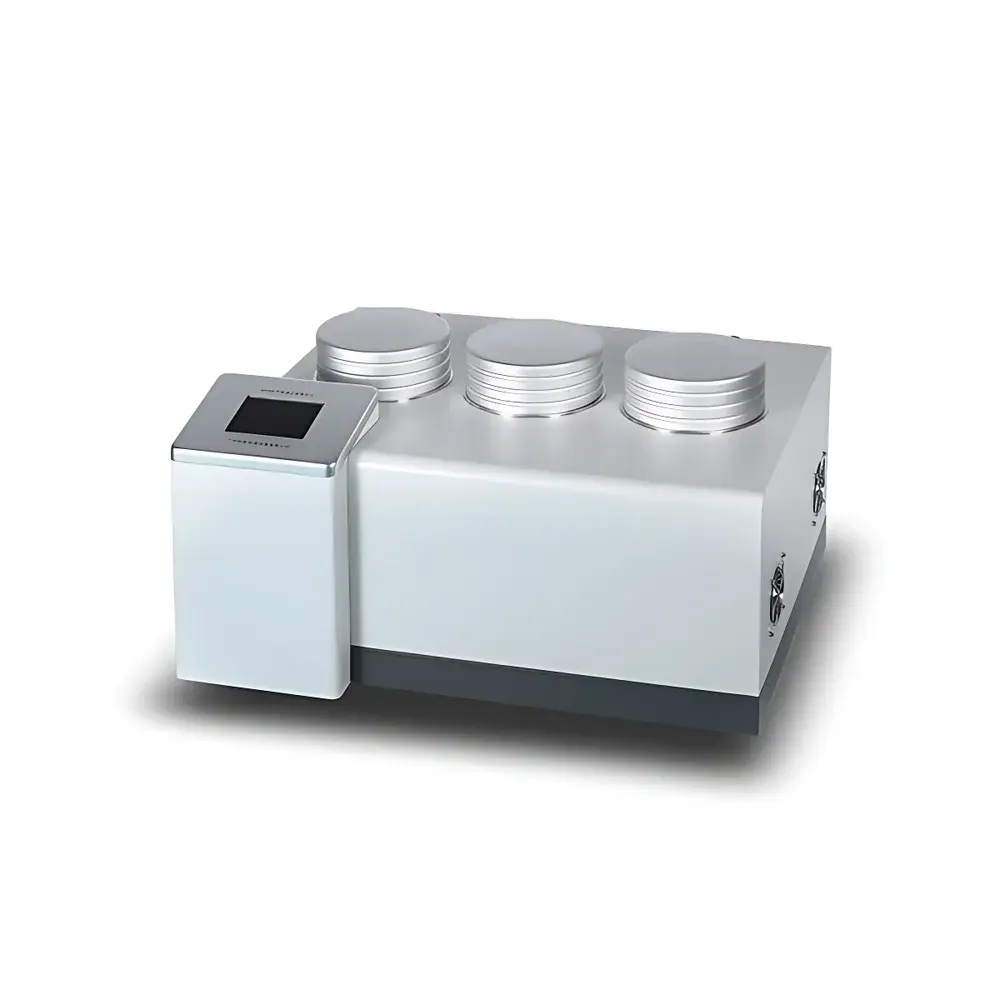
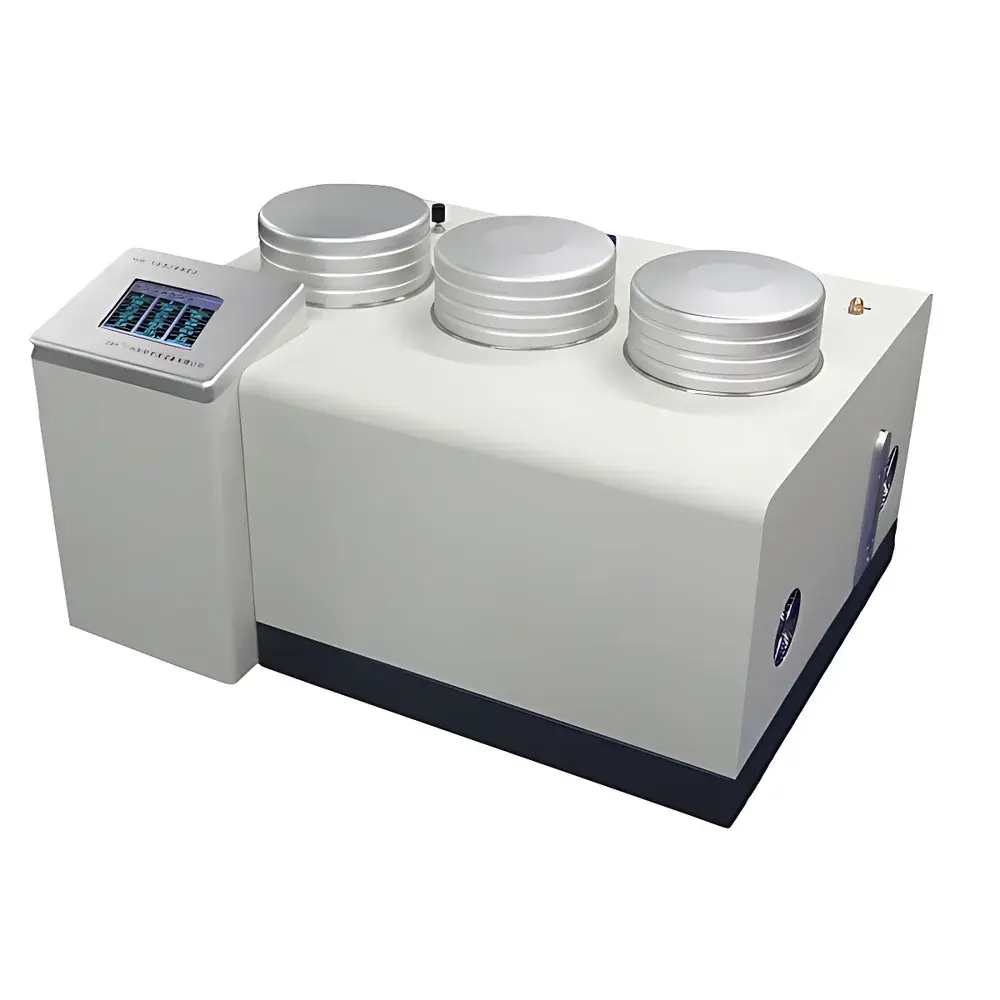
GBPI N530-G3 Triple-Chamber Independent Gas Permeability Tester
| Brand | GBPI |
|---|---|
| Origin | Guangdong, China |
| Manufacturer Type | Direct Manufacturer |
| Country of Origin | China |
| Model | N530-G3 |
| Price Range | USD 14,000 – 70,000 |
| Test Gases | O₂, CO₂, N₂ |
| Measurement Range | 0.02–50,000 cm³/(m²·24h·0.1 MPa) (expandable to 600,000 cm³/(m²·24h·0.1 MPa)) |
| Accuracy | ±0.01 cm³/(m²·24h·0.1 MPa) |
| Temperature Control Range | 5–50 °C |
| Temperature Stability | ±0.01 °C |
| Vacuum Level | <20 Pa |
| Vacuum Resolution | 0.1 Pa |
| Test Pressure Range | −0.1 to +0.1 MPa |
| Gas Supply Pressure | 0.2–0.8 MPa |
| Gas Inlet Port | 1/8″ NPT |
| Permeation Area | 50.24 cm² |
| Specimen Diameter | Φ110 mm |
| Max Specimen Thickness | ≤2 mm |
| Chamber Configuration | 3 independent test chambers |
| Dimensions | 800 × 560 × 400 mm |
| Weight | 100 kg |
| Power | 1000 W |
| Input | AC 220 V, 50 Hz |
| Compliance Standards | GB/T 1038–2000, ISO 2556:1974, ISO 15105-1:2007, ASTM D1434, YBB 00082003–2015, JIS K7126-1:2006 |
Overview
The GBPI N530-G3 Triple-Chamber Independent Gas Permeability Tester is an advanced gravimetric and differential pressure-based instrument engineered for precise, reproducible measurement of gas transmission rates (GTR) through polymeric films, laminates, foils, and rigid packaging containers. It operates on the principle of constant differential pressure (manometric method), where a controlled pressure gradient is maintained across a sealed specimen while real-time monitoring of gas accumulation in the downstream chamber yields quantitative permeation data. Designed for compliance-critical environments—including pharmaceutical packaging validation, food shelf-life modeling, and medical device barrier qualification—the N530-G3 delivers traceable, standards-aligned performance under ISO, ASTM, and Chinese pharmacopoeial regulations.
Key Features
- Triple independent test chambers: Each chamber features its own high-stability pressure sensor, temperature-controlled environment, and autonomous vacuum/gas control circuit—enabling simultaneous, non-interfering tests on up to three specimens of identical or dissimilar materials, or under different gases (O₂, CO₂, N₂).
- Automated differential pressure maintenance: Proprietary closed-loop pressure regulation maintains user-defined transmembrane pressure differences with ±0.01 kPa stability—critical for low-permeability foil and metallized film testing per ASTM D1434 Annex A2.
- High-resolution thermal management: Electromagnetic stepwise temperature control achieves ±0.01 °C uniformity across all chambers (5–50 °C range), validated via NIST-traceable PT100 sensors and integrated into system calibration routines.
- ARM-based embedded architecture: The instrument runs autonomously without external PC dependency; all test logic, data acquisition, and real-time curve visualization (pressure, differential pressure, temperature, cumulative permeation) are handled onboard.
- Modular expandability: Optional container test kits (for bottles, pouches, trays) and high-range extension modules enable GTR measurements up to 600,000 cm³/(m²·24h·0.1 MPa), supporting both ultra-high-barrier (e.g., Al foil, SiOₓ-coated PET) and highly permeable (e.g., LDPE, nonwoven) substrates.
- GMP-compliant software architecture: Fully compliant with Annex 11 (EU GMP) and FDA 21 CFR Part 11 requirements, including role-based access control, electronic signatures, and full audit trail logging for system events, method changes, and raw data modifications.
Sample Compatibility & Compliance
The N530-G3 accommodates flat specimens up to Φ110 mm and ≤2 mm thick—including monolayer plastics (LDPE, PP, PET), coextruded films, aluminum foils, metallized substrates, rubber sheets, ceramic wafers, and functional laminates used in solar backsheets or OLED encapsulation. With optional fixtures, it extends to rigid and semi-rigid packaging: blister cavities, stand-up pouches, injection-molded trays, and HDPE bottles (per ASTM F2622). All test methodologies adhere strictly to GB/T 1038–2000 (equivalent to ISO 2556), ISO 15105-1, and YBB 00082003–2015 for pharmaceutical primary packaging—ensuring regulatory acceptance in global submissions.
Software & Data Management
Equipped with GBPI’s proprietary PermeaSoft™ v4.x platform, the system provides intuitive touchscreen operation (7″ color LCD), customizable test protocols, and real-time graphical overlay of four synchronized parameters. Raw data is stored in encrypted SQLite databases with immutable timestamps and user attribution. Reports comply with GLP/GMP documentation standards: auto-generated PDF/Office exports include instrument ID, calibration status, environmental logs, statistical summaries (mean, SD, RSD), and digital signatures. Audit trails capture every action—from login/logout to parameter edits—and are exportable as CSV for internal QA review or regulatory inspection.
Applications
- Pharmaceutical packaging: Validation of blister lidding foils, cold-forming aluminum, and child-resistant pouches per USP and EP 5.1.1.
- Food packaging development: Shelf-life prediction for MAP (modified atmosphere packaging) films and retort pouches.
- Medical device packaging: Sterility barrier qualification of Tyvek® lids and peelable pouches under ISO 11607-1.
- Advanced materials R&D: Characterization of graphene-enhanced barriers, bio-based PLA films, and thin-film encapsulation for flexible electronics.
- Quality control labs: Routine release testing for incoming film rolls, laminates, and converted packaging per ISO/IEC 17025-accredited procedures.
FAQ
Does the N530-G3 support multi-gas testing in parallel?
Yes—each of the three chambers can be independently configured for O₂, CO₂, or N₂, enabling concurrent comparative studies without cross-contamination or manual reconfiguration.
How is instrument calibration verified?
The system accepts certified reference materials (CRM) traceable to GBW(E)130541/2 national standard substances. Users perform routine CRM tests and input measured values into the calibration module, which adjusts sensor gain and offset coefficients with full audit logging.
Can test data be integrated into LIMS or ERP systems?
Yes—via secure HTTPS REST API or configurable ODBC drivers, enabling automated data push to enterprise platforms while preserving audit trail integrity and user authentication.
What maintenance is required for long-term sensor stability?
Pressure and temperature sensors undergo annual verification using external metrology standards; the modular design allows field-replacement of individual chambers without system downtime.
Is training and technical support available internationally?
GBPI provides remote and on-site installation qualification (IQ), operational qualification (OQ), and user training packages—including SOP development assistance and regulatory documentation templates—for clients in over 40 countries.






