
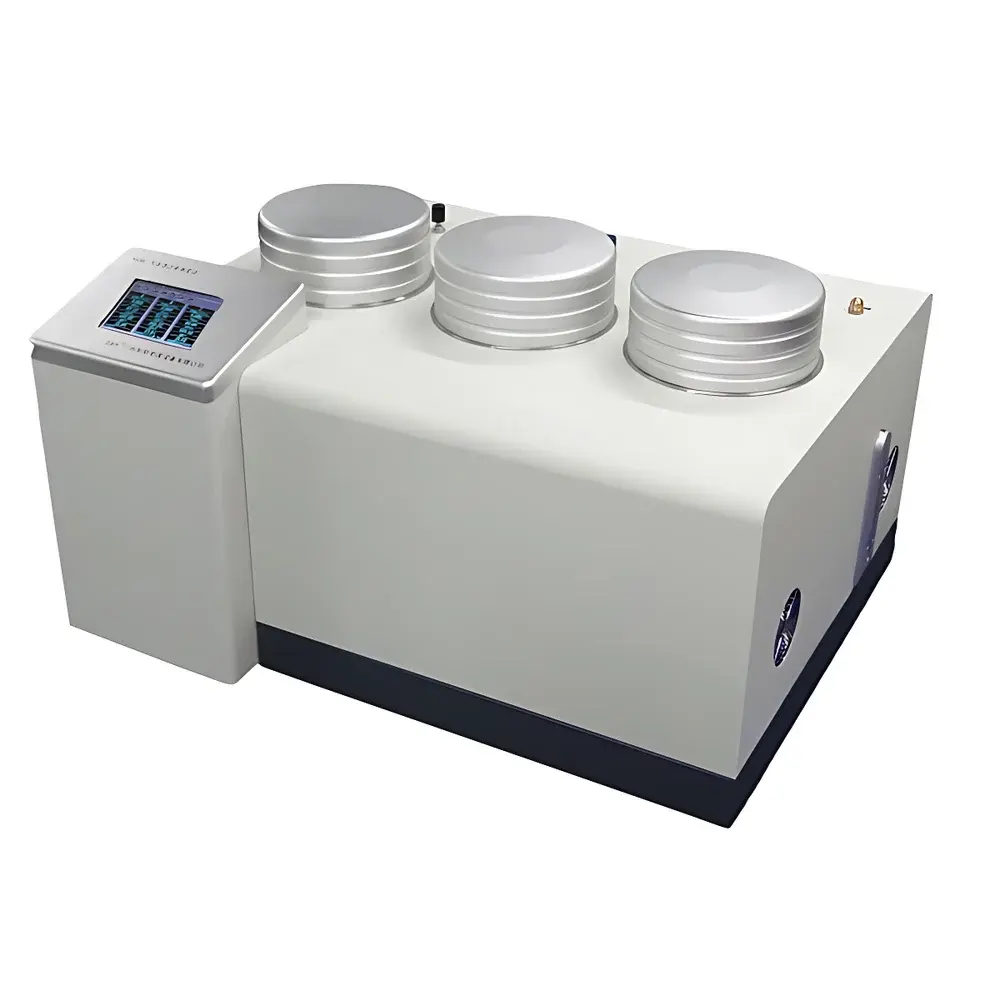
GBPI N530-G4 Gas Permeability Tester (O₂/CO₂/N₂) Compliant with GB/T 1038, ASTM D1434 & ISO 2556
| Brand | GBPI |
|---|---|
| Origin | Guangdong, China |
| Manufacturer | GBPI Packaging Equipment Co., Ltd. |
| Model | N530-G4 |
| Test Gases | O₂, CO₂, N₂ |
| Measurement Range | 0.02–50,000 cm³/(m²·24h·0.1 MPa) [expandable to 600,000 cm³/(m²·24h·0.1 MPa)] |
| Accuracy | ±0.01 cm³/(m²·24h·0.1 MPa) |
| Temperature Control | 5–50 °C (±0.01 °C stability) |
| Vacuum Level | <20 Pa (resolution: 0.1 Pa) |
| Test Pressure Range | −0.1 to +0.1 MPa |
| Gas Supply Pressure | 0.2–0.8 MPa |
| Sample Area | 50.24 cm² |
| Sample Diameter | Φ110 mm |
| Max. Thickness | ≤2 mm |
| Test Chambers | 3 independent cavities |
| Power | 1000 W (AC 220 V, 50 Hz) |
| Dimensions | 800 × 560 × 400 mm |
| Weight | 100 kg |
| Standards | GB/T 1038–2000, ISO 2556:1974, ISO 15105-1:2007, ASTM D1434, JIS K7126-1:2006, YBB 00082003–2015 |
Overview
The GBPI N530-G4 Gas Permeability Tester is a gravimetric-differential pressure-based instrument engineered for precise, traceable measurement of gas transmission rates (GTR) through polymeric films, laminates, foils, and rigid packaging structures. It operates on the principle of constant differential pressure (manometric method), where a controlled pressure gradient is maintained across a conditioned specimen while permeating gas is quantified via high-stability pressure transducers and real-time vacuum decay analysis. Designed in strict alignment with international standard test methodologies—including GB/T 1038–2000, ASTM D1434, ISO 2556, and ISO 15105-1—the system delivers reproducible O₂, CO₂, and N₂ permeability data under rigorously controlled thermal and barometric conditions. Its triple-chamber architecture enables concurrent, statistically independent determinations, making it suitable for comparative barrier evaluation, QC release testing, and regulatory submission support in pharmaceutical, food, medical device, and advanced materials development.
Key Features
- Triple independent test chambers with dedicated high-precision pressure sensors—enables parallel analysis of three identical or dissimilar samples under identical environmental conditions.
- Automated differential pressure maintenance system—dynamically regulates and sustains user-defined pressure gradients (±0.1 MPa range) across the specimen without manual intervention.
- Electromagnetic programmable temperature control—achieves ±0.01 °C stability over 5–50 °C operating range using closed-loop PID algorithms and low-drift thermal mass design.
- ARM-based embedded control architecture—supports standalone operation with integrated 7-inch color touchscreen; no external PC required for routine testing or real-time parameter monitoring.
- Multi-gas capability—configured for O₂, CO₂, and N₂ with standardized calibration protocols; optional gas-specific sensor modules available for H₂O vapor or other analytes upon request.
- Full audit trail compliance—software implements 21 CFR Part 11–aligned electronic signatures, role-based access control (administrator/operator/observer tiers), and immutable system/project/method-level audit logs.
- Expandable measurement range—standard configuration covers 0.02–50,000 cm³/(m²·24h·0.1 MPa); fitted with auxiliary flow compensation module, upper limit extends to 600,000 cm³/(m²·24h·0.1 MPa) for ultra-high-permeability substrates.
Sample Compatibility & Compliance
The N530-G4 accommodates flat sheet specimens up to Φ110 mm and ≤2 mm thickness—including monolayer plastics (e.g., LDPE, PET), metallized films (AlOx, SiOx), aluminum foil composites, rubber sheets, ceramic membranes, and flexible pouches. With optional fixture kits, it supports container testing per ASTM F2338 (e.g., blister packs, sachets, trays, bottles). All hardware and firmware comply with ISO/IEC 17025 requirements for testing laboratories, and the instrument is certified under China’s National Standard Substance Accreditation (GBW(E)130541/2) for traceable calibration using SRMs. It meets GMP Annex 11 and EU Annex 11 expectations for computerized system validation, including electronic record integrity, data retention, and change control procedures.
Software & Data Management
The proprietary GBPI PermeaSoft™ v4.2 platform provides intuitive workflow management, customizable test templates, and automated report generation compliant with GLP/GMP documentation standards. Real-time visualization includes synchronized plots of pressure differential, chamber vacuum, temperature drift, and cumulative gas transmission. Raw data are stored in encrypted SQLite databases with timestamped metadata. Export formats include PDF (with digital signature), Excel (.xlsx), and CSV. All user actions—including method edits, result overrides, and calibration events—are recorded in tamper-evident audit trails with operator ID, timestamp, and contextual description.
Applications
- Pharmaceutical packaging qualification—barrier verification of PTP blisters, cold-forming foils, and child-resistant containers per USP and YBB 00082003.
- Food packaging shelf-life modeling—O₂ transmission rate (OTR) assessment of retort pouches, vacuum-sealed films, and modified-atmosphere packaging (MAP) systems.
- Medical device packaging validation—sterility maintenance testing of Tyvek® lids, peelable lidding films, and pouch seal integrity under accelerated aging conditions.
- Advanced material R&D—characterization of barrier coatings on flexible OLED substrates, solar backsheet laminates, and hydrogel-based transdermal patches.
- Regulatory submissions—generation of metrologically traceable data packages accepted by FDA, EMA, NMPA, and PMDA for Type IV DMFs and packaging master files.
FAQ
Does the N530-G4 support compliance with 21 CFR Part 11?
Yes—the software implements electronic signatures, audit trails, role-based permissions, and data integrity safeguards fully aligned with FDA 21 CFR Part 11 requirements.
Can it test rigid containers such as bottles or trays?
Yes—using optional container test fixtures compliant with ASTM F2338, the system measures gas permeation through sealed rigid or semi-rigid packaging.
What calibration standards are used for traceability?
The instrument is calibrated using GBPI-certified national standard reference materials (GBW(E)130541/2), with documented uncertainty budgets traceable to NIM (National Institute of Metrology, China).
Is multi-gas testing performed simultaneously or sequentially?
Each chamber operates independently—three different gases (e.g., O₂ in Chamber A, CO₂ in B, N₂ in C) can be tested concurrently with separate sensor configurations.
How is temperature uniformity verified across the test area?
Thermal mapping is performed during factory acceptance testing (FAT); users receive a certificate documenting ΔT ≤ ±0.02 °C across the full 50.24 cm² test zone at setpoints from 23 °C to 40 °C.






