
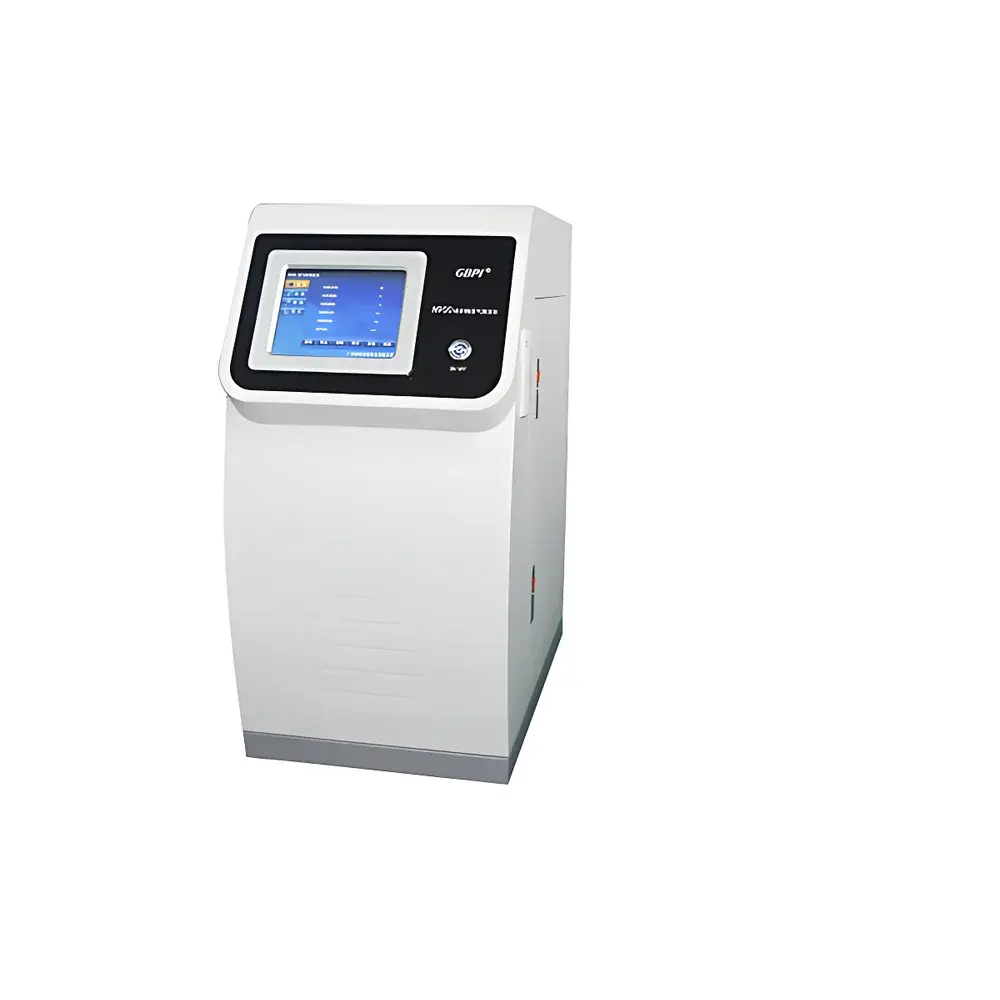
GBPI N900-1 Advanced Fabric Air Permeability Tester
| Brand | GBPI |
|---|---|
| Model | N900-1 |
| Origin | Guangdong, China |
| Manufacturer Type | Direct Manufacturer |
| Origin Category | Domestic (China) |
| Price Range | USD 7,000 – 14,000 |
| Pressure Drop Range | 1–4000 Pa (user-selectable) |
| Measurable Air Permeability | 1–40,000 mm/s |
| Measurement Accuracy | ≤ ±2% |
| Test Area Options | 5 cm², 20 cm², 50 cm², 100 cm² |
| Sample Size | 150 mm × 150 mm |
| Max. Sample Thickness | ≤10 mm |
| Nozzle Diameters | 1.2, 2, 3, 4, 6, 8, 10, 12, 16, 20 mm |
| Dimensions (L×W×H) | 640 × 380 × 865 mm |
| Weight | 70 kg |
| Power Supply | AC 220 V, 50 Hz |
Overview
The GBPI N900-1 Advanced Fabric Air Permeability Tester is a precision-engineered instrument designed for quantitative evaluation of air permeability in woven, knitted, nonwoven, and technical textile materials. It operates on the principle of constant-pressure differential airflow measurement—compliant with ISO 9237, ASTM D737, and GB/T 5453–1997—where conditioned air is driven through a standardized test area of fabric under a user-defined pressure drop (1–4000 Pa), and volumetric flow rate is measured via high-accuracy differential pressure transducers and calibrated orifice nozzles. Unlike legacy manometric methods relying on water column displacement, the N900-1 employs solid-state pressure sensing and real-time microcontroller-based data acquisition, eliminating mechanical drift, operator interpretation error, and manual interpolation from lookup tables. Its architecture supports traceable, repeatable, and auditable testing workflows required in R&D laboratories, quality control departments, and third-party certification facilities serving apparel, medical textiles, filtration media, and protective clothing industries.
Key Features
- Automated pneumatic clamping system ensures consistent sample compression and eliminates edge leakage—critical for reproducible results across heterogeneous fabric structures.
- Multi-nozzle manifold (10 calibrated orifices: Ø1.2–20 mm) enables dynamic range extension and optimal resolution across low- to high-permeability materials without hardware reconfiguration.
- Integrated color touchscreen HMI (no external PC required) displays real-time airflow curves, permeability values (mm/s), coefficient of variation (CV%), and statistical confidence intervals (95% CI).
- Onboard microprocessor performs automatic unit conversion among 10 industry-standard air permeability units—including L/(dm²·min), m³/(m²·h), cfm, and mL/s—ensuring global reporting compatibility.
- Full audit trail functionality: all test parameters (pressure setpoint, test area, nozzle ID, environmental conditions), raw sensor outputs, and final calculated results are timestamped and stored locally with optional USB export.
- Compliant with GLP and GMP documentation requirements: built-in report generator produces ISO/IEC 17025-aligned test certificates containing sample ID, standard reference (e.g., GB/T 5453), test area, pressure differential, directional airflow notation, and statistical summary.
Sample Compatibility & Compliance
The N900-1 accommodates flat, flexible textile specimens up to 150 mm × 150 mm and 10 mm thick—including coated fabrics, laminates, geotextiles, surgical gowns, HVAC filter media, and flame-retardant composites. Its modular test head allows rapid interchange of sealing gaskets and orifice plates to maintain integrity across diverse surface finishes and porosities. The instrument meets mechanical and electrical safety requirements per IEC 61010-1 and electromagnetic compatibility standards EN 61326-1. All firmware and calibration routines adhere to metrological traceability principles aligned with ISO/IEC 17025:2017 Clause 6.5; factory calibration certificates include uncertainty budgets referenced to NIM (National Institute of Metrology, China) primary standards.
Software & Data Management
While fully functional as a standalone instrument, the N900-1 includes optional PC software (Windows 10/11 compatible) supporting advanced data management: batch test sequencing, multi-sample comparative analysis, trend charting over time, and automated compliance checking against internal specification limits. Raw data exports are provided in CSV and XML formats—with embedded metadata tags for sample attributes, operator ID, and instrument serial number—to facilitate integration into LIMS or ERP systems. Software modules support FDA 21 CFR Part 11-compliant electronic signatures, role-based access control, and immutable audit logs for regulated environments.
Applications
- Quality assurance of automotive interior fabrics for cabin air filtration efficiency and thermal comfort validation.
- Development of breathable medical barrier fabrics meeting AAMI PB70 Level 3/4 performance criteria.
- Performance benchmarking of industrial filtration nonwovens used in dust collection and liquid separation systems.
- Regulatory submission support for PPE certifications (EN 14683, ASTM F2100) requiring documented air permeability thresholds.
- Academic research on structure–property relationships in smart textiles, electrospun membranes, and bio-based fiber composites.
FAQ
Does the N900-1 require annual recalibration?
Yes—GBPI recommends annual traceable recalibration using certified pressure and flow standards; calibration intervals may be adjusted per internal quality procedures based on usage frequency and risk assessment.
Can the instrument measure bidirectional airflow resistance?
No—the N900-1 measures unidirectional airflow under positive pressure differential only, as specified in ISO 9237 and GB/T 5453. Bidirectional testing requires separate instrumentation.
Is environmental conditioning (temperature/humidity) integrated?
The N900-1 does not include built-in climate control; however, it features ambient sensor inputs (optional) to log lab temperature and RH alongside test data for post-hoc correction per ISO 139.
What nozzle should I select for low-permeability fabrics (e.g., waterproof-breathable laminates)?
Use the smallest orifice (Ø1.2 mm) to maximize pressure sensitivity and minimize flow turbulence at low permeability ranges (<10 mm/s).
How is measurement uncertainty quantified in reports?
Reported uncertainty incorporates contributions from pressure transducer accuracy (±0.5% FS), area definition tolerance (±0.3%), repeatability (based on ≥10 replicate tests), and environmental variability—calculated per GUM (JCGM 100:2008).





