
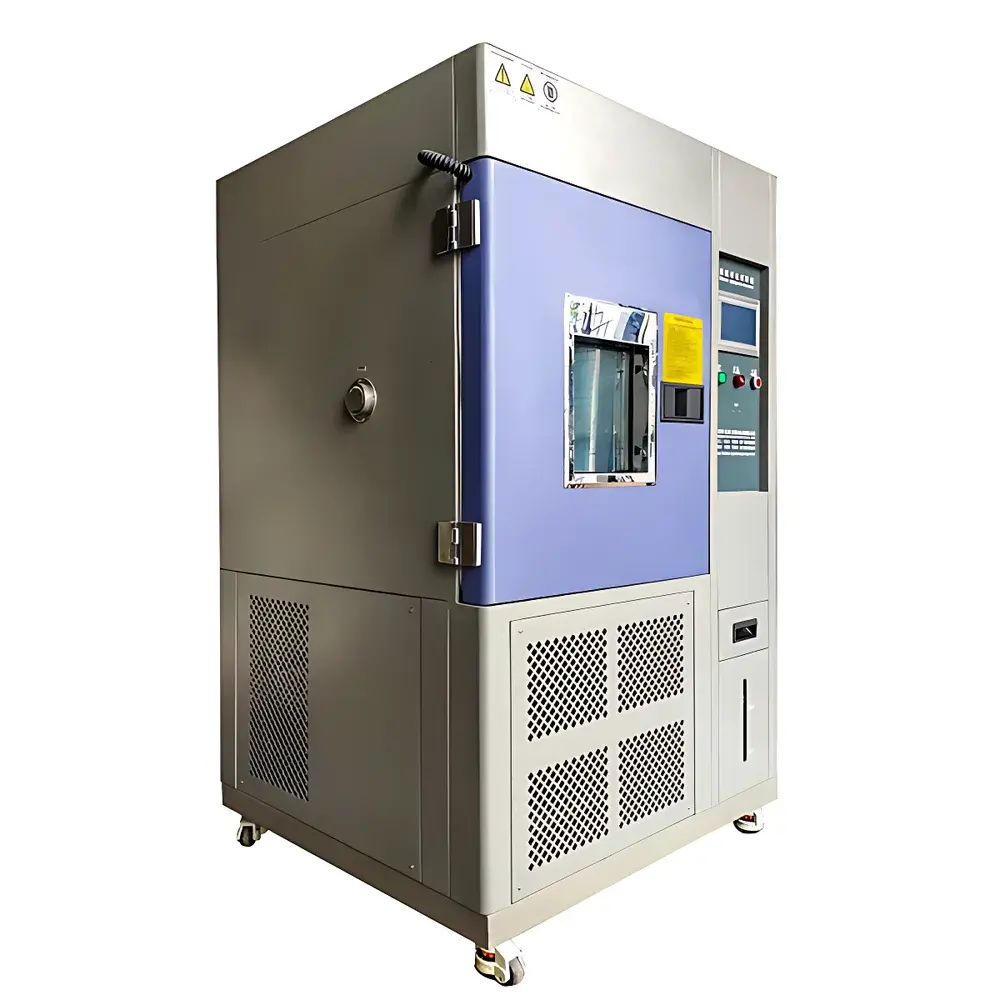
GBPI OCY-150D Dynamic Ozone Aging Test Chamber
| Brand | GBPI |
|---|---|
| Origin | Guangdong, China |
| Manufacturer Type | Manufacturer |
| Origin Category | Domestic |
| Model | OCY-150D |
| Quotation | Upon Request |
Overview
The GBPI OCY-150D Dynamic Ozone Aging Test Chamber is an engineered environmental simulation system designed specifically for evaluating the ozone resistance of elastomeric materials—particularly vulcanized rubber and thermoplastic elastomers—under dynamically strained conditions. Unlike static ozone exposure methods, this chamber implements controlled mechanical deformation during exposure, replicating real-world service stresses where rubber components (e.g., seals, gaskets, tires, cable jackets) undergo cyclic elongation while exposed to ambient or accelerated ozone concentrations. The system operates on the principle of corona discharge ozone generation, coupled with precise regulation of temperature, airflow velocity, sample rotation kinetics, and ozone concentration (50–1000 pphm), enabling reproducible acceleration of ozone-induced surface cracking per internationally recognized test protocols.
Key Features
- Dynamic sample actuation: Motor-driven rotating sample rack rotates at 1 rpm (adjustable), ensuring uniform 360° exposure; linear scanning speed maintained at 20–25 mm/s within a vertical plane perpendicular to airflow.
- High-fidelity ozone control: Silent discharge ozone generator with integrated electrochemical ozone sensor enables closed-loop feedback control; concentration accuracy ±10% of setpoint across full range (50–1000 pphm).
- Thermal management system: PID-controlled ceramic heating elements (±0.1℃ + 1 digit accuracy) and a dual-stage refrigeration circuit featuring a hermetic Tecumseh (France) compressor, R404A eco-refrigerant (ODP = 0), finned evaporator with auto-capacity modulation, and nitrogen-purged brazed joints.
- Robust chamber construction: Inner chamber fabricated from SUS304 stainless steel; 100 mm thick rigid polyurethane insulation; double-silicone-sealed left-hinged door with anti-condensation heater and W220 × H280 mm observation window.
- Intuitive human-machine interface: 7-inch color touchscreen controller (Zhenghang brand) supporting bilingual (English/Chinese) operation, graphical program editing, real-time curve visualization, and up to 96 independent test patterns with 9999-cycle capability.
- Comprehensive safety architecture: Includes compressor overheat & high-pressure cutouts, heater surface overtemperature protection, circulating motor thermal overload relay, condenser fan overheat detection, and electromagnetic circuit breakers.
Sample Compatibility & Compliance
The OCY-150D accommodates standard dumbbell- or strip-shaped specimens per GB/T 9865.1, with minimum dimensions of 10 mm width × 2.0 ± 0.2 mm thickness × ≥40 mm gauge length. Specimens are clamped in non-ozone-decomposing aluminum fixtures and subjected to dynamic strain (5–45% elongation) during exposure. The chamber meets core requirements of multiple national and industry standards, including GB/T 7762–2003 (static and dynamic ozone cracking of vulcanized rubber), GB/T 2951.21–2008 (electrical cable insulation testing), and GB/T 11206–2009 (surface cracking evaluation). While not certified to ISO 1431-1 or ASTM D1149 directly, its operational parameters—including airflow velocity (12–16 mm/s), effective scan area (>40% of chamber cross-section), and ozone homogeneity—align with the physical constraints specified in those standards for dynamic exposure methodology.
Software & Data Management
The embedded controller logs timestamped temperature, ozone concentration, elapsed time, cycle count, and alarm events with automatic storage to internal flash memory. All data entries include audit trail metadata (operator ID, timestamp, parameter change history), satisfying basic GLP documentation requirements. Export is supported via USB port in CSV format for external analysis. The interface supports scheduled start/stop, power-loss recovery (retains program state and resumes execution post-interruption), and password-protected LOCK mode to prevent unauthorized parameter modification. No network connectivity or FDA 21 CFR Part 11 compliance features are included; users requiring electronic signature or multi-user role-based access must integrate third-party LIMS or data acquisition software.
Applications
This instrument serves quality assurance laboratories in rubber compounding, automotive component manufacturing, wire & cable production, aerospace sealing systems, and medical device elastomer development. Typical use cases include comparative screening of antiozonant additives (e.g., p-phenylenediamine derivatives), validation of vulcanization recipes under oxidative stress, lifetime prediction modeling for outdoor-exposed rubber goods, and regulatory submission support for ISO 10993 biocompatibility assessments involving elastomeric packaging or delivery systems. Its dynamic loading capability provides superior correlation to field failure modes compared to static stretch tests—particularly for parts experiencing vibration, thermal cycling, or mechanical flexing in service.
FAQ
What standards does the OCY-150D comply with?
It is engineered to fulfill the procedural and dimensional requirements of GB/T 7762–2003, GB/T 2951.21–2008, and GB/T 11206–2009 for dynamic ozone aging testing.
Can the ozone concentration be calibrated traceably?
Yes—the integrated electrochemical ozone sensor may be verified using NIST-traceable ozone calibration gas; GBPI provides optional calibration certificate documentation upon request.
Is the chamber suitable for testing non-rubber polymers?
While optimized for elastomers, it can assess ozone susceptibility of other susceptible materials (e.g., certain TPEs, polybutadiene-based blends) provided specimen geometry and clamping meet mechanical stability requirements.
What maintenance is required for the ozone generation system?
The silent discharge tube requires periodic cleaning (every 6–12 months depending on usage); replacement intervals for the ozone sensor are recommended every 24 months under continuous operation.
Does the unit include exhaust ducting for ozone abatement?
The chamber is equipped with an internal exhaust fan and outlet port compatible with external activated carbon scrubbers or dedicated ozone destruct units; connection hardware is user-supplied.
Related Products






