
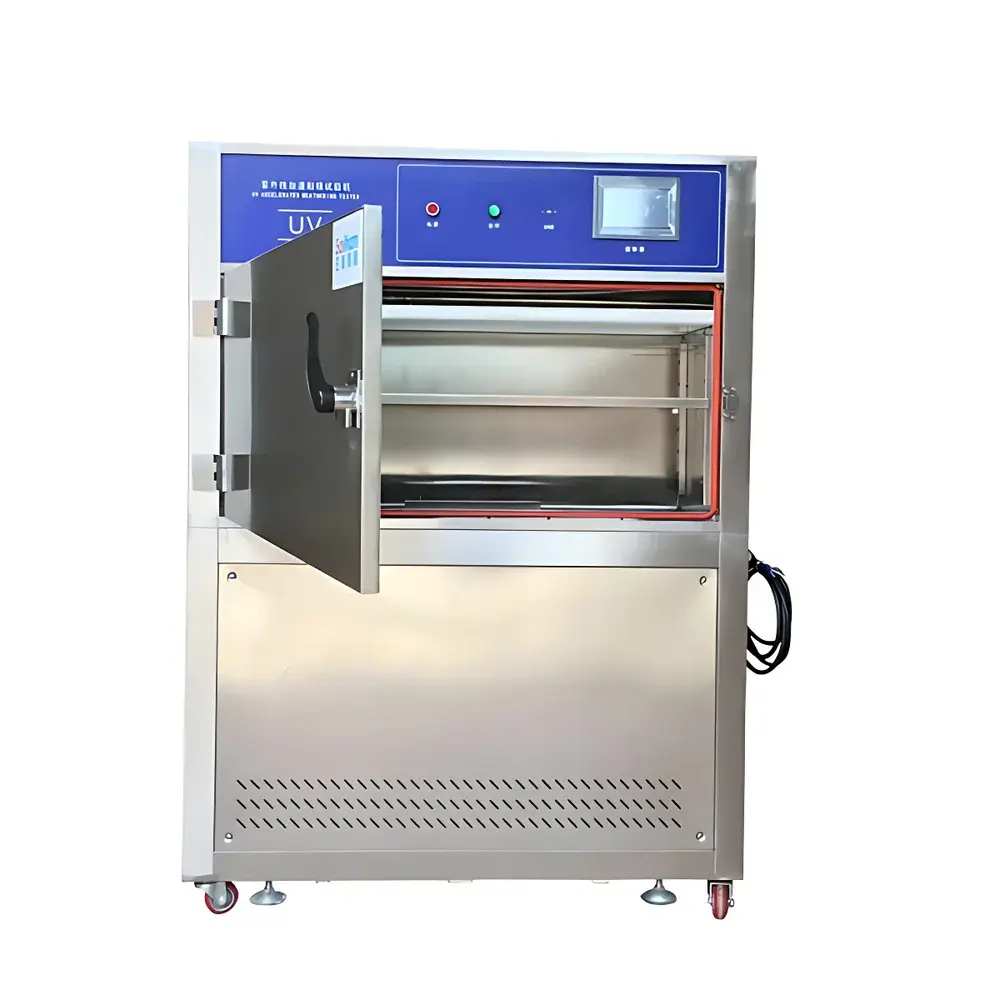
GBPI OUV-115 Benchtop UV Weathering Test Chamber
| Brand | GBPI |
|---|---|
| Origin | Guangdong, China |
| Manufacturer Type | Direct Manufacturer |
| Country of Origin | China |
| Model | OUV-115 |
| UV Lamps | 8 × UVA-340 (1200 mm × Φ38 mm, 40 W) |
| Irradiance Range | 0.35–1.0 W/m² |
| Wavelength Range (UVA-340) | 315–400 nm |
| Sample-to-Lamp Distance | 100 ± 10 mm (adjustable) |
| Temperature Range | RT+10°C to 70°C |
| Temp. Uniformity | ±3.0°C |
| Humidity | ≥93% RH (uncontrolled display) |
| Control System | 7-inch TFT color touchscreen, programmable & fixed-mode operation |
| Data Export | USB interface, Excel (.xlsx) + JPG curve export with zoom capability |
| Internal Dimensions | W1140 × H500 × D500 mm |
| External Dimensions | W1300 × H1560 × D600 mm |
| Power Supply | AC220V ±10%, 50/60 Hz, 4.5 kW (3 kW operational), grounded (ground resistance <4 Ω) |
| Compliance Standards | GB/T 16585-1996, GB/T 14522-2008, GB/T 16422.3-2014 |
| Safety Protections | Ground fault protection, overcurrent circuit breaker, fuse-protected control loop, low-water cutoff, overtemperature cutoff, dry-heater protection |
| Sample Restrictions | Not for flammable, explosive, volatile, corrosive, biological, or high-EMI-emitting specimens |
Overview
The GBPI OUV-115 Benchtop UV Weathering Test Chamber is an engineered solution for accelerated artificial weathering evaluation of polymeric, coating, and composite materials used in packaging, automotive, construction, and consumer goods industries. It replicates the photodegradative effects of solar ultraviolet radiation—primarily UVA (315–400 nm) and optionally UVB (280–315 nm)—combined with cyclic condensation, thermal stress, and high-humidity exposure. Based on the fluorescent UV lamp principle, the chamber employs eight parallel-mounted UVA-340 lamps (1200 mm length, 38 mm diameter, 40 W each), calibrated to emit spectral energy closely matching terrestrial sunlight below 400 nm. This enables standardized simulation of long-term outdoor degradation mechanisms—including polymer chain scission, pigment fading, surface chalking, and loss of mechanical integrity—in a controlled laboratory environment. The system operates under fully automated cycling protocols defined by internationally recognized test standards, eliminating manual intervention while ensuring repeatability across laboratories.
Key Features
- Stainless steel (SUS 304) construction—both interior and exterior—ensures corrosion resistance and long-term dimensional stability under humid, UV-intensive conditions.
- Single-loop air circulation system driven by axial fans, optimized for uniform temperature distribution (±3.0°C tolerance) and rapid thermal response.
- Water-jacketed inner chamber heating with auto-refill function prevents heater dry-out and ensures stable thermal ramping from ambient +10°C to 70°C.
- 7-inch full-color TFT touchscreen controller supporting both programmable multi-step cycles and fixed-mode operation; intuitive UI with real-time parameter monitoring and alarm logging.
- Integrated safety architecture: ground-fault protection, SSR-controlled overtemperature cutoff, dual-stage water-level sensing, short-circuit fusing on control circuits, and dedicated circuit breaker for main power feed.
- USB data export functionality: historical temperature/irradiance curves saved as scalable JPG images; time-stamped test logs exported in native Excel (.xlsx) format for traceability and audit readiness.
Sample Compatibility & Compliance
The OUV-115 accommodates flat-panel specimens up to 1140 mm wide × 500 mm deep × variable thickness (within 100 ± 10 mm lamp distance range). Its design complies strictly with Chinese national standards GB/T 16585-1996 (vulcanized rubber), GB/T 14522-2008 (plastics, coatings, elastomers), and GB/T 16422.3-2014 (plastics—fluorescent UV exposure). While not certified to ISO 4892-3 or ASTM G154 directly, its irradiance control, lamp geometry, and cycle definition align with the physical basis of those methods. The chamber excludes specimens posing safety hazards—including flammable, explosive, volatile organic, strongly corrosive, or biologically active materials—as mandated by IEC 61000-4-3 EMC guidelines and internal risk assessment protocols. All electrical components meet CE, FCC, and RoHS directives; mechanical design conforms to ISO 12100:2012 principles for machinery safety.
Software & Data Management
The embedded controller firmware supports GLP-compliant data handling: all operational events—including start/stop timestamps, setpoint changes, alarm triggers, and sensor deviations—are time-stamped and stored locally. USB export enables retrieval of raw datasets for statistical analysis in third-party tools (e.g., JMP, Minitab). Curve images retain original resolution and scaling metadata, permitting pixel-level measurement validation. No cloud connectivity or remote access is implemented—data sovereignty remains fully under user control. Audit trails are immutable once generated; no editing or deletion functions are exposed in the UI. Firmware updates require physical USB media and administrator authentication, consistent with FDA 21 CFR Part 11 Annex 11 expectations for regulated environments where electronic records serve as primary evidence.
Applications
This chamber serves quality assurance and R&D labs evaluating UV resistance of flexible packaging films (e.g., PET/AL/PE laminates), printed labels, inkjet inks, adhesive tapes, pharmaceutical blister foils, and food-grade barrier coatings. It supports comparative shelf-life modeling per ISTA 3A and ASTM D4332 conditioning protocols. In academic settings, it facilitates mechanistic studies on photo-oxidation kinetics using FTIR or XPS pre-/post-exposure analysis. Users routinely correlate OUV-115 exposure hours with field-aged samples via carbonyl index quantification or yellowness index (ASTM E313) tracking. Its compact footprint (1.3 m width) makes it suitable for ISO 17025-accredited labs with space-constrained environmental testing suites.
FAQ
What UV lamp types are supported, and how do they differ?
The standard configuration uses eight UVA-340 lamps (315–400 nm), optimized for solar-spectrum fidelity. UVB-313 and UVA-351 options are available upon request—UVB-313 induces faster degradation but with less environmental relevance; UVA-351 better simulates through-glass exposure.
Is humidity actively controlled or passively maintained?
Humidity is generated solely via condensation on cooled specimen surfaces during dark cycles; it is not independently regulated. The system achieves ≥93% RH during condensation phases but does not monitor or modulate RH as a closed-loop parameter.
Can test cycles be customized beyond standard norms?
Yes—the controller allows user-defined sequences combining UV irradiation, condensation, dark soak, and thermal hold steps, with independent duration and setpoint assignment per phase.
What maintenance is required for long-term calibration stability?
Lamp output degrades over time; GBPI recommends irradiance recalibration every 500 operational hours using a NIST-traceable UV radiometer. Stainless steel chambers require only periodic wipe-down with deionized water; no lubrication or filter replacement is needed.
Does the unit comply with ISO/IEC 17025 documentation requirements?
While the chamber itself is not accredited, its data export structure (time-stamped Excel logs, non-editable JPG curves, and event-driven alarm history) meets ISO/IEC 17025 clause 7.5.2 for record retention and traceability when integrated into an accredited lab’s quality management system.






