
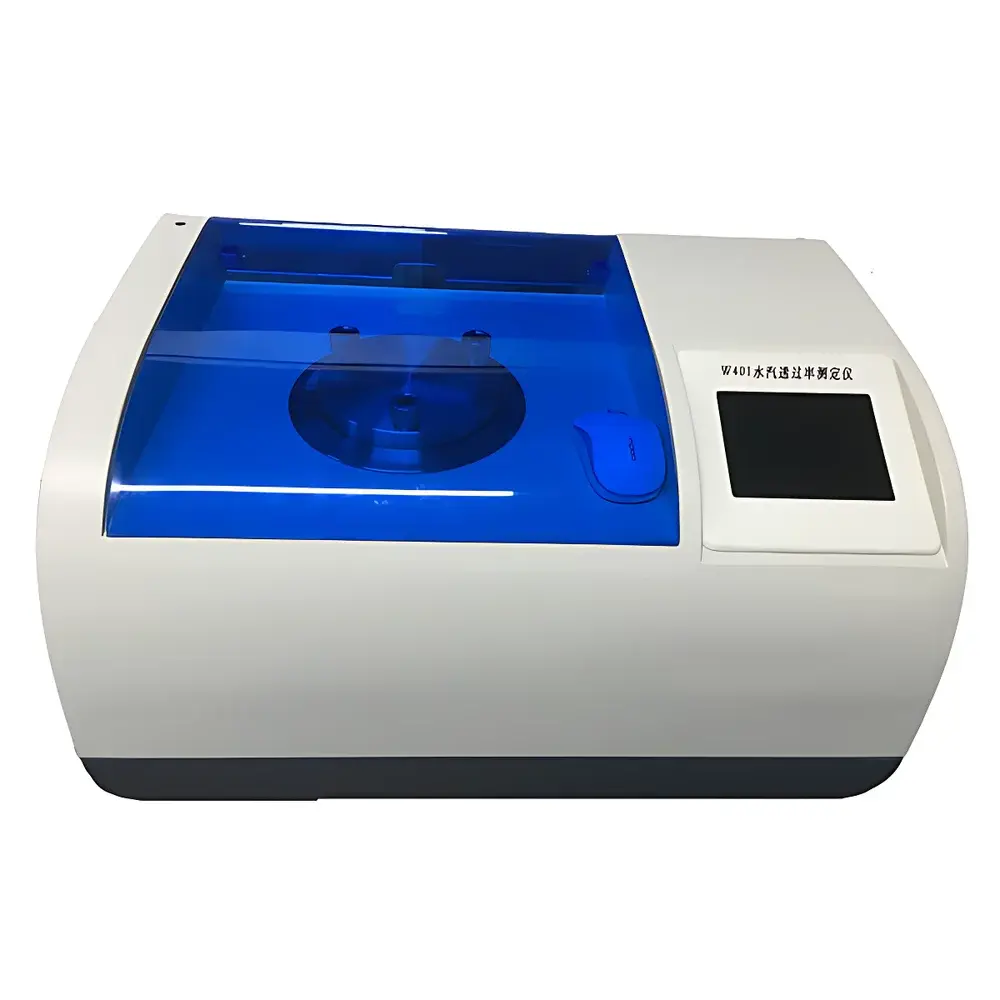
GBPI W201 Electrolytic Water Vapor Transmission Rate (WVTR) Tester
| Brand | GBPI |
|---|---|
| Model | W201 |
| Measurement Principle | Electrolytic Sensor Detection |
| Standard Compliance | GB/T 21529, ISO 15106-3, DIN 53122-2, YBB 00092003-2015, ASTM E 398 |
| WVTR Range | 0.001–100 g/(m²·24h) |
| Resolution | 0.001 g/(m²·24h) |
| Temperature Control | 15–45 °C (optional up to 60 °C), ±0.1 °C accuracy |
| Humidity Control | 0% RH and 30–90% RH, ±1% RH accuracy |
| Sample Area | 50.24 cm² (Φ100 mm) |
| Max Sample Thickness | ≤2 mm |
| Carrier Gas | Ultra-high-purity N₂ (99.999%), flow 0–100 mL/min, inlet pressure ≥0.1 MPa |
| Power Supply | 220 V, 50 Hz (110 V optional) |
| Dimensions | 610 × 550 × 400 mm |
| Weight | 80 kg |
Overview
The GBPI W201 Electrolytic Water Vapor Transmission Rate (WVTR) Tester is a precision-engineered instrument designed for quantitative determination of water vapor permeation through packaging materials and barrier structures under controlled temperature and humidity conditions. It operates on the electrolytic detection principle—where water molecules permeating through a conditioned test specimen are carried by a dry nitrogen carrier gas stream to a proprietary dual-electrode electrolytic sensor. The sensor generates a current proportional to the water vapor concentration, enabling high-sensitivity, real-time quantification of WVTR in units of g/(m²·24h). This method delivers superior long-term stability and low-drift performance compared to traditional coulometric or infrared-based systems, particularly for ultra-low-permeability materials such as metallized films, SiOₓ-coated substrates, and multilayer coextrusions widely used in pharmaceutical blister packaging, sterile medical device pouches, and high-end food packaging.
Key Features
- Electromagnetic precision temperature control with programmable ramping and ±0.1 °C stability across 15–45 °C (60 °C optional), eliminating external chiller requirements.
- Dual-stream humidity control architecture—separate humidified and desiccated gas paths—ensures stable, repeatable RH gradients (0%, 30–90% RH) with ±1% RH accuracy and no external humidifier dependency.
- Dual calibration protocols: certified reference membranes (traceable to NIST-equivalent standards) and certified zero-gas / span-gas standardization for sensor baseline verification and linearity validation.
- Automated test termination logic: self-detects equilibrium state via slope convergence analysis and halts measurement upon reaching steady-state diffusion conditions.
- Comprehensive system protection: over-range safeguarding, power-failure data retention with non-volatile memory, real-time error diagnostics, and operator guidance prompts for misalignment or seal failure.
- Modular software architecture with independent functional modules—test configuration, baseline acquisition, calibration management, report generation, and raw data export—supporting audit-ready documentation per GLP/GMP requirements.
- Standalone operation mode: embedded ARM-based controller enables full test execution, data logging, and local display without PC connection; USB interface supports firmware updates, encrypted data backup, and remote diagnostic logging.
- Two physically isolated test chambers permit concurrent evaluation of dissimilar specimens or cross-chamber validation studies—enhancing throughput while maintaining strict environmental isolation between tests.
Sample Compatibility & Compliance
The W201 accommodates flat sheet materials—including plastic films (e.g., PET, OPP, PE, PVDC), laminates, aluminum foils, metallized papers, glassine, ceramic substrates, and solar backsheet composites—as well as rigid and semi-rigid containers (bottles, trays, blister cavities, pouches) when used with optional fixture kits. All testing adheres strictly to internationally recognized barrier characterization standards: ISO 15106-3 (electrolytic sensor method), ASTM E 398 (standard test method for water vapor transmission of sheet materials), GB/T 21529 (Chinese national standard for plastic film WVTR), DIN 53122-2 (German standard for water vapor permeability), and YBB 00092003-2015 (Chinese pharmaceutical packaging regulation). Its design supports 21 CFR Part 11-compliant electronic records when deployed with validated software configurations, including user access controls, electronic signatures, and immutable audit trails.
Software & Data Management
The W201’s embedded operating system and optional PC-based software provide synchronized real-time visualization of WVTR, sensor current, chamber humidity, and temperature profiles. All parameters are logged at user-defined intervals (1–60 s) and stored with timestamped metadata—including operator ID, sample ID, calibration status, and environmental setpoints. Raw data exports support CSV and XML formats compatible with LIMS integration. Report templates comply with ISO/IEC 17025 documentation requirements and include uncertainty estimation per GUM guidelines. Software validation packages—including IQ/OQ documentation, traceable test scripts, and version-controlled release notes—are available upon request for regulated environments.
Applications
Primary applications span quality assurance and R&D in pharmaceutical packaging (blister foil integrity, vial stopper compatibility, IV bag barrier validation), food packaging (retort pouch shelf-life modeling, snack bag moisture ingress prediction), electronics encapsulation (flexible OLED moisture barrier qualification), medical devices (sterile barrier system validation per ISO 11607), and renewable energy (solar module backsheet durability assessment). Extended use cases include testing of battery enclosures for electrolyte containment, automotive fuel tank polymer liners, pharmaceutical bubble packaging, transdermal patch backing films, and single-use bioprocessing bags—where long-term moisture-induced degradation directly impacts product safety and efficacy.
FAQ
What carrier gas is required, and why must it be ultra-high-purity nitrogen?
Ultra-high-purity nitrogen (99.999%) is mandatory to prevent sensor poisoning and baseline drift caused by trace oxygen, hydrocarbons, or moisture in lower-grade gases. Impurities compromise electrolytic sensor response linearity and accelerate electrode degradation.
Can the W201 test irregular or three-dimensional packages without custom fixtures?
No—flat-sheet testing requires standardized circular samples (Φ100 mm). Container testing necessitates application-specific sealing fixtures (sold separately) to ensure leak-tight boundary conditions and uniform diffusion area definition.
Is the instrument compliant with FDA 21 CFR Part 11 for electronic records?
Yes—when configured with validated software, role-based access control, electronic signature capability, and full audit trail functionality, the W201 meets predicate rule requirements for regulated laboratory environments.
How often should sensor calibration be performed?
Daily baseline verification is recommended before first test; full two-point calibration using certified reference membranes is required after sensor replacement, major maintenance, or every 30 operational days—whichever occurs first.
Does the dual-chamber configuration allow comparative testing under identical environmental conditions?
Yes—both chambers share the same temperature and humidity control manifold, ensuring matched boundary conditions for statistically robust inter-material comparisons or method transfer studies.






