
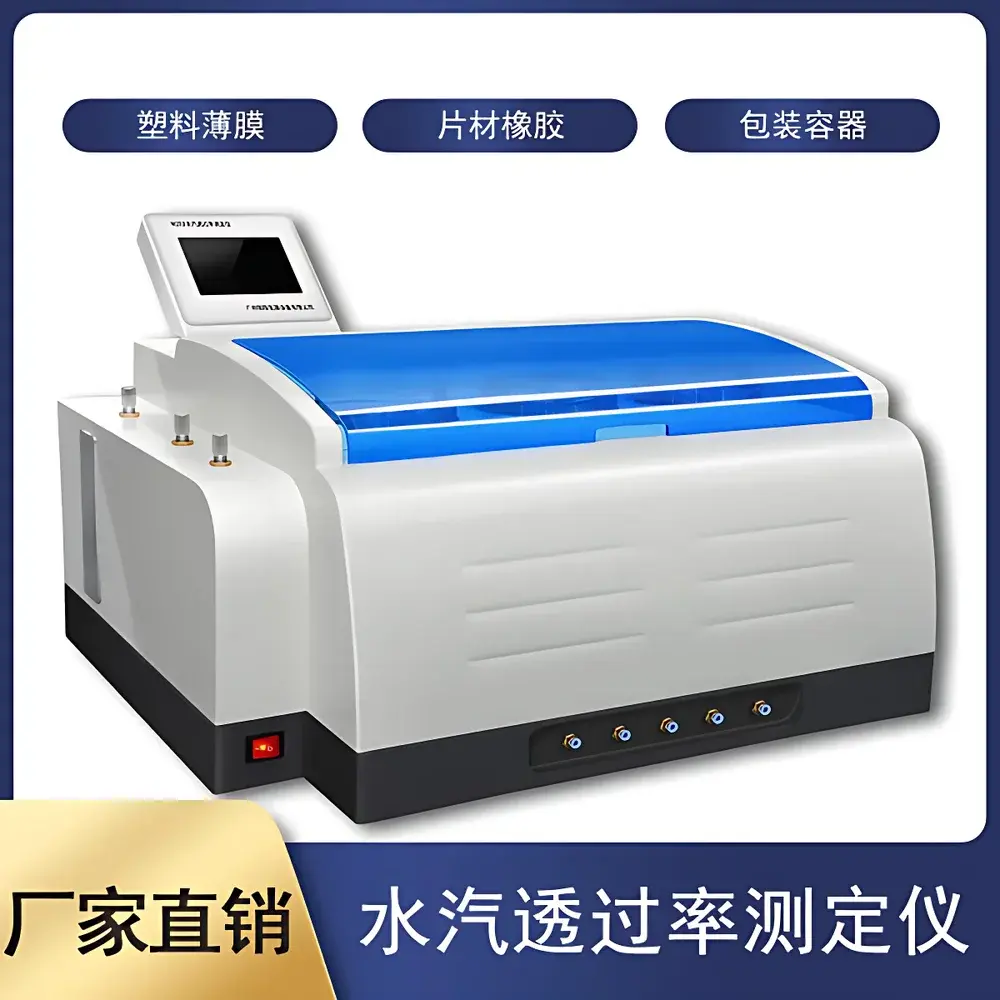
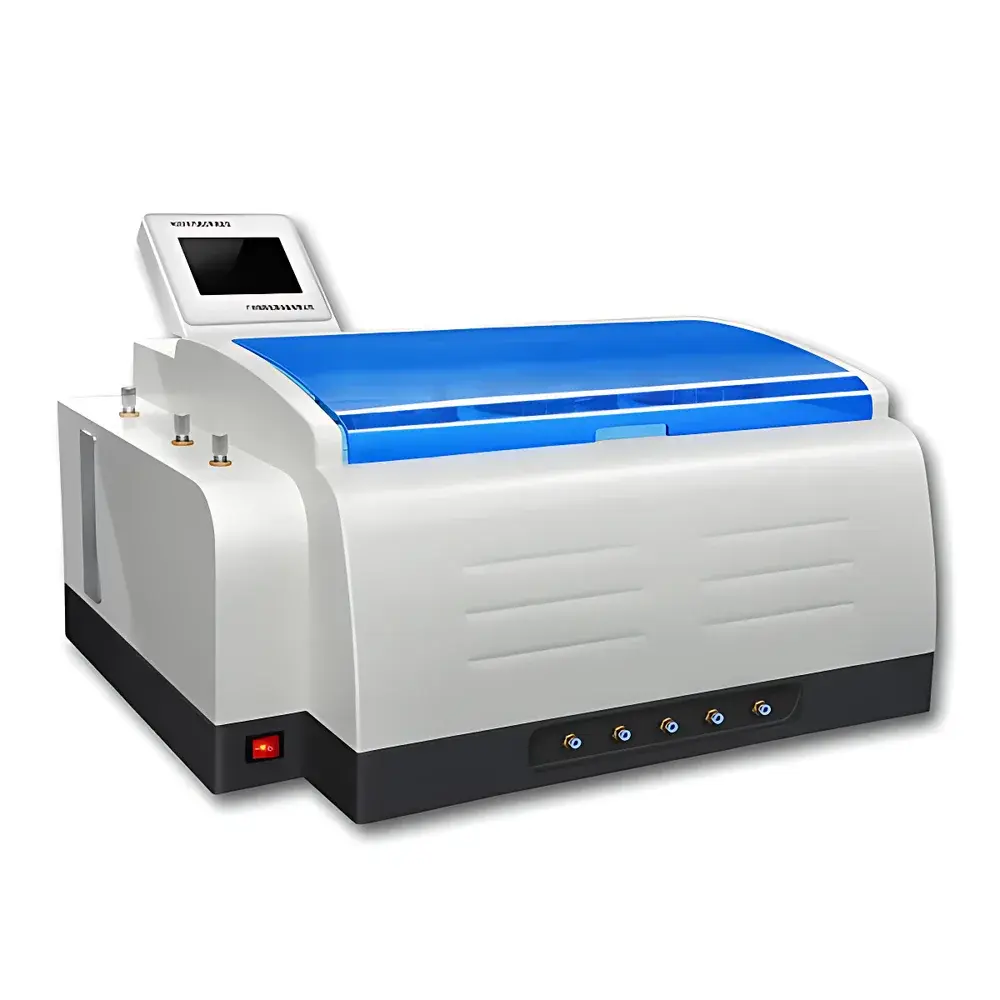
GBPI W203 Electrolytic Water Vapor Transmission Rate (WVTR) Tester
| Brand | GBPI |
|---|---|
| Origin | Guangdong, China |
| Manufacturer Type | Manufacturer |
| Country of Origin | Domestic (China) |
| Model | W203 |
| Pricing | Upon Request |
| Test Range | 0.001–50 g/(m²·24h) (films & sheets) |
| Test Accuracy | 0.001 g/(m²·24h) |
| Temperature Control Range | 15–45 °C |
| Temp. Stability | ±0.1 °C |
| Humidity Control Range | 0% RH (dry), 30–90% RH, 100% RH |
| Humidity Stability | ±1% RH |
| Test Area | 50.24 cm² |
| Specimen Diameter | Φ100 mm |
| Max. Specimen Thickness | ≤3 mm |
| Sample Capacity | 3 independent test chambers |
| Carrier Gas | 99.999% N₂ (user-supplied) |
| Gas Pressure | ≥0.1 MPa |
| Flow Rate | 0–100 mL/min |
| Interface | 1/8″ metal tubing |
| Dimensions | 670 × 550 × 400 mm |
| Weight | 57.1 kg |
| Power | 1000 W |
| Supply | AC 220 V, 50 Hz (110 V optional) |
Overview
The GBPI W203 Electrolytic Water Vapor Transmission Rate (WVTR) Tester is a precision-engineered instrument designed for quantitative determination of water vapor permeation through packaging and functional barrier materials under controlled temperature and humidity conditions. It operates on the principle of electrolytic detection—where water vapor diffusing across a specimen is carried by a dry nitrogen carrier gas stream to a high-sensitivity dual-electrode coulometric sensor. This sensor quantifies moisture concentration via Faraday’s law of electrolysis, enabling trace-level detection with inherent linearity and long-term stability. The instrument complies with internationally recognized standards including ISO 15106-3 (electrolytic detection method), ASTM E398-2013, GB/T 21529-2008, DIN 53122-2, and YBB00092003-2015, making it suitable for regulatory submissions in pharmaceutical, food, medical device, and renewable energy sectors.
Key Features
- Triple-chamber independent testing architecture: Three fully isolated test cells, each equipped with dedicated temperature/humidity sensors and electrolytic detectors—enabling concurrent evaluation of heterogeneous samples with autonomous start/stop control and individual report generation.
- High-resolution electrolytic sensing: Utilizes imported coulometric moisture sensors with detection limit of 0.001 g/(m²·24h), validated for ultra-low-permeability materials such as aluminum foil, PVDC-coated films, and SiOx/AlOx barrier coatings.
- Advanced environmental control: Electromagnetic stepwise temperature regulation (±0.1 °C stability) combined with dual-stream humidity generation (dry + humid gas mixing) ensures precise RH setpoints from 0% to 100% (±1% RH accuracy).
- Integrated ARM-based embedded system: Standalone operation via 7-inch color touchscreen; no external PC required for real-time monitoring of temperature, RH, sensor signal, and calculated WVTR curves.
- GMP-aligned software architecture: Role-based user access (Administrator, Operator, Viewer), full audit trail (system, method, and run-level), electronic signatures, and 21 CFR Part 11-compliant data integrity controls—including immutable raw data storage and change history logging.
- Modular hardware design: Sensor protection circuitry prevents over-range damage; field-replaceable modules simplify maintenance and reduce downtime.
Sample Compatibility & Compliance
The W203 accommodates a broad spectrum of geometries and material classes without modification: flat specimens (films, sheets, foils, papers, laminates), rigid containers (PET bottles, HDPE jugs, metal cans, glass jars), flexible packages (stand-up pouches, vacuum bags, blister cavities), and specialty components (solar backsheet substrates, lithium battery enclosures, transdermal patch films, sterile wound dressings, and automotive fuel tanks). Its standardized test area (50.24 cm²) and Φ100 mm clamping configuration conform to ISO 15106-3 requirements for planar samples. Optional fixtures enable ASTM F1249-compliant container testing per gravimetric or modulated IR methods. All calibration and verification procedures reference GBW(E)130543/4 certified national standard reference materials, traceable to NIM (National Institute of Metrology, China).
Software & Data Management
Embedded firmware supports customizable test protocols—including dynamic RH ramping, multi-point temperature profiling, and baseline drift compensation. Real-time visualization includes synchronized plots of temperature, relative humidity, sensor current output, and cumulative WVTR. Data are stored in an encrypted local SQLite database with automatic timestamping and operator ID tagging. Reporting modules generate compliant PDF or Office-compatible outputs featuring metadata (instrument ID, calibration date, environmental logs), statistical summaries (mean, SD, CV%), and graphical overlays for comparative analysis. Exported files retain full audit trail linkage and support LIMS integration via CSV or XML schema.
Applications
- Pharmaceutical packaging validation per USP and EU Annex 1 for moisture-sensitive dosage forms (e.g., lyophilized biologics, hygroscopic tablets, ophthalmic solutions in HDPE bottles).
- Food packaging shelf-life modeling—quantifying WVTR of retort pouches, coffee laminates, and modified atmosphere packaging (MAP) films.
- Solar photovoltaic module qualification—assessing edge-seal integrity and polymer backsheet permeability per IEC 61215-2 MQT 06.
- Battery enclosure certification—evaluating moisture ingress resistance of Li-ion cell housings to prevent electrolyte hydrolysis.
- Medical device barrier validation—testing sterile barrier systems (SBS) per ISO 11607-1 and wound contact layer permeability per ISO 10993-10.
- Automotive fuel system compliance—measuring hydrocarbon vapor transmission through polyethylene fuel tanks per SAE J1708.
FAQ
What standards does the W203 comply with?
It meets ISO 15106-3 (electrolytic detection), ASTM E398-2013, GB/T 21529-2008, DIN 53122-2, and YBB00092003-2015 for film and sheet testing; container testing follows ASTM F1249 principles with appropriate fixtures.
Is nitrogen gas included with the instrument?
No—99.999% pure nitrogen must be supplied externally via regulated gas source meeting ≥0.1 MPa pressure and 0–100 mL/min flow control.
Can the W203 test irregularly shaped containers?
Yes—using optional custom fixtures that maintain hermetic seal integrity while accommodating bottles, cups, trays, and tubs per ASTM F1249 methodology.
How is instrument calibration verified?
Using GBW(E)130543/4 certified national standard reference materials; calibration data is entered directly into the software interface to auto-adjust sensitivity coefficients.
Does the system support 21 CFR Part 11 compliance?
Yes—the software implements role-based authentication, electronic signatures, and comprehensive audit trails covering all data creation, modification, and deletion events.
Related Products





