
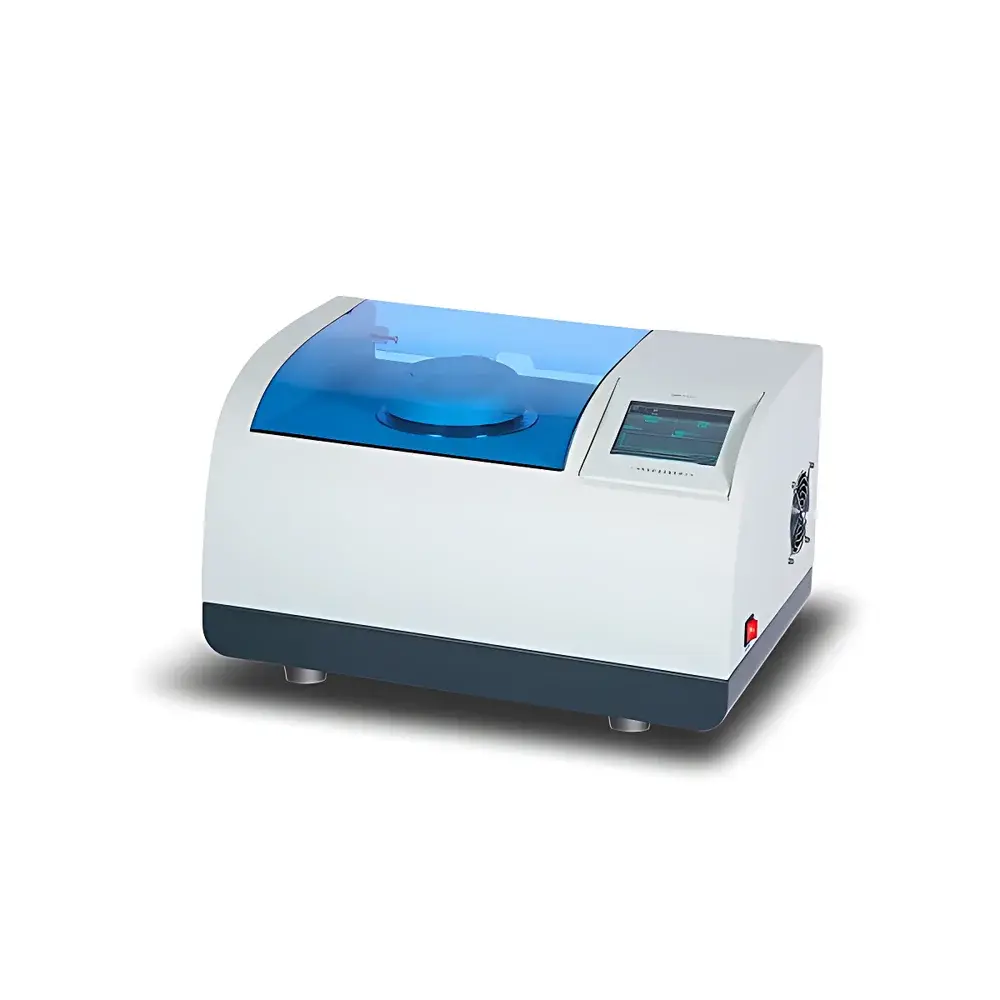
GBPI W401A Infrared Water Vapor Transmission Rate (WVTR) Tester
| Brand | GBPI |
|---|---|
| Model | W401A |
| Measurement Principle | Infrared Detection |
| Test Range | 0.001–100 g/(m²·24h) |
| Resolution | 0.001 g/(m²·24h) |
| Temperature Control | 15–45 °C (optional up to 60 °C), ±0.1 °C accuracy |
| Humidity Control | 30–90% RH (up to 100% RH), ±1% RH accuracy |
| Permeation Area | 50.24 cm² (down to 0.785 cm² with optional fixtures) |
| Sample Diameter | Φ100 mm |
| Max Sample Thickness | ≤3 mm |
| Carrier Gas | Ultra-high-purity N₂ (99.999%), 0.1 MPa min pressure, 5–120 mL/min flow |
| Power | 750 W, AC 220 V / 50 Hz |
| Dimensions | 600 × 400 × 330 mm |
| Weight | 80 kg |
Overview
The GBPI W401A Infrared Water Vapor Transmission Rate (WVTR) Tester is a precision instrument engineered for quantitative determination of water vapor permeation through packaging materials and functional barriers under controlled temperature and humidity conditions. It operates on the principle of infrared (IR) spectroscopic detection: water vapor molecules permeating through a test specimen are carried by a dry nitrogen carrier gas stream into an IR absorption cell, where their concentration is measured in real time based on characteristic absorption at 2.7 µm. This non-destructive, continuous-monitoring method delivers high reproducibility and traceable quantification without chemical reagents or consumables. Designed for compliance-driven environments—including pharmaceutical packaging, medical device sterilization barrier validation, and flexible electronics encapsulation—the W401A meets the metrological rigor required for GLP, GMP, and ISO 17025-accredited laboratories.
Key Features
- Infrared sensor architecture: High-stability, factory-calibrated IR detector with automatic over-range protection ensures long-term signal integrity and eliminates drift-related recalibration cycles.
- Programmable dual-gas humidity control: Independent dry- and wet-gas mixing system enables precise, stable RH setpoints from 30% to 100% RH (±1% RH accuracy), critical for evaluating moisture-sensitive barrier performance across regulatory climatic zones.
- Electromagnetic stepwise temperature regulation: Achieves ±0.1 °C thermal stability across 15–45 °C (extendable to 60 °C), supporting accelerated aging studies per ASTM F1249 Annex A3 and ISO 15106-2 Annex B.
- Modular permeation area configuration: Standard 50.24 cm² test area (Φ100 mm) with optional mini-fixtures enabling down to 0.785 cm²—essential for small-format samples such as OLED encapsulation films or transdermal patch backing layers.
- ARM-based embedded control system: Fully autonomous operation via 7-inch color touchscreen; no external PC required for routine testing, data logging, or report generation.
- GMP-compliant software architecture: Role-based user access (Administrator, Operator, Reviewer), full audit trail (system, method, and run-level), electronic signatures, and 21 CFR Part 11–ready data integrity controls.
Sample Compatibility & Compliance
The W401A accommodates rigid and flexible planar specimens up to 3 mm thick—including polymer films (PET, PE, PP), metallized laminates, aluminum foil, ceramic substrates, rubber elastomers, and coated paperboard—as well as non-planar containers (bottles, pouches, trays) when used with GBPI’s optional container test kits. Its measurement range (0.001–100 g/(m²·24h)) supports both ultra-high-barrier applications (e.g., PVDC-coated pharma blisters, solar backsheet ETFE layers) and highly permeable materials (hydrogels, breathable medical fabrics). The instrument conforms to multiple international standards: GB/T 26253–2010, YBB 00092003–2015 (China Pharmacopoeia), ISO 15106-2:2005, ASTM F1249–2013, and JIS K7129–2008. Certified reference materials (CRM) GBW(E)130543/4 are integrated into the calibration protocol, ensuring traceability to national metrology institutes.
Software & Data Management
GBPI’s proprietary WinWVTR software provides intuitive workflow management—from method creation and parameter scheduling to real-time visualization of temperature, RH, vapor concentration, and cumulative WVTR curves. All data are stored in an encrypted local SQLite database with timestamped metadata. Reports auto-generate in PDF or Office-compatible formats and include instrument ID, operator log, environmental conditions, calibration history, and statistical summaries (mean, SD, CV%). Raw data export supports third-party statistical analysis (e.g., JMP, Minitab). Audit trails record every user action—including login/logout, parameter edits, result overrides, and report exports—with immutable timestamps and user identifiers, satisfying FDA and EMA requirements for computerized system validation (CSV) and ALCOA+ data governance principles.
Applications
- Pharmaceutical packaging qualification per USP and ICH Q5C stability guidelines
- Medical device sterile barrier system (SBS) validation per ISO 11607-1
- Flexible electronics moisture ingress modeling for OLED, perovskite solar cells, and MEMS sensors
- Food packaging shelf-life prediction using Arrhenius-based WVTR acceleration
- Transdermal drug delivery patch backing layer permeability assessment
- Quality control of lithium-ion battery separator films and pouch cell laminates
FAQ
What carrier gas is required, and why must it be ultra-high-purity nitrogen?
Ultra-high-purity nitrogen (99.999%) is mandatory to eliminate background moisture and hydrocarbon interference that would distort IR absorbance readings. Impurities >1 ppm H₂O or CO₂ compromise baseline stability and lower detection limits.
Can the W401A measure WVTR of 3D containers without modification?
No—container testing requires GBPI’s dedicated W401A-C accessory kit, which includes custom sealing fixtures, pressure-balanced diffusion chambers, and volumetric correction algorithms per ASTM F1249 Annex D.
Is calibration traceable to national standards?
Yes—calibration uses GBPI-certified CRMs GBW(E)130543/4, accredited by China’s National Institute of Metrology (NIM), with documented uncertainty budgets compliant with ISO/IEC 17025:2017 Clause 6.6.
How does the system handle low-permeability materials like aluminum foil?
The W401A employs extended-duration, low-flow-rate protocols (5–20 mL/min) combined with high-sensitivity IR detection to resolve sub-0.01 g/(m²·24h) values with <5% RSD, validated per ISO 15106-2 Annex C.
Does the software support multi-user environments in shared laboratory networks?
Yes—WinWVTR supports concurrent network deployment with centralized database hosting, LDAP integration, and configurable domain-level authentication, enabling enterprise-wide instrument fleet management and cross-site data harmonization.





