
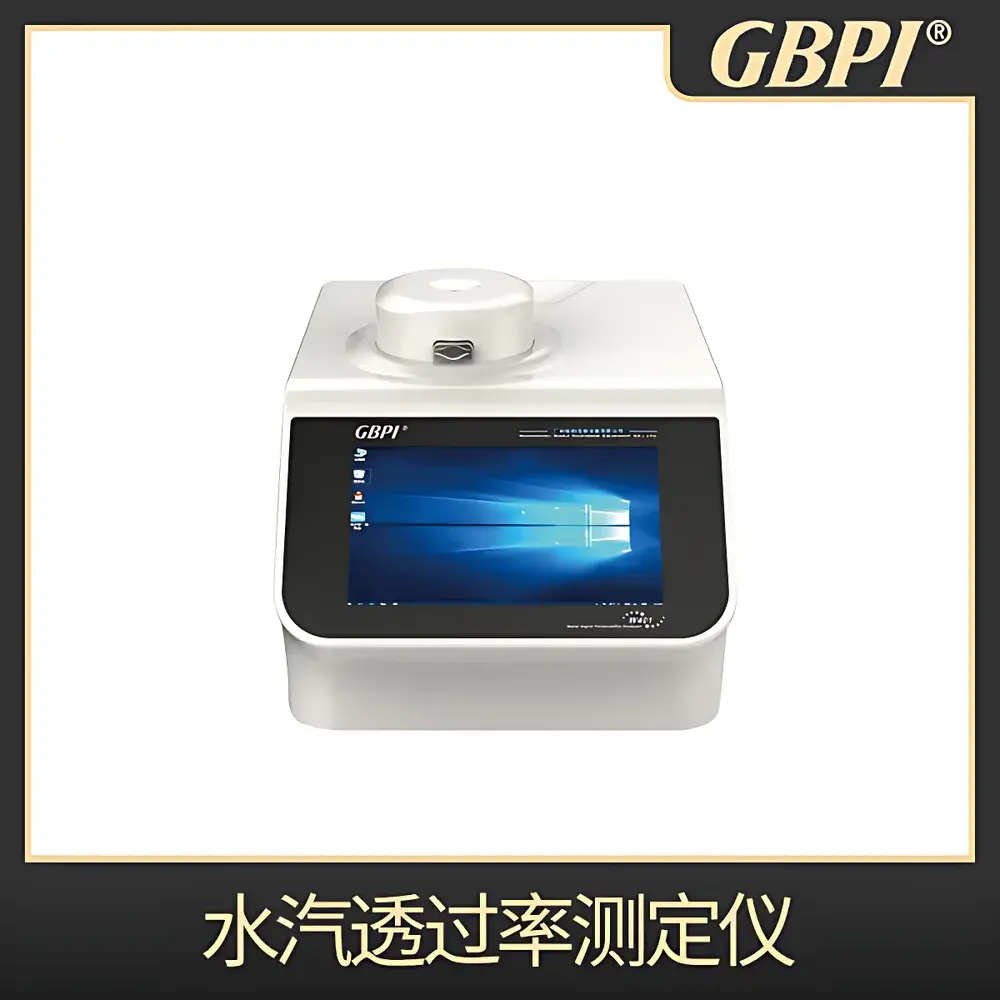
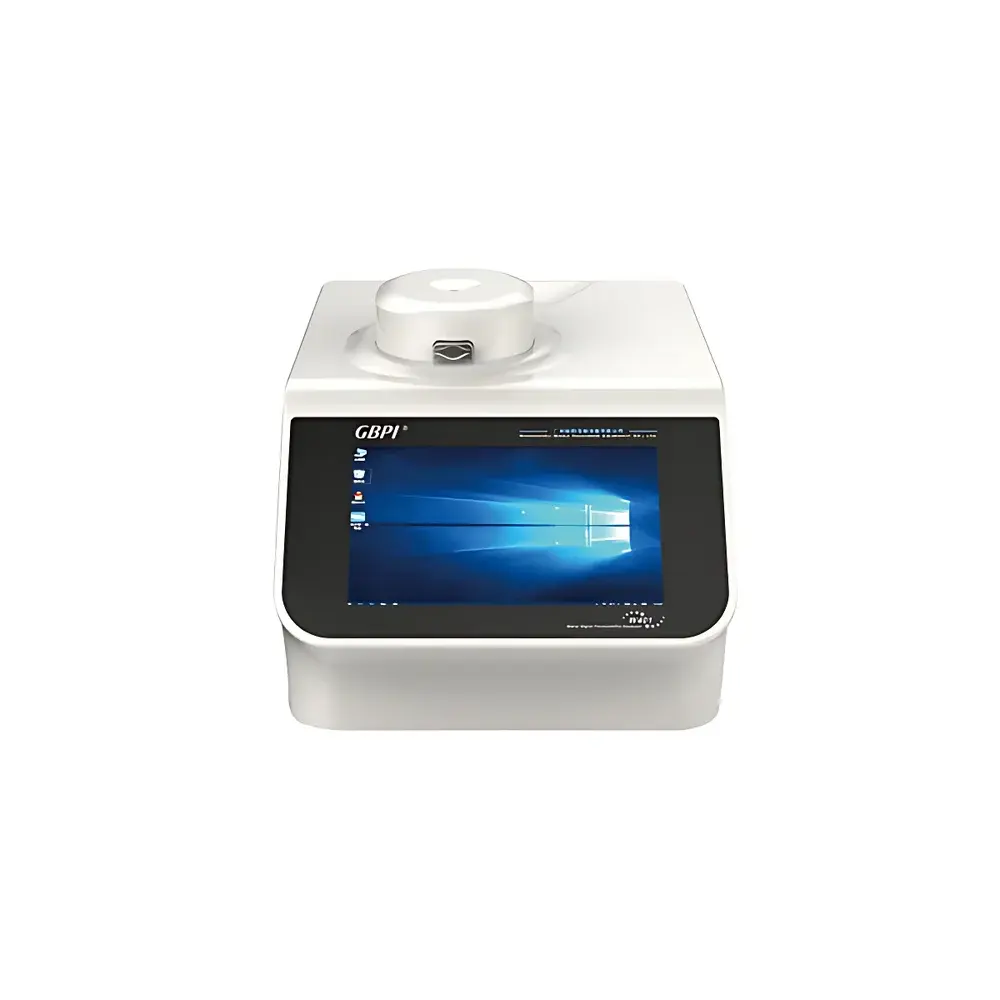
GBPI W401C Infrared-Based Water Vapor Transmission Rate (WVTR) Tester for High-Barrier Packaging Materials
| Brand | GBPI |
|---|---|
| Origin | Guangdong, China |
| Manufacturer Type | Direct Manufacturer |
| Origin Category | Domestic (China) |
| Model | W401C |
| Price Range | USD 14,000 – 28,000 |
| Test Principle | Infrared Moisture Detection |
| Standard Compliance | GB/T 26253 |
| Measurement Range | 0.002–500 g/(m²·24h) |
| Resolution | 0.001 g/(m²·24h) |
| Temperature Control Range | 15–45 °C |
| Temp. Accuracy | ±0.1 °C |
| Humidity Control Range | 0–100 %RH (dual-stream dry/wet gas method) |
| RH Accuracy | ±1 %RH |
| Permeation Area | 50.24 cm² |
| Specimen Diameter | Φ100 mm |
| Max. Specimen Thickness | ≤3 mm |
| Sample Capacity | 1 test chamber |
| Carrier Gas | ≥99.999% N₂ (user-supplied) |
| N₂ Pressure | ≥0.1 MPa |
| N₂ Flow Rate | 5–100 mL/min |
| Pneumatic Clamping Pressure | ≥0.3 MPa |
| Power | 750 W |
| Supply | AC 220 V, 50 Hz |
Overview
The GBPI W401C is a high-precision, infrared-based Water Vapor Transmission Rate (WVTR) tester engineered for quantitative assessment of moisture barrier performance in packaging and functional thin-film materials. It operates on the principle of non-dispersive infrared (NDIR) detection—where water vapor molecules traversing a test specimen are carried by a purified nitrogen stream into an infrared absorption cell; the concentration-dependent attenuation of IR radiation at 2.7 µm is converted into a mass flux value. This methodology ensures traceable, interference-free quantification without chemical consumables or sensor drift associated with coulometric or electrolytic sensors. Designed and validated per GB/T 26253—China’s national standard aligned with ISO 15106-3 (infrared detection method)—the W401C delivers metrologically sound data essential for regulatory submissions, shelf-life modeling, and material qualification in regulated industries including pharmaceuticals, medical devices, flexible electronics, and food packaging.
Key Features
- Infrared sensor architecture: High-stability NDIR detector with auto-zero compensation and over-range protection circuitry ensures >12-month baseline stability and eliminates calibration drift under continuous operation.
- Integrated environmental control: Dual-stream humidity generation (dry + saturated wet gas blending) enables precise, dynamic RH setpoint control from 0 to 100 %RH at ±1 %RH accuracy; electromagnetic step-programmable temperature control maintains chamber setpoints within ±0.1 °C across 15–45 °C.
- Single-chamber modular design: Optimized for high-barrier materials (e.g., Al foil, SiOx/AlOx-coated PET, PVDC laminates), achieving resolution down to 0.001 g/(m²·24h) with 50.24 cm² defined test area and pneumatic sample clamping (≥0.3 MPa).
- Standalone intelligent interface: 10.1″ color capacitive touchscreen HMI with embedded real-time plotting—simultaneously displays temperature, RH, WVTR, carrier gas flow, and supply voltage curves; supports on-screen curve toggle, zoom, and historical database query without external PC dependency.
- GMP-compliant software architecture: Complies with Annex 11 (EU GMP) and FDA 21 CFR Part 11 requirements—featuring role-based user access control, electronic signatures, audit trail logging (per-event timestamped records for test initiation, parameter change, result approval, report export), and immutable data storage.
Sample Compatibility & Compliance
The W401C accommodates rigid and flexible planar specimens up to 3 mm thickness and Ø100 mm diameter—including monolayer polymers (PET, PP, PE), metallized films (Al-coated OPP, PET), oxide-coated substrates (SiOx, AlOx), laminates (paper-Al-PE, PET/AL/PE), pharmaceutical blister foils, solar backsheet composites, OLED encapsulation films, transdermal patch backing layers, and molded packaging containers (e.g., thermoformed trays, pouches). All measurements adhere to GB/T 26253, which references ISO 15106-3 for instrument validation protocols and uncertainty budgeting. Certified reference materials (CRM) GBW(E)130543 and GBW(E)130544—issued by the National Institute of Metrology (NIM), China—are used for factory calibration and periodic verification, ensuring traceability to SI units via national primary standards.
Software & Data Management
GBPI’s proprietary WinWVTR v4.x software provides full lifecycle data governance: automated test sequence definition (pre-set or custom profiles), real-time statistical process monitoring (mean, SD, CV%), configurable pass/fail criteria, and PDF report generation with embedded metadata (operator ID, instrument serial, calibration status, environmental logs). All raw sensor outputs, intermediate calculations, and final results are stored in encrypted SQLite databases with SHA-256 hashing. Audit trails capture every system event—including login/logout, parameter modification, result override, and report export—with immutable timestamps and user attribution. Export formats include CSV (for LIMS integration), XML (for eCTD submissions), and password-protected PDF with digital signature fields compliant with ISO/IEC 17025 documentation requirements.
Applications
- Pharmaceutical packaging validation: Quantifying WVTR of blister lidding foils, cold-forming aluminum sheets, and child-resistant pouches per USP <671> and ICH Q5C stability guidance.
- Medical device packaging: Barrier verification of Tyvek®-based sterile barrier systems and peelable lidstocks for ISO 11607-1 compliance.
- Flexible electronics encapsulation: Screening of ultra-high-barrier films (WVTR < 10−6 g/m²·day) for OLED lighting panels and foldable display substrates.
- Food packaging R&D: Comparative analysis of bio-based films (PLA, PHA), nanocomposite coatings, and vacuum-metallized structures for shelf-life extension modeling.
- Quality control laboratories: Routine batch release testing with automated pass/fail flagging against internal specifications or ASTM F1249 (for comparative correlation).
FAQ
What calibration standards are supported?
The W401C is calibrated using GBW(E)130543 and GBW(E)130544 certified reference materials issued by China’s National Institute of Metrology. These CRMs are traceable to NIST SRM 1893 (water vapor permeation standard) via interlaboratory comparison.
Is nitrogen purity critical for measurement integrity?
Yes. Carrier gas must be ≥99.999% pure nitrogen (oxygen <1 ppm, moisture <0.1 ppm) to prevent spectral interference and baseline noise in the IR cell. GBPI recommends inline purifiers and dew point monitors for long-term operation.
Can the instrument test curved or non-planar packages?
No. The W401C is configured for flat-sheet specimens only. For 3D containers (bottles, cups), complementary gravimetric cup tests per ASTM E96 or ISO 2528 are recommended.
Does the system support 21 CFR Part 11 enforcement?
Yes. WinWVTR v4.x implements full electronic signature workflows, audit trail encryption, and role-based permissions—validated per IQ/OQ protocols included in the delivery package.
What maintenance intervals are recommended?
IR sensor zero-check: daily; NDIR cell purge: weekly; humidity generator desiccant replacement: every 6 months; full system verification with CRMs: annually or after major component service.





