
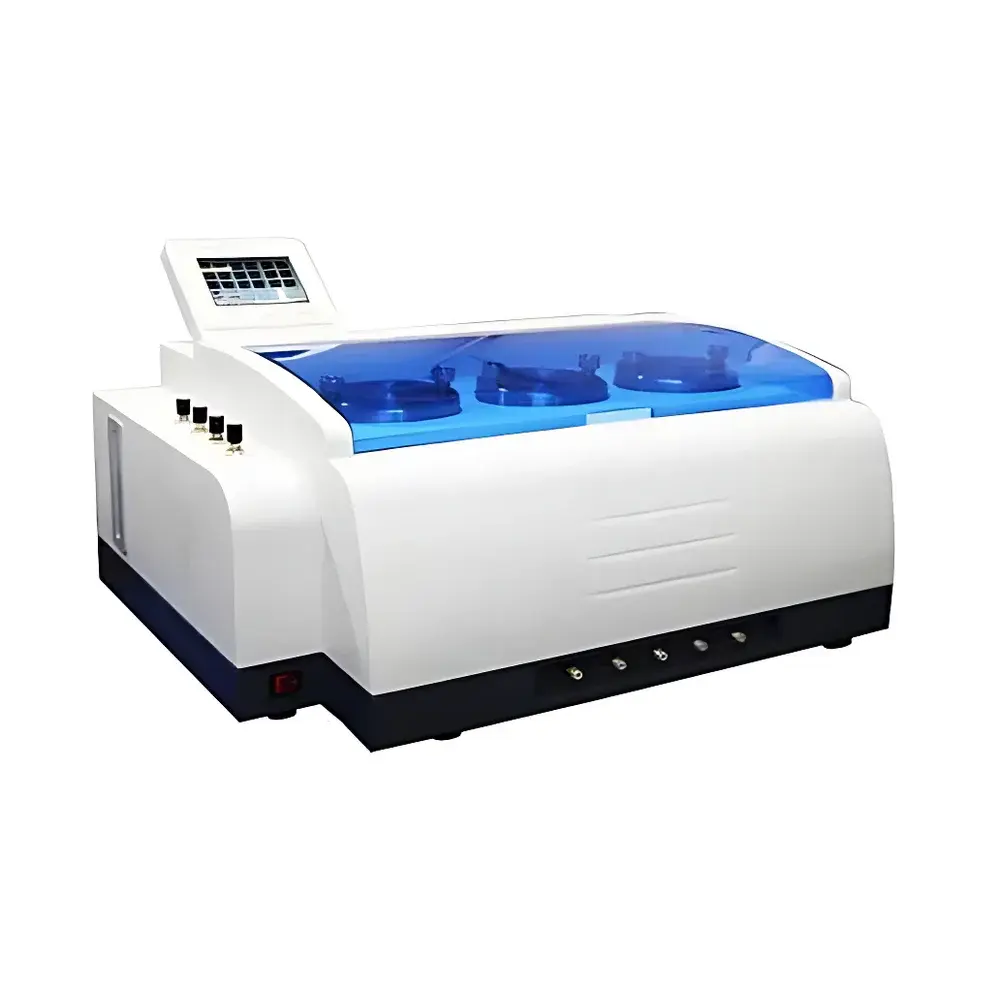
GBPI W403A Infrared Sensor-Based Water Vapor Transmission Rate (WVTR) Tester
| Brand | GBPI |
|---|---|
| Origin | Guangdong, China |
| Manufacturer Type | Direct Manufacturer |
| Country of Origin | China |
| Model | W403A |
| Moisture Permeation Range | 0.001–100 g/(m²·24h) |
| Resolution | 0.001 g/(m²·24h) (for films & sheets) |
| Temperature Control Range | 15–45°C (optional 5–55°C) |
| Temperature Accuracy | ±0.1°C |
| Humidity Control Range | 0% RH, 30–90% RH, 100% RH |
| Humidity Accuracy | ±1% RH |
| Specimen Quantity | 3 |
| Sensors | 3 infrared moisture sensors |
| Specimen Size | Φ100 mm (test area: 50.24 cm²) |
| Max. Specimen Thickness | ≤2 mm |
| Carrier Gas | Ultra-high-purity nitrogen (99.999%), ≥0.1 MPa pressure |
| Gas Flow Rate | 0–100 mL/min |
| Interface | 1/8″ stainless-steel tubing |
| Dimensions | 610 × 550 × 400 mm |
| Weight | 80 kg |
| Power | 220 V, 50 Hz (110 V optional) |
| Power Consumption | 500 W |
Overview
The GBPI W403A is a precision-engineered, dual-chamber infrared sensor-based water vapor transmission rate (WVTR) tester designed for rigorous barrier performance evaluation of packaging and functional materials in regulated industrial environments. It operates on the principle of modulated humidity gradient-driven permeation, compliant with the fundamental physical model described in ISO 15106-2:2017 — where water vapor diffuses across a test specimen under controlled relative humidity (RH) differential, and the transmitted vapor is quantified via calibrated non-dispersive infrared (NDIR) detection. Unlike gravimetric or electrolytic methods, the infrared sensor approach delivers real-time, continuous, and interference-free measurement of water vapor concentration in the carrier gas stream, enabling high reproducibility (<2% RSD per ASTM F1249 Annex A1) and minimal operator dependency. The instrument supports both flat specimens (films, sheets, foils) and rigid or flexible containers (bottles, pouches, trays), making it suitable for QC laboratories in pharmaceutical packaging, medical device sterilization packaging, food shelf-life modeling, photovoltaic backsheet qualification, and battery enclosure development.
Key Features
- Triple independent infrared moisture sensors with factory traceable calibration, ensuring long-term signal stability and cross-channel comparability.
- Electromagnetic PID temperature control system with programmable ramp-and-soak profiles; achieves ±0.1°C uniformity across dual test chambers without external chillers or heaters.
- Dual-stream humidity generation architecture: separates saturated and desiccated nitrogen flows to maintain precise RH gradients (0%, 30–90%, or 100% RH on high-humidity side) without external humidification modules — eliminating condensation risk and mechanical drift.
- Modular software architecture with fully decoupled functional modules: baseline acquisition, calibration (gas standard + certified reference film), test execution, real-time curve overlay (WVTR, RH, T, flow), and GLP-compliant reporting.
- Standalone operation capability: embedded Linux-based controller allows full test initiation, monitoring, and data logging without host PC connection; USB interface enables firmware updates, backup export, and diagnostic log retrieval.
- Dual-test-cavity design permits parallel or cross-comparison testing of two dissimilar materials under identical environmental conditions, improving throughput for formulation screening or supplier qualification.
- Comprehensive hardware safety logic: automatic shutdown on over-range detection, power-failure data retention (non-volatile memory), real-time error prompting for seal integrity failure or gas pressure drop.
Sample Compatibility & Compliance
The W403A accommodates standardized flat specimens (Φ100 mm, max. 2 mm thickness) and container formats including bottles (up to 2 L volume), pouches (with custom sealing fixtures), trays, and tubs. It complies with international regulatory test standards including ISO 15106-2 (infrared detection method), ASTM F1249 (standard test method for WVTR of plastic film and sheeting), TAPPI T557, JIS K7129, and GB/T 26253. Its measurement uncertainty profile has been validated against NIST-traceable moisture gas standards, and the instrument meets essential requirements for GLP and GMP-aligned environments — supporting audit-ready electronic records, user access control, and 21 CFR Part 11–compatible data integrity features when paired with optional validation packages.
Software & Data Management
The proprietary GBPI TestSuite v4.x software provides intuitive workflow navigation with role-based permissions, configurable pass/fail limits, and automated report generation in PDF/CSV/XLSX formats. All raw sensor outputs (voltage vs. time), environmental parameters (T, RH, flow), and calculated WVTR values are timestamped and stored with immutable metadata (operator ID, calibration status, chamber ID). Audit trails record every user action, parameter change, and calibration event. Data export supports LIMS integration via ODBC or direct file transfer. Optional IQ/OQ documentation kits and 21 CFR Part 11 compliance modules (electronic signatures, audit trail encryption, and electronic record retention policies) are available for pharmaceutical and medical device manufacturers requiring formal validation.
Applications
- Pharmaceutical packaging: blister foil lamination integrity, HDPE/PP bottle WVTR for lyophilized products, IV bag film compatibility, and sterile barrier system validation.
- Food packaging: shelf-life prediction for snack bags, coffee pouches, and retort pouches using accelerated WVTR correlation models.
- Photovoltaics: solar backsheet moisture ingress resistance assessment per IEC 61215-2 MQT10.
- Automotive: plastic fuel tank liner permeation testing per SAE J1742 and OEM-specific specifications.
- Battery technology: evaluation of moisture barrier performance in Li-ion battery cell enclosures and pouch laminates.
- Medical devices: water vapor transmission through wound dressings, transdermal patch backing layers, and sterilization wrap materials.
- Consumer packaging: cup stock, paperboard coatings, biodegradable film qualification, and hot-fill container performance.
FAQ
What carrier gas is required, and why must it be ultra-high-purity nitrogen?
Ultra-high-purity nitrogen (99.999%) is mandatory to prevent interference from ambient CO₂, hydrocarbons, or residual moisture in the carrier stream — all of which compromise NDIR sensor specificity and baseline stability. Impure gas introduces systematic bias and accelerates sensor contamination.
Can the W403A test irregularly shaped or non-planar containers?
Yes — with optional container test fixtures (e.g., bottle cradles, pouch clamps, and vacuum-seal adapters), the instrument supports ASTM F1249-compliant container testing by maintaining internal dry nitrogen purge while exposing the exterior surface to controlled humid air.
Is calibration traceable to national standards?
Yes — GBPI provides factory calibration certificates traceable to CNAS-accredited gas standards and certified reference membranes (e.g., NIST SRM 1921b analogues); users may perform in-house verification using supplied gas standard kits or certified films.
Does the system support 21 CFR Part 11 compliance?
Out-of-the-box functionality includes electronic signatures, audit trail logging, and data immutability. Full 21 CFR Part 11 compliance requires installation of the optional Validation Support Package and site-specific configuration per FDA guidance.
How is temperature and humidity uniformity verified across the test chamber?
Each chamber integrates dual platinum RTD sensors and capacitive RH probes; GBPI supplies a chamber mapping protocol (per ISO 17025 Annex C) for users to validate spatial uniformity during qualification.
Related Products





