
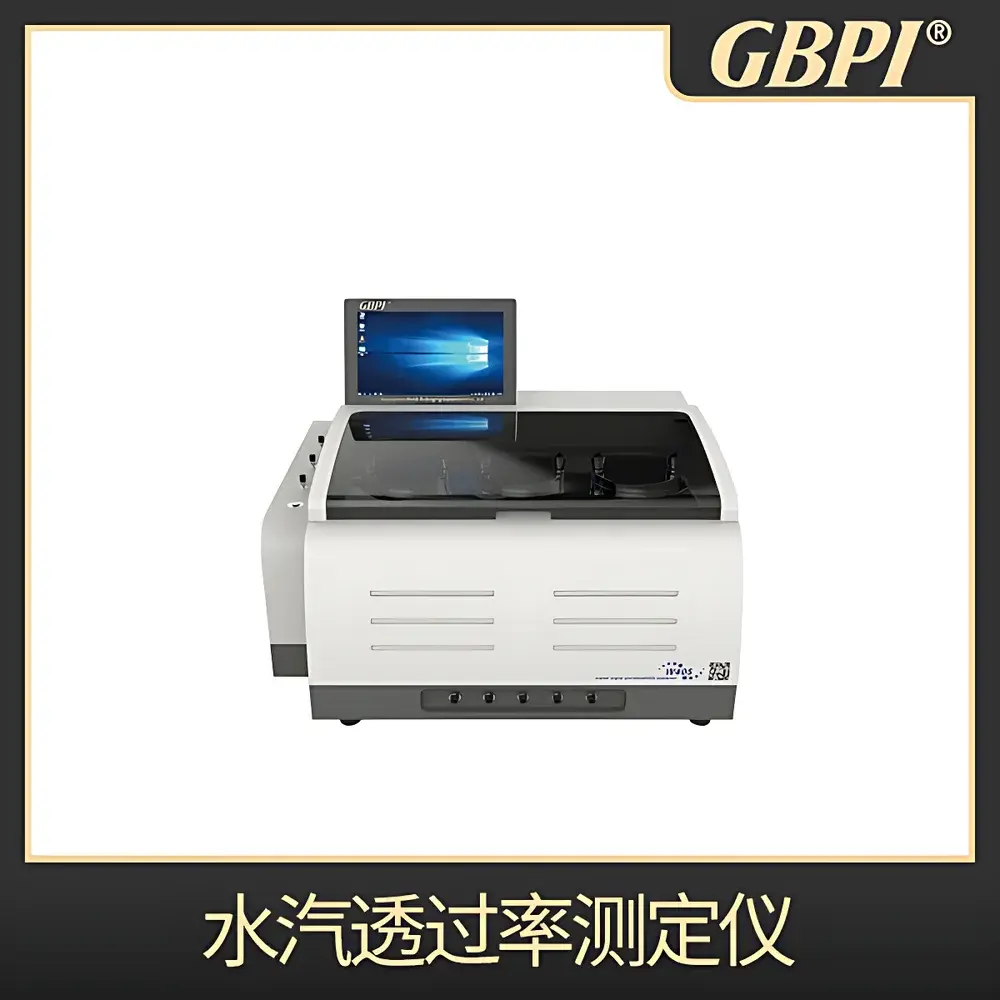
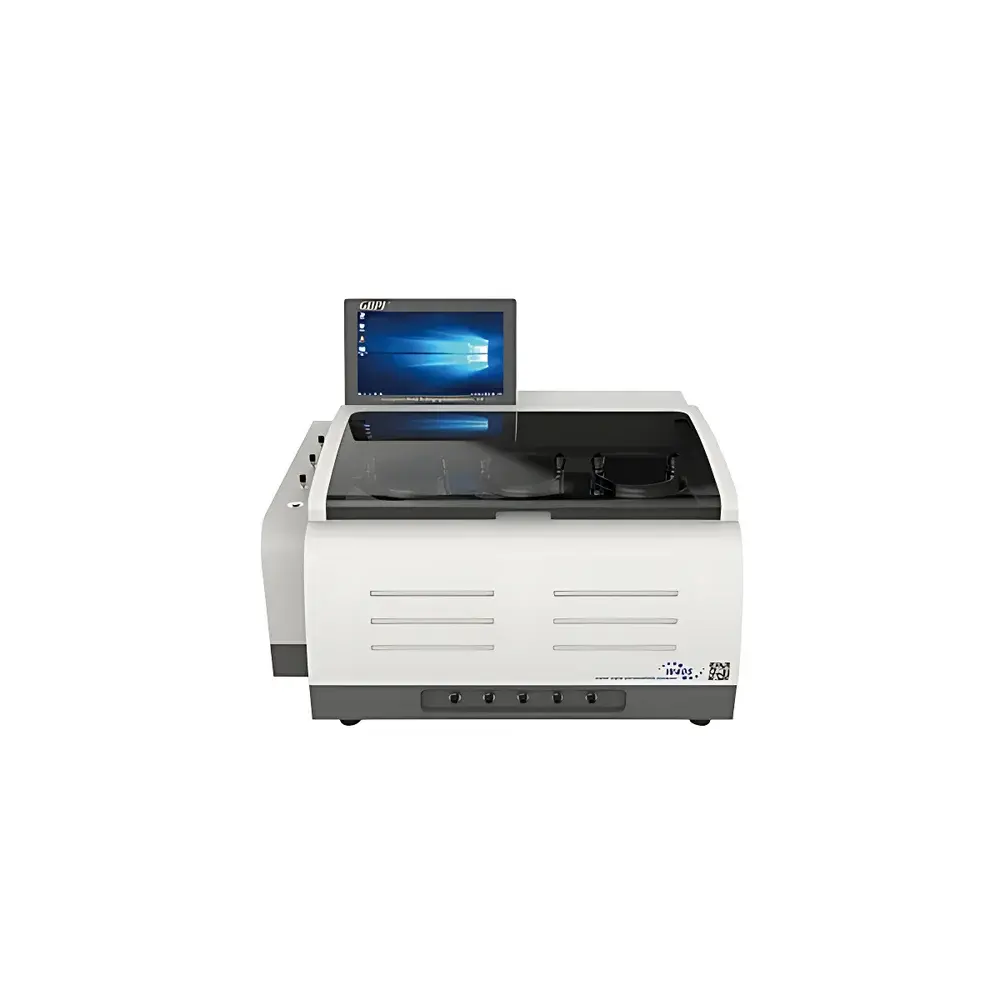
GBPI W405C Infrared Sensor-Based Water Vapor Transmission Rate (WVTR) Tester
| Brand | GBPI |
|---|---|
| Origin | Guangdong, China |
| Manufacturer | GBPI Packaging Instruments Co., Ltd. |
| Model | W405C |
| Measurement Principle | Infrared Absorption Spectroscopy |
| Standard Compliance | GB/T 26253-2010, ASTM F1249-2013, ISO 15106-2:2005, JIS K7129-2008, YBB 00092003-2015 |
| Test Range | 0.002–500 g/(m²·24h) |
| Resolution | 0.001 g/(m²·24h) |
| Temperature Control Range | 15–45 °C |
| Temperature Accuracy | ±0.1 °C |
| Humidity Control Range | 0–100 %RH (dual-stream dry/wet gas method) |
| Humidity Accuracy | ±1 %RH |
| Test Area | 50.24 cm² |
| Specimen Diameter | Φ100 mm |
| Max. Specimen Thickness | ≤3 mm |
| Carrier Gas | High-purity N₂ (≥99.999%, 0.1–0.6 MPa, 5–100 mL/min) |
| Power Supply | AC 220 V, 50 Hz, 750 W |
| Sample Capacity | 3 positions |
| Data Integrity | Audit trail, electronic signatures, 21 CFR Part 11–compliant software architecture |
Overview
The GBPI W405C Infrared Sensor-Based Water Vapor Transmission Rate (WVTR) Tester is an engineered metrological instrument designed for precise, traceable, and repeatable quantification of water vapor permeation through barrier materials. It operates on the principle of non-dispersive infrared (NDIR) absorption spectroscopy: a controlled humidity gradient is established across a planar specimen mounted in a dual-chamber test cell; water vapor diffusing through the sample is carried by a high-purity nitrogen stream into an infrared detection chamber, where its concentration is measured in real time via characteristic absorption at 2.7 µm. This first-principles analytical approach eliminates reliance on gravimetric equilibrium or electrochemical sensors—ensuring linearity, long-term sensor stability, and immunity to interference from CO₂, O₂, or volatile organic compounds. The system complies with ISO 15106-2 (infrared detection method), ASTM F1249 (for high-barrier films), and GB/T 26253—making it suitable for regulatory submission in pharmaceutical packaging validation, medical device packaging qualification, and food contact material compliance.
Key Features
- High-fidelity NDIR sensor calibrated against GBW(E)130543/4 certified reference materials—traceable to China’s National Institute of Metrology (NIM) and compliant with JJG 812–2016 calibration specifications.
- Integrated electromagnetic programmable temperature control (15–45 °C, ±0.1 °C accuracy) eliminating external chiller/heater units and reducing thermal lag and cross-chamber drift.
- Dual-stream humidity generation: independent dry-gas and saturated-wet-gas mass flow control enables stable, programmable RH setpoints from 0% to 100% RH (±1 %RH accuracy) without condensation or saturation artifacts.
- Modular pneumatic clamping system with Φ100 mm aperture and 50.24 cm² defined test area—supports rapid, reproducible sealing of rigid sheets, flexible laminates, and formed containers (e.g., blister cavities, pouches).
- Embedded 10.1″ capacitive touchscreen HMI with real-time overlay of five synchronized curves: temperature, RH, WVTR, carrier gas flow, and sensor voltage—enabling immediate process diagnostics without external PC dependency.
- GMP-aligned software architecture featuring role-based user permissions, electronic signatures (per 21 CFR Part 11 §11.200), automated audit trails (including parameter changes, test start/stop, report generation), and immutable database logging.
Sample Compatibility & Compliance
The W405C accommodates flat specimens up to 3 mm thick—including monolayer polymers (PET, PP, PE), metallized films (AlOx, SiOx, Al foil), multilayer coextrusions, paperboard laminates, and ceramic-coated substrates. It also supports formed packaging via custom fixture kits (e.g., cup-shaped test cells for trays, inverted lid configurations for bottles). Validated applications include: pharmaceutical blister packaging per USP and Ph. Eur. 5.2; solar backsheet WVTR qualification per IEC 61215-2 MQT10; medical transdermal patch barrier verification; and OLED encapsulation film testing under low-humidity (<5% RH) conditions. All hardware and firmware comply with IEC 61326-1 (EMC), IEC 61010-1 (safety), and ISO/IEC 17025–recommended instrument qualification protocols (IQ/OQ/PQ).
Software & Data Management
The GBPI LabSuite™ v4.2 software provides full lifecycle data governance. Test methods are stored as encrypted templates with version-controlled parameters (temperature ramp profiles, RH dwell times, flow rates). Raw sensor output is sampled at 10 Hz and archived in binary format with SHA-256 checksums. Reports conform to GLP/GMP requirements: each includes instrument ID, operator ID, calibration certificate numbers, environmental logs, curve overlays, statistical summaries (mean, SD, RSD%), and digital signature fields. Export formats include PDF/A-2b (archival), CSV (for LIMS integration), and XML (for eCTD submissions). Database encryption (AES-256) and optional Windows Active Directory integration ensure enterprise-grade access control.
Applications
- Pharmaceutical packaging: Quantifying moisture ingress into blister packs, sachets, and cold-form foil to support shelf-life modeling and ICH Q5C stability protocols.
- Flexible electronics: Measuring ultra-low WVTR (<0.005 g/m²·24h) in thin-film encapsulation layers for OLED displays and perovskite photovoltaics.
- Food packaging R&D: Benchmarking barrier performance of bio-based films (PLA, PHA) versus conventional PET/AlOx structures under accelerated aging conditions.
- Medical device packaging: Validating seal integrity and material permeability for sterile barrier systems per ISO 11607-1.
- Quality control laboratories: Routine release testing of incoming film rolls, laminates, and preformed containers using SOP-driven automated workflows.
FAQ
What standards does the W405C meet for regulatory submissions in the EU and US?
It fully supports ASTM F1249 (US), ISO 15106-2 (EU), and GB/T 26253 (China); software design conforms to FDA 21 CFR Part 11 and EU Annex 11 requirements for electronic records and signatures.
Can the system test rigid containers such as plastic bottles or aluminum cans?
Yes—via optional container test fixtures that maintain hermetic sealing while exposing only the sidewall or base surface to the humidity gradient.
Is nitrogen the only acceptable carrier gas?
High-purity nitrogen (≥99.999%) is required to avoid spectral interference; argon may be used in specific low-RH applications but requires revalidation per ISO 15106-2 Annex B.
How is sensor drift managed during extended operation?
The NDIR detector includes automatic zero-point compensation using periodic dry-gas purges, and calibration verification is triggered before each test batch using built-in reference gas pulses.
Does the system support 21 CFR Part 11-compliant audit trails out of the box?
Yes—the audit trail captures all user actions, parameter modifications, report approvals, and system events with timestamps, operator IDs, and reason-for-change fields—exportable as tamper-evident PDF or CSV.



