
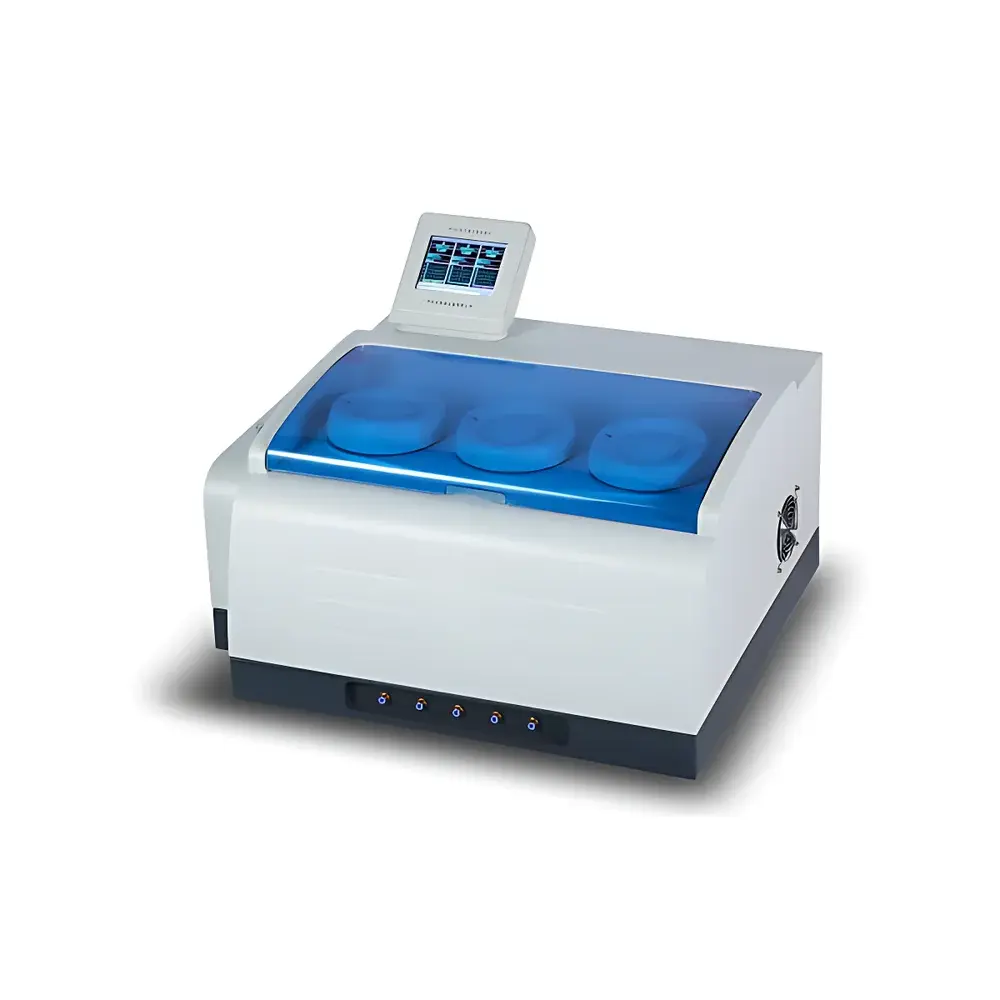
GBPI W405G Infrared Water Vapor Transmission Rate (WVTR) Tester
| Brand | GBPI |
|---|---|
| Origin | Guangdong, China |
| Manufacturer Type | Direct Manufacturer |
| Country of Origin | China |
| Model | W405G |
| Price Range | USD 14,000–28,000 |
| Test Range | 0.005–500 g/(m²·24h) |
| Measurement Accuracy | 0.001 g/(m²·24h) |
| Temperature Control Range | 15–45°C (optional up to 60°C) |
| Temp. Stability | ±0.1°C |
| Humidity Control Range | 30–90% RH (up to 100% RH optional) |
| Humidity Stability | ±1% RH |
| Test Area | 50.24 cm² (down to 0.785 cm² with optional fixtures) |
| Specimen Diameter | Φ100 mm |
| Max. Specimen Thickness | ≤3 mm |
| Sample Capacity | 1–3 independent chambers |
| Carrier Gas | Ultra-high-purity N₂ (≥99.999%), inlet pressure ≥0.1 MPa, flow rate 5–120 mL/min |
| Gas Fitting | 1/8″ stainless steel compression fitting |
| Dimensions | 700 × 560 × 370 mm |
| Weight | 80 kg |
| Power | 750 W, AC 220 V / 50 Hz (110 V available on request) |
Overview
The GBPI W405G Infrared Water Vapor Transmission Rate (WVTR) Tester is a gravimetrically referenced, dual-chamber, infrared detection-based instrument engineered for high-precision measurement of water vapor permeation through packaging materials and functional barriers. It operates on the principle of dynamic carrier gas transport coupled with non-dispersive infrared (NDIR) spectroscopy—where water vapor carried by a controlled nitrogen stream passes through a calibrated optical path, and its concentration is quantified via absorption at 2.6 µm wavelength. This method ensures trace-level sensitivity, minimal drift, and immunity to interference from CO₂ or hydrocarbons—critical for regulatory-compliant testing in pharmaceutical, medical device, and high-barrier electronics applications. Designed for ISO 15106-2:2005, ASTM F1249-2013, JIS K 7129:2008, TAPPI T557, and GB/T 26253-2010 compliance, the W405G delivers metrologically traceable results aligned with national standard reference materials certified under CNAS-accredited protocols (GBW(E)130543/4).
Key Features
- Triple independent test chambers enable concurrent, fully autonomous evaluation of up to three dissimilar specimens—with individual start/stop, real-time data logging, and separate report generation per chamber.
- ARM-based embedded control architecture supports standalone operation: no external PC required for routine testing; full functionality accessible via integrated 7-inch color touchscreen with intuitive workflow navigation.
- Dual-stream humidity generation system (dry + saturated gas mixing) achieves stable, programmable RH control from 30% to 100% RH at ±1% RH accuracy—validated across temperature gradients from 15°C to 60°C (±0.1°C stability).
- Infrared sensor with auto-range protection and long-term baseline drift compensation ensures >12-month calibration interval under continuous operation; sensor lifetime extended via over-range cutoff logic.
- GMP-aligned software architecture compliant with FDA 21 CFR Part 11 and EU Annex 11 requirements: role-based user access (Administrator, Operator, Reviewer), full audit trail (system, method, run-level), electronic signatures, and immutable database logging.
- Modular hardware design facilitates field serviceability—sensor modules, gas manifolds, and environmental control units are hot-swappable without recalibration.
Sample Compatibility & Compliance
The W405G accommodates flat specimens (films, foils, laminates, ceramics, elastomers) up to 3 mm thick and 100 mm in diameter, as well as rigid or flexible containers—including bottles, trays, pouches, and blister packs—via optional fixture kits. Its minimum test area of 0.785 cm² (using Φ10 mm sealing die) extends applicability to micro-scale barrier layers used in OLED encapsulation and transdermal patch development. All measurements adhere to internationally recognized standards for permeation testing: ISO 15106-2 specifies infrared detection methodology for plastic films; ASTM F1249 defines performance criteria for high-sensitivity WVTR instrumentation; and GB/T 26253 establishes metrological validation requirements for Chinese national certification. Instrument calibration is traceable to GBPI-certified standard reference membranes (125 µm polyethylene), with documented uncertainty budgets meeting ILAC-MRA equivalency.
Software & Data Management
The embedded WinCE-based platform provides real-time visualization of four synchronized parameter curves: chamber temperature, relative humidity, water vapor concentration (ppm), and cumulative transmission (g/m²·24h). Users configure multi-step test protocols—including pre-conditioning, baseline stabilization, active measurement, and post-test purge—via drag-and-drop sequence editor. All raw data are stored in encrypted SQLite databases with timestamped metadata (operator ID, method version, environmental logs). Reporting complies with GLP/GMP documentation standards: PDF and Office-compatible exports include instrument ID, calibration status, uncertainty statements, pass/fail flags against specification limits, and digital signature fields. Audit trails record every action—including parameter edits, result overrides, and user logins—with hash-verified immutability.
Applications
This instrument serves critical quality control and R&D functions across regulated industries. In pharmaceutical packaging, it validates moisture barrier integrity of cold-form blisters, sachets, and desiccant-lined vials—directly supporting stability protocol submissions per ICH Q1/Q5. For food packaging, it quantifies shelf-life limiting factors in retort pouches, vacuum-sealed trays, and metallized snack wrappers. In electronics, it characterizes moisture ingress resistance of thin-film encapsulants for flexible displays and perovskite solar cells. Additional use cases include permeation screening of wound dressings, transdermal drug delivery patches, and fuel cell proton exchange membranes—where sub-0.01 g/m²·24h resolution is essential.
FAQ
What carrier gas is required, and why must it be ≥99.999% pure nitrogen?
Ultra-high-purity nitrogen eliminates spectral interference in the IR detection band and prevents oxidation or contamination of sensitive sensor optics. Impurities such as moisture, oxygen, or hydrocarbons compromise baseline stability and introduce systematic bias.
Can the W405G test irregularly shaped or non-planar samples like injection-molded caps?
Yes—when equipped with custom cavity fixtures (sold separately), the system supports container testing per ASTM F1307 methodology, with sealed headspace conditioning and quantitative headspace moisture analysis.
Is third-party calibration support available?
GBPI provides ISO/IEC 17025-accredited calibration services, including on-site verification using NIST-traceable reference standards and uncertainty reporting per GUM guidelines.
How does the system ensure data integrity during power interruption?
All active test sessions auto-save to non-volatile memory every 10 seconds; upon recovery, the instrument resumes measurement from last valid timestamp without data loss.
Does the software support LIMS integration?
Yes—via configurable ODBC drivers and HL7-compliant export templates, enabling bidirectional data exchange with major laboratory information management systems (e.g., LabWare, STARLIMS, Thermo Fisher SampleManager).






