
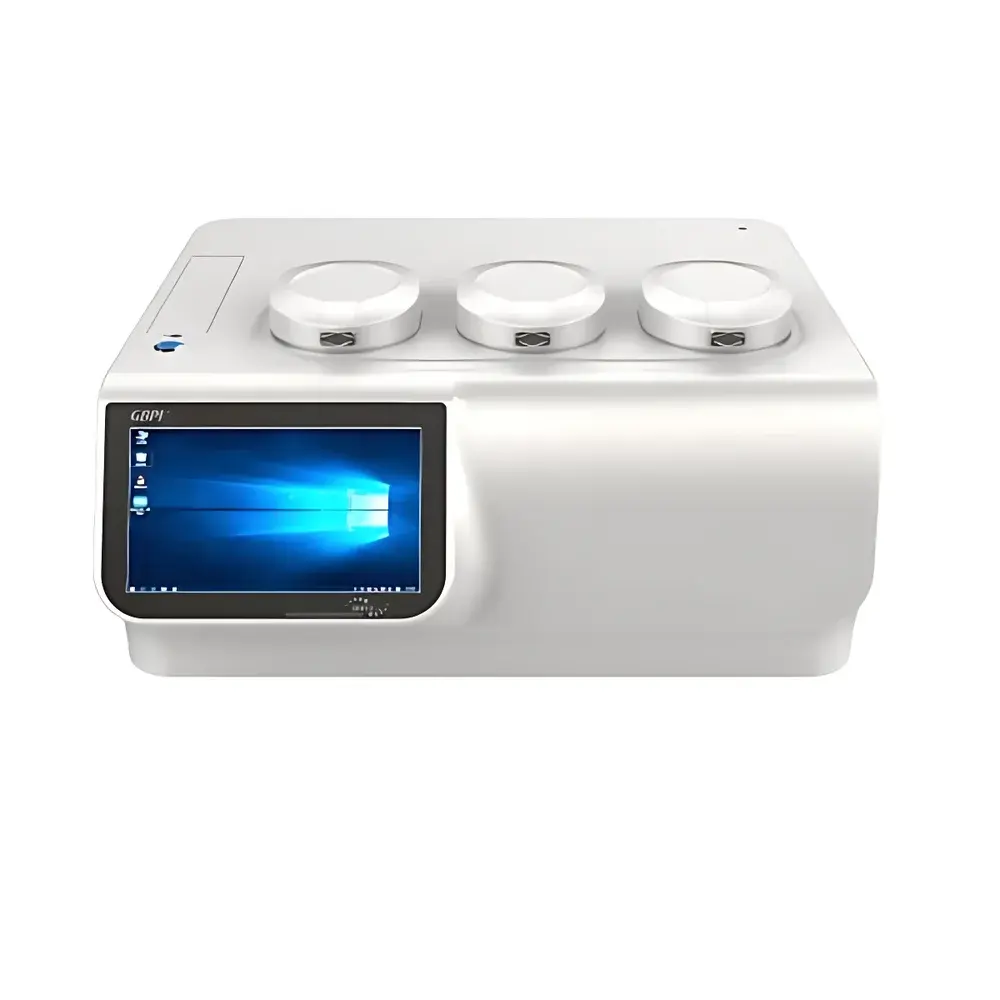
GBPI W413 2.0S Water Vapor Transmission Rate (WVTR) Tester
| Brand | GBPI |
|---|---|
| Origin | Guangdong, China |
| Manufacturer Type | OEM/ODM Manufacturer |
| Country of Origin | China |
| Model | W413 2.0S |
| Price Range | USD 42,000 – 70,000 |
| Test Principle | Infrared Moisture Detection |
| Standards Compliance | GB/T 26253-2010, ASTM F1249-2013, ISO 15106-2:2005, JIS K7129-2008, YBB 00092003-2015 |
| Measurement Range | 0.002–500 g/(m²·24h) |
| Resolution | 0.001 g/(m²·24h) |
| Temperature Control Range | 15–45 °C |
| Temp. Accuracy | ±0.1 °C |
| Humidity Control Range | 0% (dry gas), 30–90% RH, and 100% RH |
| Humidity Accuracy | ±1% RH |
| Test Area | 50.24 cm² |
| Specimen Diameter | Φ100 mm |
| Max. Specimen Thickness | ≤3 mm |
| Sample Capacity | 3 specimens per cycle |
| Carrier Gas | Ultra-high-purity N₂ (99.999%), ≥0.1 MPa supply pressure, 5–100 mL/min flow rate |
| Pneumatic Clamping Pressure | ≥0.3 MPa |
| Power | 750 W, AC 220 V / 50 Hz |
Overview
The GBPI W413 2.0S Water Vapor Transmission Rate (WVTR) Tester is an engineered solution for precise, traceable, and regulatory-compliant measurement of water vapor permeation through packaging and barrier materials. It operates on the principle of infrared moisture detection—where water vapor diffusing across a test specimen is carried by a dry nitrogen purge gas stream into a high-sensitivity IR sensor. The sensor quantifies absolute moisture concentration in real time, enabling direct calculation of WVTR in g/(m²·24h) without gravimetric weighing or desiccant-based indirect methods. Designed in strict accordance with GB/T 26253-2010 and harmonized international standards—including ASTM F1249-2013, ISO 15106-2:2005, and JIS K7129-2008—the instrument delivers metrologically sound data suitable for quality control, regulatory submissions, and material development workflows in pharmaceutical, food, medical device, and electronics packaging sectors.
Key Features
- Infrared sensor architecture: High-stability, drift-compensated IR detector with auto-range protection and extended operational lifetime under continuous use.
- Integrated environmental control: Dual-gas humidity generation (dry + saturated streams) enables stable, programmable RH setpoints from 0% to 100% RH with ±1% RH accuracy; electromagnetic step-programmable temperature control maintains chamber uniformity within ±0.1 °C across 15–45 °C.
- Modular pneumatic clamping system: Motor-driven, pressure-regulated (≥0.3 MPa) sample sealing ensures repeatable contact integrity for films, foils, laminates, and rigid containers—compatible with specimens up to 3 mm thick and Ø100 mm diameter.
- Self-contained operation: 10.1-inch capacitive touchscreen interface eliminates dependency on external PCs; real-time visualization of five synchronized curves (temperature, RH, WVTR, carrier gas flow, supply voltage) with toggle visibility and zoom functionality.
- GMP-aligned software architecture: Role-based user access control, electronic signatures, audit trail (21 CFR Part 11 compliant), and immutable test logs—including timestamped parameter changes, operator ID, and result modifications.
Sample Compatibility & Compliance
The W413 2.0S accommodates a broad spectrum of planar and form-fill-seal specimens: flexible polymer films (e.g., PET, PE, PP, EVOH), metallized and aluminum foil laminates, barrier-coated papers, silicone elastomers, ceramic substrates, and preformed packaging (bottles, trays, pouches). Its 50.24 cm² active test area and triple-sample capacity support statistical validation per ISO/IEC 17025 requirements. Regulatory alignment extends beyond physical testing standards: firmware and software are validated per ICH Q9/Q10 principles; calibration traceability is maintained via GBW(E)130543/4 certified reference materials issued by China’s National Institute of Metrology—ensuring equivalence with NIST-traceable WVTR standards used in FDA-reviewed dossiers.
Software & Data Management
GBPI’s proprietary WinWVTR v3.2 software provides full lifecycle data governance. Test protocols are configurable via intuitive wizards—supporting multi-step RH/temperature ramps, dynamic endpoint detection, and pass/fail threshold logic. All raw sensor outputs, environmental logs, and calculated WVTR values are stored in an embedded SQLite database with SHA-256 hash integrity verification. Reports comply with GLP and GMP Annex 11 requirements: PDF export includes metadata (instrument ID, calibration due date, operator signature, audit trail summary), digital watermarking, and optional QR-coded traceability links. Data backup supports network share, USB, and encrypted cloud sync with TLS 1.3 encryption.
Applications
- Pharmaceutical primary packaging qualification (blister foils, cold-forming films, child-resistant pouches) per USP and YBB 00092003-2015.
- Food packaging shelf-life modeling—quantifying moisture ingress into dried foods, confectionery, and nutraceuticals.
- Medical device packaging validation (ISO 11607-1), including Tyvek®/PET laminates and sterilization pouches.
- Advanced material R&D: solar backsheet durability assessment, OLED encapsulation barrier performance, transdermal patch adhesion layer permeability.
- Supplier qualification audits where certified WVTR data must be reproducible across laboratories using identical reference materials and procedures.
FAQ
What carrier gas specifications are required for optimal sensor performance?
Ultra-high-purity nitrogen (99.999% purity, hydrocarbon-free) is mandatory. Supply pressure must remain ≥0.1 MPa; flow is dynamically regulated between 5–100 mL/min depending on test conditions and specimen permeability.
Can the instrument test non-planar or 3D containers?
Yes—optional custom fixtures enable testing of cups, bottles, and trays using volumetric headspace analysis mode, with results normalized to surface area per ISO 15106-3.
Is hardware calibration traceable to international standards?
All factory calibrations use GBW(E)130543/4 certified moisture permeation standards, accredited by CNAS (China National Accreditation Service) and cross-validated against NIST SRM 2812 reference materials.
How is data integrity ensured during power interruption or software crash?
The system implements atomic write operations and journaling file system (JFFS2) on internal flash storage—guaranteeing zero data loss even during unexpected shutdowns.
Does the software support IQ/OQ/PQ protocol templates?
Preconfigured validation packages—including installation qualification checklists, operational qualification test scripts, and performance qualification acceptance criteria—are included and editable per client SOP requirements.






