
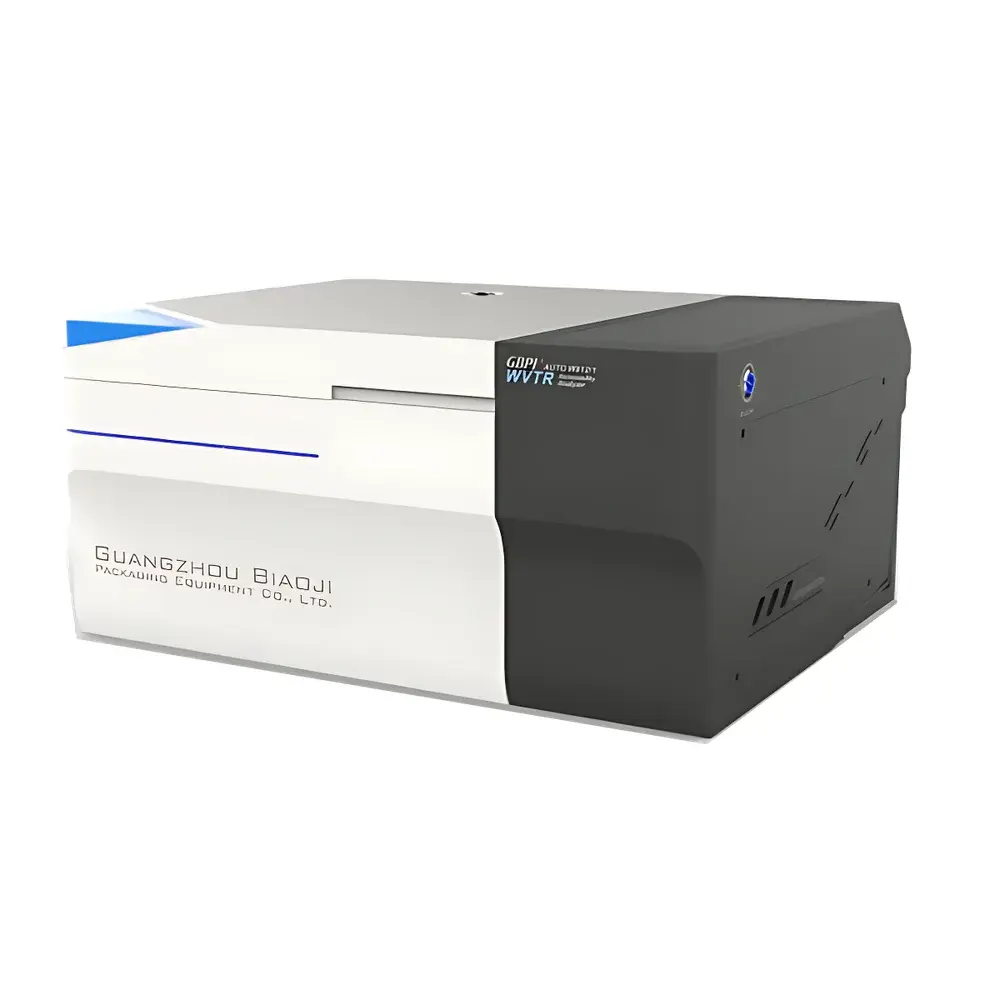
GBPI W812 Gravimetric Water Vapor Transmission Rate (WVTR) Tester
| Brand | GBPI |
|---|---|
| Origin | Guangdong, China |
| Manufacturer Type | Original Equipment Manufacturer (OEM) |
| Country of Origin | China |
| Model | W812 |
| Price | USD 55,000 (FOB Guangzhou) |
| Testing Principle | Gravimetric Cup Method (ASTM E96 / GB/T 1037) |
| Test Range | 0.05–10,000 g/(m²·24h) |
| Resolution | 0.0001 g/(m²·24h) |
| Test Stations | 12 |
| Balance Capacity | 220 g |
| Balance Readability | 0.1 mg (optional 0.01 mg) |
| Temperature Control Range | 10–50 °C ±0.1 °C |
| Humidity Control Range | 5–90 %RH ±2 %RH |
| Air Velocity | 0.3–2.5 m/s (optional low-flow 0.03–0.5 m/s) |
| Test Area | 33 cm² |
| Specimen Diameter | Φ74 mm |
| Max. Specimen Thickness | ≤3 mm |
| Test Modes | Gravimetric Gain & Loss Methods |
| Carrier Gas | Compressed Air ≥0.6 MPa |
| Dimensions | 830 × 670 × 440 mm |
| Weight | 75 kg |
| Power Supply | AC 220 V, 50 Hz |
| Compliance | ChP 2025 <4010>, ASTM E96, ASTM D1653, ISO 2528, GB/T 1037, GB/T 16928, GB/T 17146, GB/T 12704, GB/T 19082, GB/T 21332, TAPPI T464, DIN 53122-1, YBB00092003 |
Overview
The GBPI W812 Gravimetric Water Vapor Transmission Rate (WVTR) Tester is an engineered solution for precise, reproducible measurement of water vapor permeation through packaging and barrier materials. It operates on the standardized gravimetric cup method—where a test specimen seals a cup containing either desiccant (gain method) or distilled water (loss method)—and quantifies mass change over time under controlled environmental conditions. This principle aligns with internationally recognized protocols including ASTM E96, ISO 2528, and the 2025 Chinese Pharmacopoeia , ensuring regulatory acceptability across pharmaceutical, food, medical device, and personal care industries. The instrument delivers high-resolution data across an exceptionally broad dynamic range (0.05–10,000 g/(m²·24h)), enabling characterization of both ultra-high-barrier films (e.g., AlOx-coated PET) and highly permeable substrates (e.g., nonwovens or hydrophilic hydrogels). Its dual-mode capability (gain/loss), 12-station parallel testing architecture, and integrated environmental control system support throughput-intensive QC workflows while maintaining metrological traceability.
Key Features
- Twelve independent test stations with automated rotating balance platform for sequential high-precision weighing—minimizing thermal drift and operator-induced variability.
- Triple-parameter environmental control: semiconductor-based bidirectional temperature regulation (±0.1 °C), dual-stream humidity generation (dry/wet gas mixing), and programmable laminar airflow (0.3–2.5 m/s) with optional low-velocity mode (0.03–0.5 m/s) to eliminate condensation and ensure uniform boundary-layer conditions.
- High-stability analytical balance (220 g capacity, 0.1 mg readability; upgradeable to 0.01 mg) housed in thermally isolated, anti-humidity enclosure—extending calibration stability and service life.
- Real-time multi-curve visualization: simultaneous display of WVTR vs. time, temperature vs. time, RH vs. time, and cup mass vs. time—with interactive zoom, overlay, and curve toggle functionality.
- Fully automated operation with one-touch test initiation, auto-endpoint detection based on mass equilibrium criteria, and programmable pause/resume logic for unattended overnight runs.
- Self-diagnostic boot sequence verifying sensor integrity, balance zero stability, chamber seal integrity, and gas flow continuity prior to test execution.
Sample Compatibility & Compliance
The W812 accommodates flat, flexible specimens up to 3 mm thick and 74 mm in diameter—including monolayer and multilayer polymer films (e.g., BOPP, PET, PE, PLA, PBAT), coated papers, aluminum-laminated composites, medical-grade nonwovens, rubber sheets, pharmaceutical blister foils (PVC, PP, PTP), and transdermal patch backing layers. All test configurations comply with sample preparation requirements defined in ASTM E96 Annex A1 (cup sealing), GB/T 1037 Section 5 (specimen conditioning), and ChP 2025 Annex II (validation of desiccant activity and water purity). Instrument qualification includes IQ/OQ documentation templates aligned with ISO/IEC 17025 and EU GMP Annex 15. Calibration traceability is maintained via GBPI’s NIM-certified national standard reference materials (GBW(E)130543 & GBW(E)130544), issued by the State Administration for Market Regulation (SAMR), China.
Software & Data Management
The embedded operating system complies with Annex 11 of the EU GMP Guidelines and FDA 21 CFR Part 11 for computerized systems. It features role-based user access control (administrator, analyst, reviewer), full audit trail logging (including parameter changes, manual interventions, and report exports), electronic signatures with biometric or token-based authentication, and immutable raw data storage in encrypted SQLite databases. Reports are configurable per client SOP—supporting PDF, Excel, and CSV export—and include metadata such as environmental logs, balance diagnostics, and uncertainty calculations per GUM (JCGM 100:2008). Data can be exported directly to LIMS via OPC UA or scheduled FTP push. Remote connectivity enables secure cloud-based instrument monitoring, firmware updates, and diagnostic session initiation via GBPI’s certified IoT platform—accessible only through TLS 1.2+ authenticated sessions with two-factor login.
Applications
- Pharmaceutical packaging validation: moisture barrier assessment of blister lidding foils, sachet laminates, and cold-chain transport pouches per USP and ICH Q5C stability guidelines.
- Food packaging R&D: comparative WVTR screening of compostable films (PLA/PBAT blends), metallized CPP, and SiOx-coated PET under accelerated shelf-life conditions (40 °C/90 %RH).
- Medical device packaging: verification of sterile barrier system (SBS) integrity for Tyvek® pouches, peelable lids, and thermoformed trays per ISO 11607-1.
- Regulatory submission support: generation of GLP-compliant datasets for FDA 510(k), CE Mark technical files, and NMPA registration dossiers.
- Quality control laboratories: routine batch release testing of incoming film rolls, coated papers, and laminated structures against internal specifications or customer-facing AQL limits.
FAQ
What standards does the W812 fully support for regulatory submissions?
The instrument implements all physical and procedural requirements of ASTM E96 (Procedure A/B), ISO 2528, GB/T 1037, and ChP 2025 . Full compliance documentation—including method validation reports, uncertainty budgets, and equipment qualification records—is provided upon delivery.
Can the W812 perform both gain and loss methods without hardware reconfiguration?
Yes. The system automatically detects cup content (desiccant or water) via pre-test weight signature analysis and adjusts environmental setpoints, sampling intervals, and calculation algorithms accordingly—no manual component swapping required.
Is the balance calibration traceable to international standards?
All factory calibrations use NIM-certified reference masses (GBW(E)130543/130544), with full calibration certificates issued under CNAS accreditation (No. CNAS L9296). On-site recalibration services include uncertainty reporting per ISO/IEC 17025.
How is data integrity ensured during long-duration tests (e.g., 30-day stability studies)?
The system logs timestamped mass readings at user-defined intervals (1 min to 24 h), performs real-time outlier rejection using robust regression (Theil-Sen estimator), and stores raw sensor outputs independently from processed results—enabling retrospective reanalysis without data loss.
Does GBPI provide installation qualification (IQ) and operational qualification (OQ) support?
Yes. Standard delivery includes IQ/OQ protocol templates, executed test records, and a final qualification summary signed by a GBPI-certified validation engineer—fully compatible with pharmaceutical site QA review processes.






