
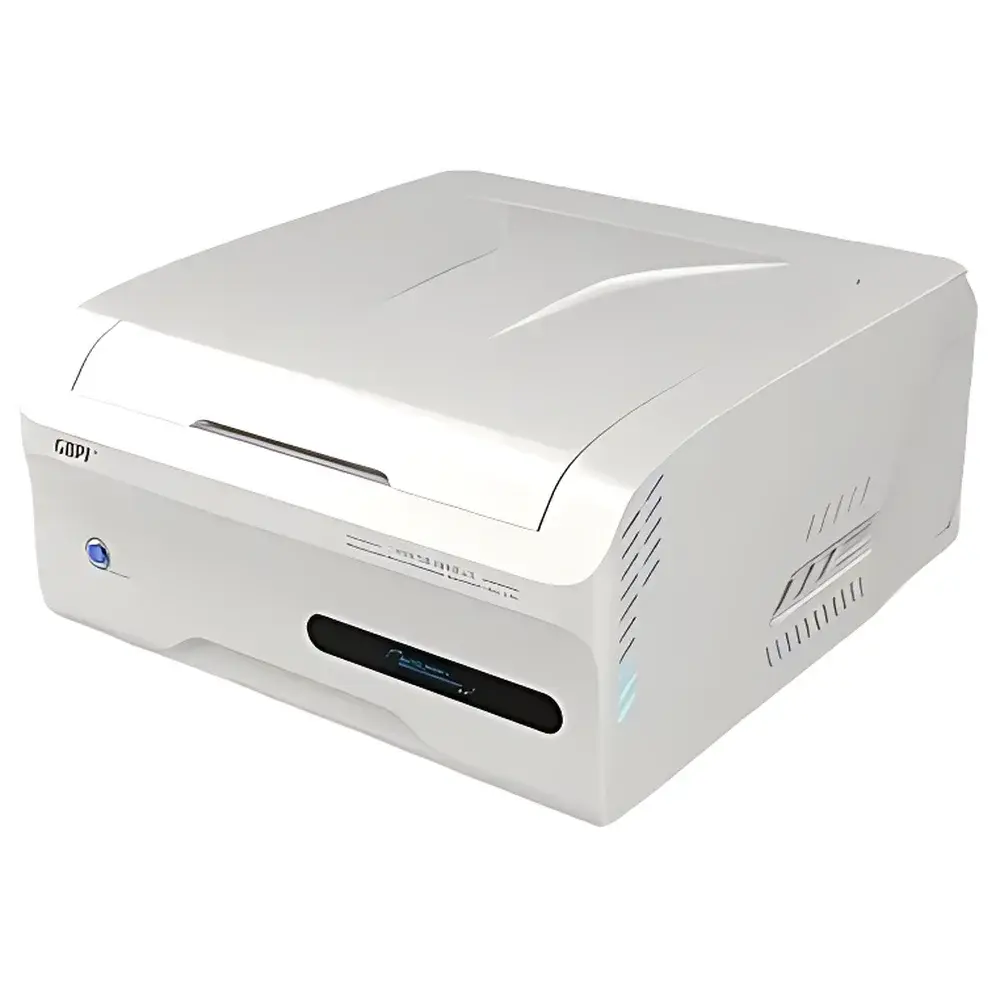
GBPI W900 Gravimetric Water Vapor Transmission Rate Tester
| Brand | GBPI |
|---|---|
| Origin | Guangdong, China |
| Manufacturer Type | Direct Manufacturer |
| Country of Origin | China |
| Model | W900 |
| Price Range | USD 42,000 – 70,000 |
| Measurement Range (Film) | 0.05–10,000 g/(m²·24h) |
| Measurement Range (Container) | 0.0002–30 g/(pkg·24h) |
| Test Accuracy (Film) | ±0.05 g/(m²·24h) |
| Test Accuracy (Container) | ±0.0002 g/(pkg·24h) |
| Test Stations | 9 |
| Balance Capacity | 210 g |
| Balance Resolution | 0.1 mg |
| Temperature Range | 10–50 ±0.1 °C |
| Humidity Range | 5–95 %RH |
| Air Velocity | 0.5–2.5 m/s (optional low-flow mode: 0.03–0.5 m/s) |
| Sample Diameter | Φ74 mm |
| Max Sample Thickness | ≤3 mm |
| Standard Test Area | 33 cm² |
| Carrier Gas | Compressed air (≥0.6 MPa) |
| Tubing Interface | Φ6 mm polyurethane |
Overview
The GBPI W900 Gravimetric Water Vapor Transmission Rate (WVTR) Tester is a precision-engineered instrument designed for regulatory-compliant permeation testing of packaging and barrier materials using the standardized gravimetric cup method. It operates on the fundamental principle of Fickian diffusion driven by a controlled humidity gradient across a specimen—either via desiccant-filled cups (weight gain method) or water-filled cups (weight loss method)—under rigorously stabilized environmental conditions. Engineered for reproducibility in regulated environments, the W900 complies with key international standards including ASTM E96 (desiccant and water methods), ISO 2528, GB/T 1037, GB/T 16928, and YBB00092003 for pharmaceutical packaging. Its dual-mode capability (gain/loss), nine parallel test stations, and sub-milligram mass resolution enable high-throughput, statistically robust WVTR quantification for film, sheet, paper, nonwoven, and rigid container formats.
Key Features
- Multi-station gravimetric architecture: Nine independent test cups mounted on an automated rotating carousel ensure uniform exposure and minimize positional bias; each cup integrates thermal isolation and anti-condensation design to preserve balance stability.
- Precision environmental control: Dual-stream humidity generation (dry + saturated gas mixing) delivers ±2 %RH accuracy across 5–95 %RH range; electromagnetic PID temperature regulation maintains ±0.1 °C uniformity within the 360° circumferential test chamber.
- Low-turbulence airflow management: Adjustable laminar flow (0.5–2.5 m/s standard; optional 0.03–0.5 m/s micro-flow mode) eliminates boundary-layer artifacts without inducing condensation—critical for ultra-low-permeability films and hydrophilic substrates.
- GMP-aligned software platform: Self-contained embedded OS compliant with Annex 11 and FDA 21 CFR Part 11 requirements, featuring role-based access control, full audit trail (user actions, parameter changes, calibration events), electronic signatures, and configurable report templates.
- Modular calibration traceability: Factory-calibrated using GBPI’s NIM-certified national reference standards (GBW(E)130543 / GBW(E)130544), accredited under CNAS ISO/IEC 17025 and authorized by the State Administration for Market Regulation (SAMR).
Sample Compatibility & Compliance
The W900 accommodates flat specimens up to Φ74 mm and ≤3 mm thickness—including polymer films (PET, PE, PP, PVDC, EVOH), metallized laminates, coated papers, medical-grade nonwovens, surgical gowns (per GB/T 19082), and sterile barrier systems. For container testing, custom fixtures support pouches, blister packs, and vials per ASTM D3078 and ISO 15106-3. All operational parameters adhere to GLP/GMP documentation standards: test logs retain raw mass vs. time data, environmental setpoints, operator ID, and instrument metadata. The system supports validation protocols per IQ/OQ/PQ frameworks and integrates seamlessly with LIMS via HL7 or ASTM E1384-compliant APIs.
Software & Data Management
The embedded operating system provides real-time visualization of four synchronized curves: WVTR vs. time, mass change vs. time, chamber temperature vs. time, and relative humidity vs. time—with toggleable preview/hide functionality. Statistical analysis includes automatic slope calculation (linear regression over user-defined intervals), coefficient of variation (CV%) across replicates, and outlier detection per ISO 5725-2. Raw data exports in CSV, PDF, and XML formats; reports embed digital signatures and revision-controlled metadata. Audit trails are immutable and timestamped, meeting FDA 21 CFR Part 11 requirements for electronic records. Optional cloud connectivity enables remote diagnostics, firmware updates, and secure data backup via TLS 1.2–encrypted channels.
Applications
- Quality control of food packaging films (e.g., snack bags, coffee pouches) per ASTM D1653 and ISO 15106-1.
- Regulatory submission support for pharmaceutical primary packaging (blister foils, sachets, IV bags) aligned with USP , Ph. Eur. 5.3, and ICH Q5C stability guidelines.
- Development of high-barrier coatings and nanocomposite films requiring sub-0.1 g/(m²·24h) resolution.
- Accelerated aging studies correlating WVTR shifts with thermal/humidity stress exposure (e.g., 40 °C/75 %RH per ICH Q1A).
- Validation of sterilization integrity for Tyvek®-based medical device packaging per ISO 11607-1.
FAQ
What standards does the W900 fully support out-of-the-box?
ASTM E96 (Procedure A/B/D/F), ISO 2528, GB/T 1037, GB/T 16928, YBB00092003, and TAPPI T464—each selectable via preconfigured test templates.
Can the W900 test rigid containers such as bottles or trays?
Yes—using optional container fixtures and the low-flow airflow configuration (0.03–0.5 m/s), it meets ASTM F1249 and ISO 15106-3 requirements for package-level WVTR quantification.
Is external PC hardware required for operation?
No—the W900 operates autonomously with its integrated touchscreen interface; a PC is only needed for advanced data export, LIMS integration, or remote monitoring.
How is measurement uncertainty validated?
Each unit ships with a NIM-traceable calibration certificate referencing GBW(E)130543/130544 certified reference materials; uncertainty budgets are provided per ISO/IEC 17025 Annex A.
Does the system support 21 CFR Part 11 compliance for pharmaceutical labs?
Yes—full electronic signature workflow, audit trail encryption, and role-based permissions are enabled by default and verified during IQ/OQ protocol execution.




