
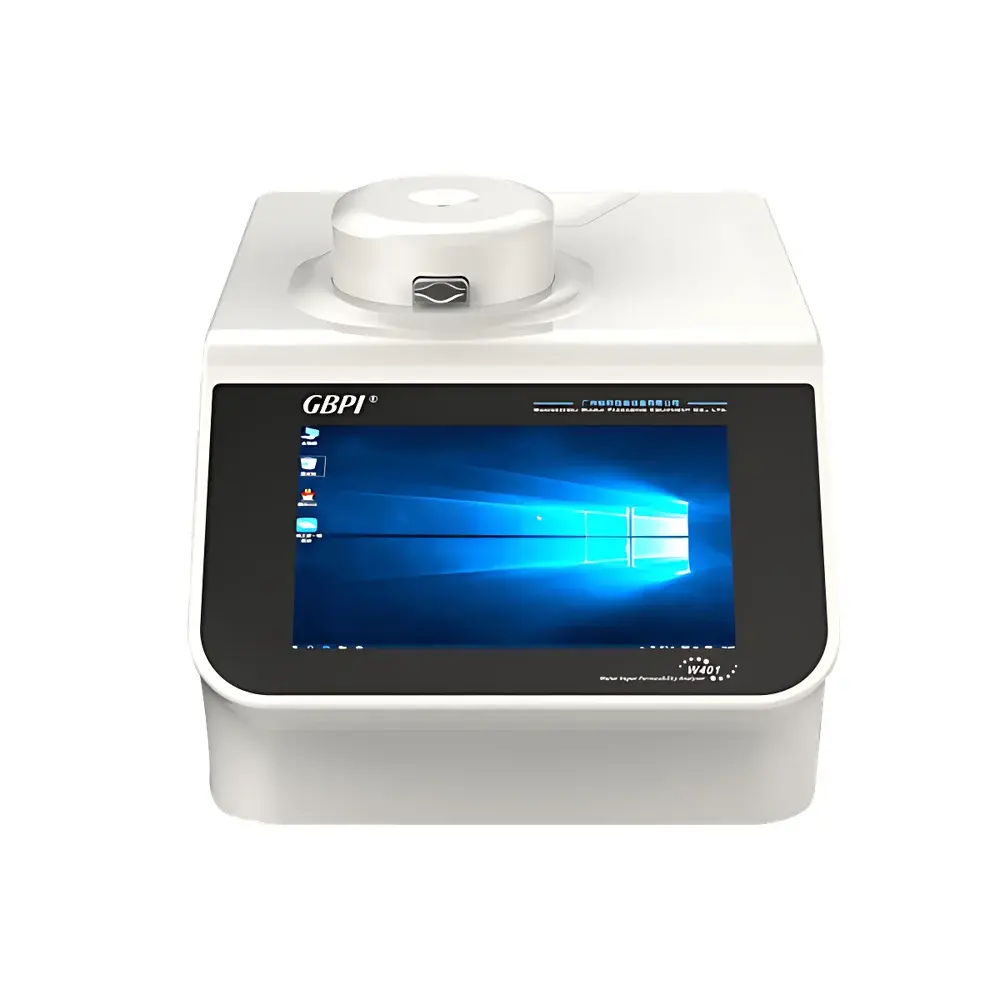
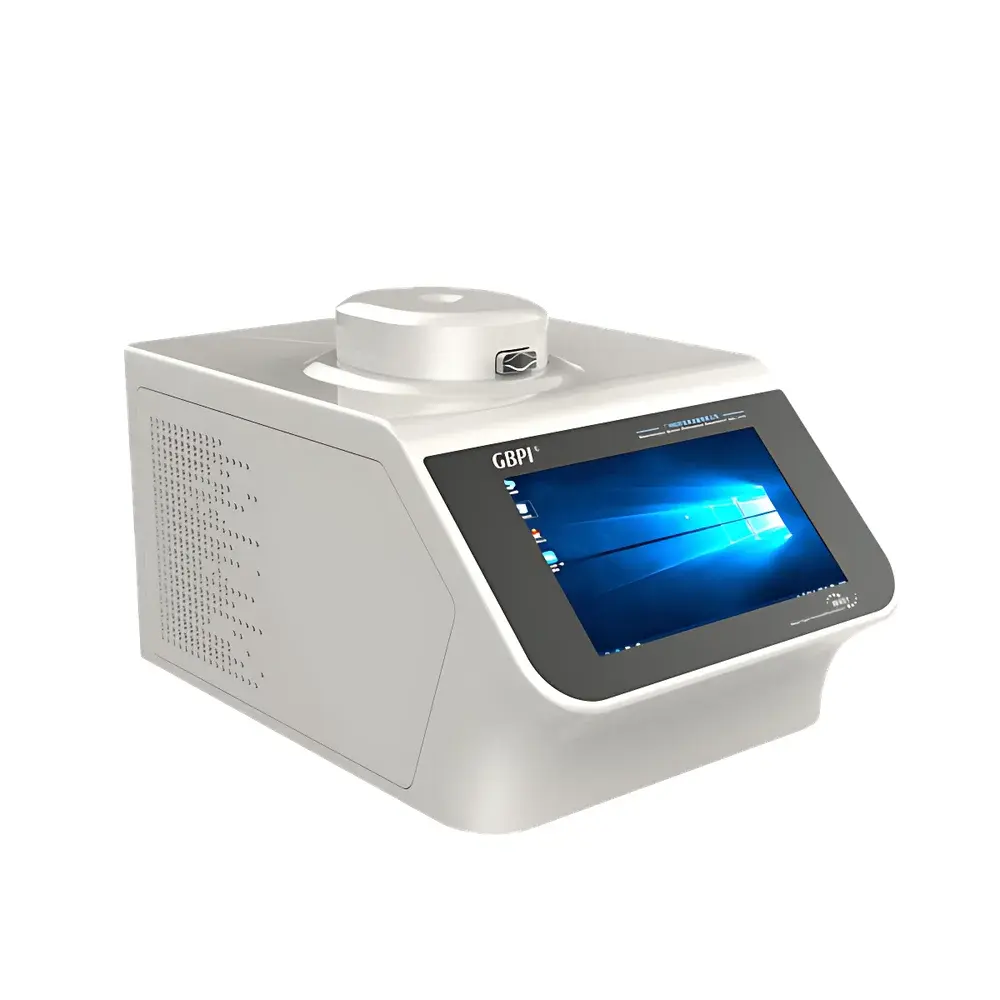
GBPI Y110 2.0A Coulometric Oxygen Transmission Rate (OTR) Analyzer
| Brand | GBPI (Guangzhou Biaoji) |
|---|---|
| Origin | Guangdong, China |
| Manufacturer Type | Direct Manufacturer |
| Model | Y110 2.0A |
| Test Principle | Coulometric Sensor Method (ASTM D3985 / ISO 15105-2) |
| Measurement Range | 0.02–16,500 cm³/(m²·24 h) [up to 260,000 cm³/(m²·24 h) with auxiliary mask] |
| Resolution | 0.001 cm³/(m²·24 h) |
| Temperature Control | 15–45 °C ±0.1 °C |
| Humidity Control | 0%, 30–90%, or 100% RH ±1% RH |
| Permeation Area | 50.24 cm² (customizable down to 0.785 cm²) |
| Specimen Size | Ø100 mm |
| Max Thickness | ≤3 mm |
| Sample Capacity | 1 specimen per test |
| Carrier Gas Pressure | ≥0.1 MPa |
| Gas Inlet | Φ3 mm tubing / 1/8″ NPT |
| Dimensions | 600 × 400 × 330 mm |
| Power | 750 W |
| Supply | AC 220 V, 50 Hz |
Overview
The GBPI Y110 2.0A Coulometric Oxygen Transmission Rate (OTR) Analyzer is an engineered solution for precise, traceable, and standards-compliant measurement of oxygen permeability in packaging materials and barrier substrates. It operates on the coulometric sensor principle—where oxygen molecules permeating through a conditioned specimen are carried by high-purity nitrogen flow into a galvanic oxygen sensor that generates a current proportional to O₂ concentration. This current is integrated over time to yield quantitative OTR values in standard units (cm³/(m²·24 h)). The instrument complies with core international test standards including ASTM D3985 (oxygen transmission rate via coulometric detection), ASTM F2622 (for multilayer films), ASTM F1927 (for flexible barrier packages), ISO 15105-2 (differential pressure method with coulometric detection), JIS K 7126-B, DIN 53380-3, and Chinese pharmacopoeial standard YBB00082003. Its design supports both R&D laboratories and QC environments requiring GMP-aligned data integrity, regulatory audit readiness, and long-term sensor stability.
Key Features
- High-stability coulometric oxygen sensor (imported origin) with resolution of 0.001 cm³/(m²·24 h) and <0.5% repeatability across full dynamic range.
- Automated pneumatic clamping system ensuring uniform specimen sealing and eliminating operator-induced variability in contact pressure.
- Electromagnetic temperature control architecture delivering ±0.1 °C accuracy across 15–45 °C operating range; humidity control supports dry (0% RH), mid-range (30–90% RH), and saturated (100% RH) conditions at ±1% RH tolerance.
- Modular permeation area configuration: standard 50.24 cm² (Ø100 mm), with optional adapters enabling testing of small-area specimens (as low as 0.785 cm²) and irregular geometries including bottles, pouches, cups, and blister cavities.
- Integrated 11.6-inch capacitive touchscreen interface running a purpose-built embedded OS compliant with Annex 11 and FDA 21 CFR Part 11 requirements—including role-based user permissions, electronic signatures, audit trails (system & test-level), and configurable data retention policies.
- Real-time six-channel visualization: OTR vs. time, temperature vs. time, RH vs. time, N₂ flow vs. time, O₂ flow vs. time, and sensor output voltage vs. time—all with toggle visibility, zoom, and export capability.
Sample Compatibility & Compliance
The Y110 2.0A accommodates flat and three-dimensional specimens across pharmaceutical, food, medical device, photovoltaic, and consumer goods sectors. Validated applications include plastic films (PET, PE, PP, BOPP, CPP, PVC), coextrusions, metallized and coated papers, aluminum laminates, biodegradable films (PLA, PBAT), pharmaceutical blisters (PVC/PVDC, cold-forming foils), rigid containers (PET bottles, HDPE jars), pouches (stand-up, vacuum-sealed), and functional components such as transdermal patches and hygiene product backsheets. All test protocols adhere to ISO/IEC 17025 traceability frameworks. Calibration is performed using GBW(E) 130497 and GBW(E) 130498 certified reference materials issued by the State Administration for Market Regulation (SAMR), ensuring metrological equivalence to NIST-traceable standards.
Software & Data Management
The embedded operating system provides full lifecycle data governance: pre-test parameter validation, real-time acquisition, post-run statistical analysis (mean, SD, CV%, trend identification), and customizable reporting (PDF, CSV, XML). Reports embed metadata including instrument ID, operator credentials, environmental logs, calibration status, and raw sensor output traces. Audit trail records capture timestamped events for login, method modification, result approval, and data export—fully compliant with GLP/GMP documentation requirements. Optional LIMS integration enables bidirectional data exchange via HL7 or RESTful API. Remote access via secure web portal permits authorized users to monitor active tests, retrieve historical datasets, download SOPs, view firmware update logs, and initiate remote diagnostics without onsite intervention.
Applications
This analyzer serves critical quality control and formulation development workflows. In pharmaceutical packaging, it verifies OTR performance of primary containers (e.g., vials, syringes, blister cards) against USP and EP 3.2.1 specifications. For food manufacturers, it validates shelf-life models by quantifying oxidation kinetics in snack bags, dairy lids, and meat trays. Medical device producers use it to assess sterility maintenance in Tyvek® pouches and silicone tubing. Photovoltaic module developers rely on its sensitivity to characterize EVA encapsulant degradation under accelerated aging. Additionally, it supports sustainability initiatives by evaluating oxygen barrier efficacy of compostable films and recycled-content laminates—providing objective metrics for life-cycle assessment and regulatory submissions (e.g., EU Directive 2019/904).
FAQ
What gas purity is required for operation?
High-purity oxygen (≥99.999%) and nitrogen (≥99.999%) are mandatory; impurities above 1 ppm CO₂ or H₂O will compromise sensor response linearity and baseline stability.
Can the instrument measure OTR under varying humidity conditions?
Yes—it supports discrete RH setpoints at 0%, 30–90% (±1% RH), and 100% RH, enabling moisture-dependent barrier characterization per ISO 15105-2 Annex A.
Is third-party calibration certification available?
GBPI provides NMI-traceable calibration certificates issued by CNAS-accredited labs, including uncertainty budgets aligned with ISO/IEC 17025:2017.
How does the system ensure data integrity during power interruption?
All measurements are buffered in non-volatile memory; upon recovery, the system resumes logging from last valid timestamp without data loss.
Does the Y110 2.0A support multi-specimen sequential testing?
While single-chamber architecture limits concurrent tests, automated sequence programming allows unattended batch runs with auto-reset between specimens.







