
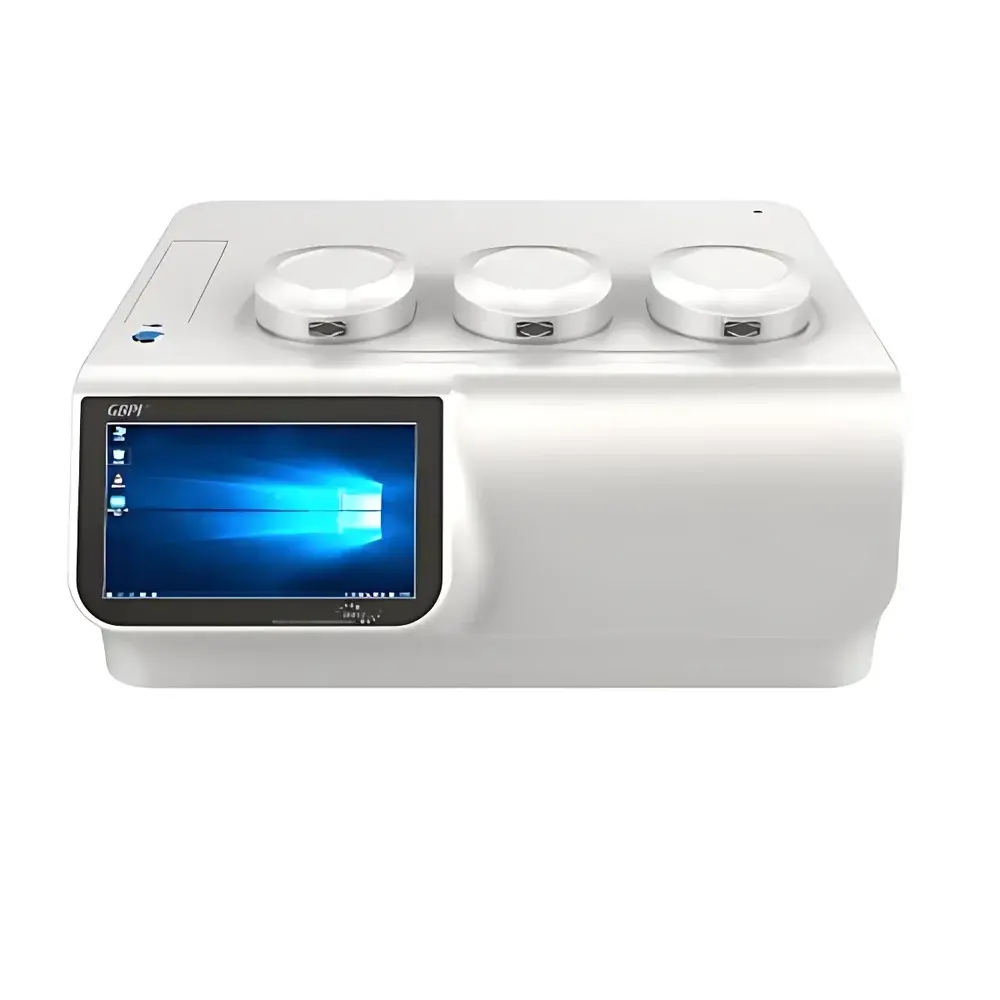
GBPI Y310 2.0T Oxygen Transmission Rate Analyzer (Coulometric Sensor Method)
| Brand | GBPI |
|---|---|
| Origin | Guangdong, China |
| Manufacturer Type | OEM Manufacturer |
| Region Category | Domestic (China) |
| Model | Y310 2.0T |
| Test Range | 0.05–1000 cm³/(m²·24h) (up to 260,000 cm³/(m²·24h) with mask accessory) |
| Resolution | 0.001 cm³/(m²·24h) |
| Temperature Control Range | 15–45 °C |
| Temperature Accuracy | ±0.1 °C |
| Permeation Area | 50.24 cm² (customizable down to 0.785 cm²) |
| Specimen Diameter | Φ100 mm |
| Max Specimen Thickness | ≤3 mm |
| Sample Capacity | 3 independent test chambers |
| Carrier Gas Pressure | ≥0.1 MPa |
| Pneumatic Pressure | ≥0.3 MPa |
| Power Consumption | 750 W |
| Electrical Supply | AC 220 V, 50 Hz |
Overview
The GBPI Y310 2.0T Oxygen Transmission Rate (OTR) Analyzer is a precision laboratory instrument engineered for quantitative determination of oxygen permeability through polymeric, laminated, and composite packaging materials. It operates on the coulometric sensor principle—compliant with ISO 15105-2, ASTM D3985, ASTM F1307, ASTM F1927, ASTM F2622, GB/T 19789, and YBB 00082003—where oxygen molecules permeating across a conditioned specimen are swept by high-purity nitrogen carrier gas into a sealed electrochemical sensor chamber. The resulting coulometric current, proportional to oxygen molar flux, is converted in real time to OTR values expressed in cm³/(m²·24h·0.1 MPa). This method delivers trace-level sensitivity, long-term baseline stability, and minimal drift—critical for regulatory-grade barrier testing in pharmaceutical, food, medical device, and photovoltaic applications.
Key Features
- Triple independent test chambers enable parallel, statistically robust OTR measurements—reducing throughput time by up to 67% versus single-chamber systems.
- Imported coulometric oxygen sensor with resolution of 0.001 cm³/(m²·24h), calibrated using NIM-certified reference standards (GBW(E)130497 & GBW(E)130498), ensuring metrological traceability to national primary standards.
- Electromagnetic temperature control system maintains chamber setpoint within ±0.1 °C across 15–45 °C range—validated per ISO 15105-2 thermal uniformity requirements.
- Automated pneumatic clamping mechanism ensures consistent 0.3 MPa sealing pressure, eliminating operator-induced variability in specimen mounting and leak integrity.
- Integrated 11.6-inch capacitive touchscreen HMI runs a GMP-compliant embedded OS with audit trail (21 CFR Part 11–ready log archiving), role-based access control, and electronic signature support.
- Real-time six-channel data visualization: OTR vs. time, temperature vs. time, humidity vs. time, N₂ flow vs. time, O₂ flow vs. time, and sensor concentration vs. time—with toggleable curve overlays and exportable .csv/.xlsx timelines.
Sample Compatibility & Compliance
The Y310 2.0T accommodates flat specimens (films, foils, sheets, papers) up to Φ100 mm and ≤3 mm thickness, as well as 3D packaging formats—including bottles, pouches, cups, trays, and caps—via optional custom fixtures. It supports all major barrier material classes: biaxially oriented polypropylene (BOPP), polyethylene terephthalate (PET), low-density polyethylene (LDPE), polyvinyl chloride (PVC), aluminum-laminated composites, metallized films (e.g., AlOx, SiOx), biodegradable substrates (PLA, PBAT), and pharmaceutical-grade cold-forming foils (PVC/PVDC, PP/PE). All hardware and software comply with GLP/GMP documentation standards; calibration procedures follow JJG 1073–2012 (Chinese National Verification Regulation for Gas Permeation Instruments), and measurement uncertainty is validated annually against certified reference materials issued by the National Institute of Metrology (NIM), China.
Software & Data Management
The proprietary GBPI LabOS v4.2 firmware implements modular workflow architecture—allowing users to define test protocols aligned with specific pharmacopoeial or industrial standards (e.g., USP , ISO 15105-2 Annex B). Each test session automatically records full metadata: environmental conditions, sensor diagnostics, pressure transients, thermal ramp profiles, and raw coulometric output. Audit trails capture user ID, timestamp, parameter changes, and result approvals—retained for ≥36 months with SHA-256 hashing. Data export supports PDF reports with embedded digital signatures, CSV time-series logs, and XML-formatted structured datasets compatible with LIMS integration via TCP/IP or RS-232. Optional cloud-enabled IoT gateway permits remote monitoring, firmware updates, and diagnostic telemetry through TLS-secured HTTPS endpoints.
Applications
This analyzer serves as a core quality control tool in regulated environments where oxygen barrier integrity directly impacts product shelf life and safety. In pharmaceutical manufacturing, it validates OTR performance of blister lidding foils, sachet laminates, and child-resistant closures per ICH Q5C stability guidelines. Food packaging labs use it to qualify retort pouches, vacuum-sealed meat trays, and modified-atmosphere packaging (MAP) films under accelerated aging protocols. Medical device firms assess sterility maintenance of Tyvek® pouches and silicone-coated paperboard. Photovoltaic R&D teams characterize ethylene-vinyl acetate (EVA) encapsulant and backsheet laminates per IEC 61215 moisture ingress thresholds. Additionally, it supports formulation development for active packaging—e.g., oxygen scavenger films—and supports sustainability initiatives by quantifying OTR shifts in compostable multilayer structures.
FAQ
What gases are required for operation?
High-purity oxygen (≥99.999%, equipped with 0–0.4 MPa regulator) and high-purity nitrogen (≥99.999%, same regulator spec) are mandatory carrier and permeant gases.
Is external PC hardware required?
No—the instrument operates autonomously via its onboard OS and touchscreen interface; however, optional PC connectivity enables advanced statistical analysis and centralized data archival.
Can the system be validated for 21 CFR Part 11 compliance?
Yes—audit trail configuration, electronic signature modules, and role-based permissions are preconfigured to meet FDA requirements for electronic records and signatures.
What is the smallest measurable permeation area?
Using optional mini-chamber adapters, the effective test area can be reduced to 0.785 cm² (Φ10 mm), enabling high-resolution OTR analysis of micro-patterned or heterogeneous samples.
Does GBPI provide ISO/IEC 17025-accredited calibration services?
Yes—GBPI’s metrology lab holds CNAS accreditation (No. CNAS L9217) for gas permeation instrument calibration; certificates include measurement uncertainty budgets and traceability statements to NIM primary standards.





