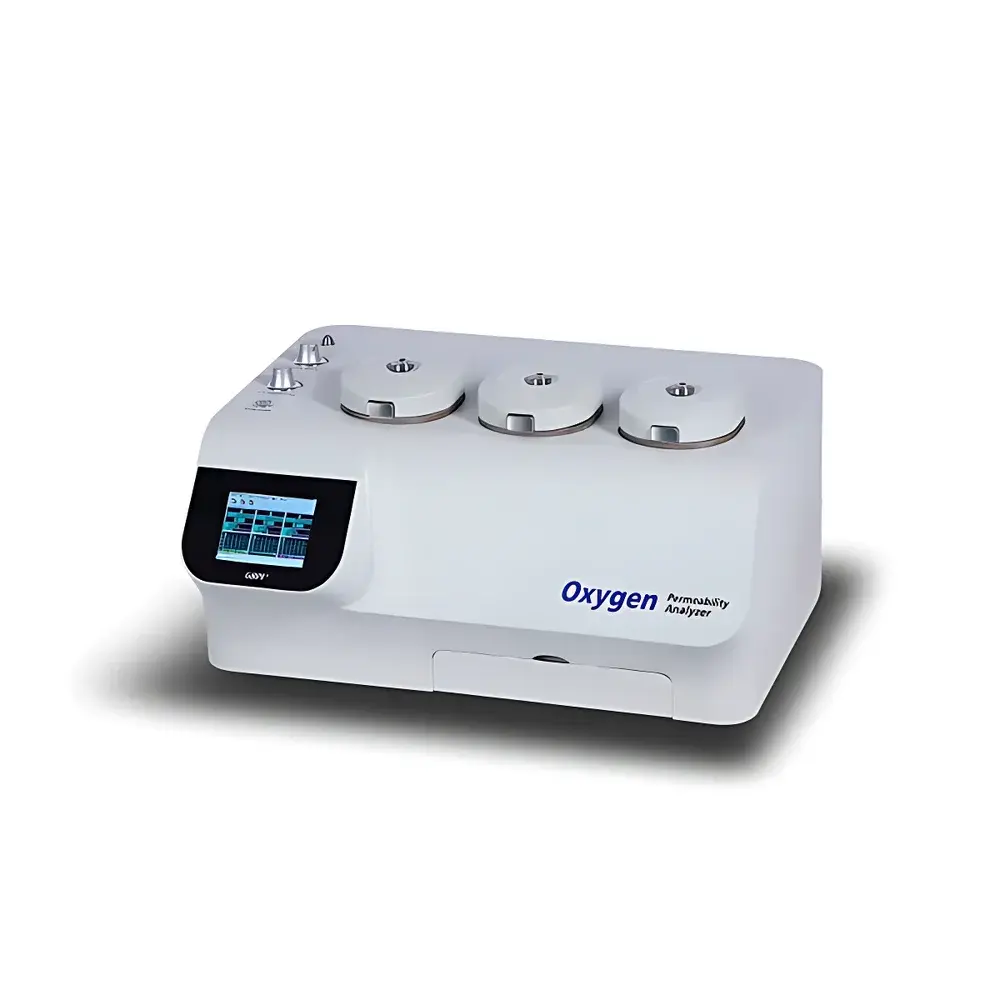
GBPI Y310-6 Oxygen Transmission Rate (OTR) Analyzer
| Brand | GBPI |
|---|---|
| Origin | Guangdong, China |
| Manufacturer Type | OEM/ODM Manufacturer |
| Regional Category | Domestic (China) |
| Model | Y310-6 |
| Price Range | USD 14,000 – 70,000 |
| Test Range | 0.02–16,500 cm³/(m²·24h) (film) |
| O₂ Detection Resolution | 0.001 cm³/(m²·24h) |
| Temperature Control | 15–45 °C (optional 5–50 °C) |
| Temp. Accuracy | ±0.1 °C |
| Humidity Control | 0% RH (dry), 30–90% RH |
| Humidity Accuracy | ±1% RH |
| Test Area | 50.24 cm² |
| Specimen Size | Ø100 mm |
| Max. Thickness | ≤3 mm |
| Sample Capacity | 1–3 independent chambers |
| Carrier Gas Pressure | 0.1–0.2 MPa |
| Gas Inlet | 1/8″ stainless steel tubing |
| Dimensions (W×D×H) | 700×560×370 mm |
| Weight | 100 kg |
| Power | 750 W |
| Supply | AC 220 V, 50 Hz |
Overview
The GBPI Y310-6 Oxygen Transmission Rate (OTR) Analyzer is a gravimetric and coulometric sensor-based instrument engineered for precise, trace-level quantification of oxygen permeation through polymeric films, laminates, foils, rigid containers, and functional barrier materials. It operates on the principle of dynamic gas transmission measurement: a controlled oxygen partial pressure gradient is established across a conditioned test specimen sealed between two chambers; oxygen molecules permeating through the material are swept by high-purity nitrogen carrier gas into a high-sensitivity electrochemical oxygen sensor, where current output is linearly proportional to O₂ concentration. The system calculates OTR in real time using standardized volumetric flow rate, temperature, humidity, and geometric parameters per ISO 15105-2 and ASTM D3985. Designed for laboratories requiring regulatory-grade data integrity, the Y310-6 supports both film-mode and container-mode testing — including bottles, pouches, trays, and blister packs — via optional fixtures and modular chamber configurations.
Key Features
- Triple independent test chambers enable concurrent, fully autonomous evaluation of up to three dissimilar specimens — each with unique environmental setpoints and runtime profiles — delivering three discrete, audit-ready reports per cycle.
- High-resolution electrochemical O₂ sensor (imported, long-life design) with detection limit of 0.001 cm³/(m²·24h), validated against NIST-traceable standard reference materials (GBW(E)130497/8 certified).
- Advanced dual-stream humidity control system: dry and saturated nitrogen streams are blended digitally to achieve stable, programmable RH levels from 0% to 90% ±1% RH; integrated desiccant and humidifier modules ensure drift-free operation over extended runs.
- Precision thermal management using electromagnetic step-controlled Peltier elements and PID feedback loops, maintaining chamber temperature within ±0.1 °C across the full 15–45 °C range (5–50 °C available as factory option).
- Embedded ARM-based controller allows standalone operation without PC dependency; all calibration, method execution, and real-time curve visualization occur locally on the 7-inch industrial LCD interface with Windows-style navigation and mouse input.
- Full compliance with 21 CFR Part 11 requirements: role-based user authentication (Administrator, Operator, Reviewer), hierarchical permission assignment, and immutable audit trails covering system events, method changes, and raw data modifications.
Sample Compatibility & Compliance
The Y310-6 accommodates flat sheet specimens (Ø100 mm, ≤3 mm thick) including monolayer plastics (PET, PE, PP), metallized films (AlOx, SiOx), aluminum foil composites, rubber sheets, ceramic substrates, and biomedical polymers (hydrogels, silicone elastomers). With optional accessories — such as the OTR face mask, container adapters, and custom sealing gaskets — it extends to rigid and semi-rigid packaging formats: HDPE/PP bottles, aluminum-plastic blisters, thermoformed trays, and flexible stand-up pouches. All hardware and software workflows align with international standards including ISO 15105-2, ASTM D3985 (electrochemical sensor method), ASTM F1927 (container mode), ASTM F1307 (high-barrier films), ASTM F2622 (multi-layer structures), GB/T 19789-2005, YBB00082003-2015 (Chinese pharmaceutical packaging), DIN 53380-3, and JIS K-7126-B. Calibration traceability is maintained through dual-path verification: certified standard membranes and certified O₂/N₂ gas mixtures.
Software & Data Management
GBPI OTR Studio v4.x is a validated, GMP-compliant application built on Microsoft .NET Framework. It provides intuitive workflow configuration — defining test duration, ramp profiles, pass/fail criteria, and auto-stop logic — alongside real-time overlay of four synchronized trend curves: OTR, O₂ concentration, temperature, and relative humidity. Curve manipulation includes zoom, pan, hide/show toggles, and export to PNG/SVG. All raw sensor outputs, metadata, and intermediate calculations are stored in an encrypted local SQLite database with SHA-256 hashing. Reports generate automatically in bilingual (English/Chinese) format and export to PDF, Excel (.xlsx), or Word (.docx) with embedded digital signatures and timestamped revision history. Audit trail logs record every login, parameter change, calibration event, and report generation — supporting GLP, GMP, and FDA inspection readiness.
Applications
- Pharmaceutical packaging validation: blister lidding foil, cold-forming aluminum, PTP foil, and child-resistant pouches per USP and EP 3.2.1.
- Food packaging shelf-life modeling: evaluating barrier performance of retort pouches, vacuum-sealed meat films, and modified-atmosphere packaging (MAP) laminates.
- Electronics encapsulation R&D: characterizing moisture/oxygen ingress resistance of OLED backplane films, flexible display substrates, and conformal coatings.
- Medical device sterility assurance: quantifying OTR of Tyvek® lids, peelable pouches, and breathable wound dressings under accelerated aging conditions.
- Renewable energy materials testing: assessing encapsulant durability and edge-seal integrity of photovoltaic module backsheets per IEC 61215.
- Academic and government research: fundamental diffusion coefficient derivation, Arrhenius activation energy analysis, and humidity-dependent permeability modeling.
FAQ
What gases are required for operation?
High-purity oxygen (≥99.999%) and nitrogen (≥99.999%), each supplied via dedicated cylinders equipped with dual-stage stainless steel regulators (0–0.4 MPa output).
Is external PC mandatory for daily use?
No — the embedded ARM controller enables complete method setup, test execution, real-time monitoring, and report preview without any computer connection. A PC is only required for advanced data export, long-term archival, or multi-instrument network integration.
How is instrument accuracy verified?
Using GBPI-certified reference materials: primary standard films (125 µm LDPE, traceable to GBW(E)130497/8) and secondary certified gas mixtures (e.g., 100 ppm O₂ in N₂). Calibration routines follow ASTM E29 and ISO/IEC 17025 guidelines.
Can the system test non-planar samples like bottles?
Yes — with the optional container test fixture kit, which includes custom-machined sealing chucks, pressure-balanced headspace compensation, and volumetric normalization algorithms compliant with ASTM F1927.
Does the software support electronic signatures per 21 CFR Part 11?
Yes — all user actions are logged with unique identifiers, timestamps, and cryptographic hashes. Electronic signatures require pre-defined roles, biometric or token-based second-factor authentication, and documented approval workflows.