
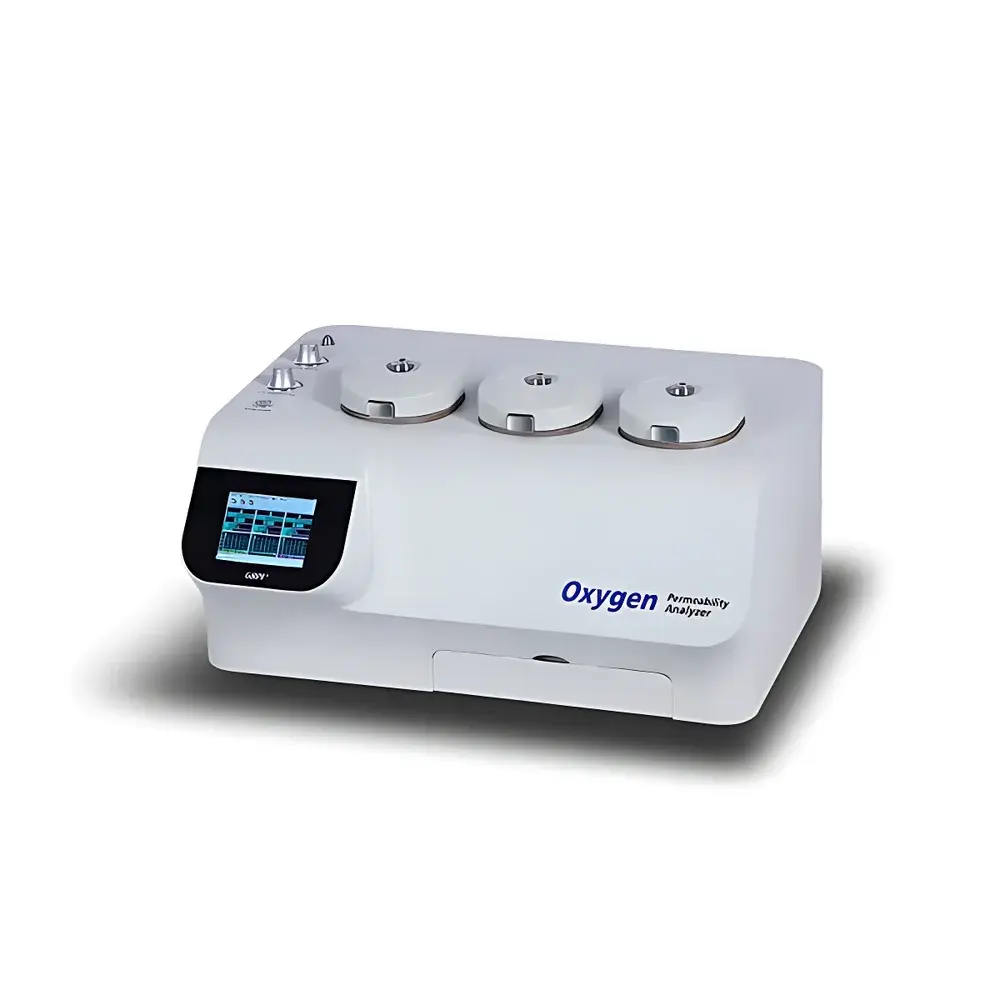
GBPI Y310-T2 Oxygen Transmission Rate (OTR) Analyzer for Pharmaceutical Packaging Materials
| Brand | GBPI |
|---|---|
| Origin | Guangdong, China |
| Manufacturer Type | Direct Manufacturer |
| Region Classification | Domestic |
| Model | Y310-T2 |
| Price Range | USD 14,000 – 70,000 |
| Test Range | 0.02–16,500 cm³/(m²·24h) (film) |
| O₂ Resolution | 0.001 cm³/(m²·24h) |
| Temp Control | 15–45°C (5–50°C optional), ±0.1°C accuracy |
| RH Control | 0% (dry), 30–90% RH, ±1% RH accuracy |
| Test Area | 50.24 cm² |
| Specimen Size | Ø100 mm |
| Max Thickness | ≤3 mm |
| Sample Capacity | 1–3 independent chambers |
| Carrier Gas Pressure | 0.1–0.2 MPa |
| Interface | 1/8″ stainless steel tubing |
| Dimensions | 700 × 560 × 370 mm |
| Weight | 100 kg |
| Power | 750 W, AC 220 V, 50 Hz |
Overview
The GBPI Y310-T2 Oxygen Transmission Rate (OTR) Analyzer is a gravimetric- and coulometric-based instrument engineered for precise, traceable, and regulatory-compliant measurement of oxygen permeation through packaging materials used in pharmaceutical, medical device, food, and high-barrier electronics applications. It operates on the principle of dynamic gas transmission under controlled temperature and relative humidity (RH), employing a dual-stream humidity generation system and high-stability electrochemical oxygen sensors to quantify O₂ flux across planar films or rigid containers. The system conforms to core international test methodologies—including ASTM D3985 (coulometric sensor), ASTM F1927 (moisture-modified OTR), ASTM F1307 (container testing), ASTM F2622 (high-resolution film testing), ISO 15105-2, GB/T 19789-2005, YBB00082003-2015, DIN 53380-3, and JIS K-7126-B—ensuring data interoperability across global quality control laboratories.
Key Features
- Triple-chamber independent testing architecture enables concurrent analysis of up to three distinct specimens—each with autonomous start/stop, real-time monitoring, and individual report generation—maximizing throughput without cross-contamination or calibration drift.
- High-resolution coulometric oxygen sensor (detection limit: 0.001 cm³/(m²·24h)) certified via GBW(E)130497/8 national standard reference materials; traceable calibration supported by both certified OTR films and primary-standard gases.
- Electromagnetic programmable temperature control with ±0.1°C stability over 15–45°C range (5–50°C optional); dual-gas (dry N₂ + humidified N₂) RH regulation achieving ±1% RH accuracy from 0% to 90% RH.
- ARM-based embedded control system allows standalone operation—no host PC required for routine testing—reducing software dependency and enhancing system robustness in regulated environments.
- Full GMP-aligned software architecture compliant with Annex 11 (EU GMP) and FDA 21 CFR Part 11 requirements: role-based user authentication (Administrator, Operator, Reviewer), configurable permission sets, and immutable audit trails covering system events, method changes, and raw data modifications.
- Modular hardware design facilitates field serviceability; critical components—including oxygen sensor, humidity generator, and pressure regulators—are isolated, swappable, and protected against over-range exposure.
Sample Compatibility & Compliance
The Y310-T2 accommodates flat specimens (films, foils, laminates, ceramics, rubber sheets) up to 3 mm thick and Ø100 mm in diameter, as well as rigid or flexible packaging containers—including bottles, pouches, trays, and blister cavities—via optional fixtures and sealing adapters. Its extended-range face mask configuration supports ultra-high-permeability measurements up to 260,000 cm³/(m²·24h), enabling characterization of non-barrier substrates such as PETG, LDPE, or uncoated paperboard. All test protocols adhere to pharmacopoeial and regulatory frameworks governing primary and secondary packaging validation, including USP , Ph. Eur. 3.2.1, and ICH Q5C stability guidance. Instrument qualification documentation (IQ/OQ/PQ templates) and metrological traceability records are provided per ISO/IEC 17025 and GLP principles.
Software & Data Management
The proprietary Windows-based OTRControl Suite features intuitive workflow navigation, real-time multi-parameter visualization (OTR, O₂ concentration, temperature, RH), and scalable curve manipulation (zoom, pan, overlay, hide). Test methods are fully customizable—including ramped RH profiles, multi-step temperature conditioning, and pass/fail criteria integration. Reports comply with ALCOA+ data integrity standards: automated generation in PDF, Excel, and Word formats; digital signatures; electronic retention with SHA-256 hashing; and SQL-based backend storage supporting long-term archival and query-driven analytics. Audit trail logs record timestamps, operator IDs, parameter edits, and result approvals—exportable in CSV or XML for internal review or regulatory submission.
Applications
- Pharmaceutical packaging: Barrier validation of PTP blisters, cold-form foil, Alu-Alu laminates, and polymer-coated vials per YBB00082003-2015 and USP .
- Medical device packaging: OTR verification of Tyvek® pouches, sterile barrier systems, and peel-open trays under accelerated aging conditions.
- Food & beverage: Shelf-life modeling support via OTR correlation with lipid oxidation kinetics in snack bags, coffee pouches, and retort pouches.
- Emerging materials: Characterization of solar backsheet films (e.g., ETFE/EVA), OLED encapsulation layers, hydrogel contact lenses, and transdermal patch membranes.
- Quality assurance: In-process release testing, supplier material qualification, and annual requalification per ISO 11607-1.
FAQ
Does the Y310-T2 meet FDA 21 CFR Part 11 requirements for electronic records and signatures?
Yes. The system implements role-based access control, electronic audit trails, and secure digital signature workflows validated per Part 11 Annex A guidance.
Can it test both flat films and 3D containers without hardware modification?
Flat films are tested in the standard chamber; container testing requires optional fixtures (e.g., bottle adapter, pouch clamp) and seal verification per ASTM F1307.
Is calibration traceable to national standards?
Yes—calibration uses GBW(E)130497/8 certified reference materials issued by China’s National Institute of Metrology, with full uncertainty budgets documented.
What gas purity is required for carrier and zero gases?
99.999% pure nitrogen (carrier) and oxygen (zero/reference) are mandatory; impurities >1 ppm CO₂ or H₂O will compromise sensor linearity and baseline stability.
How is sensor longevity maintained during high-throughput operation?
The system includes automatic sensor protection logic that interrupts flow upon O₂ saturation or pressure excursion, extending operational life beyond 24 months under typical QC use.



