
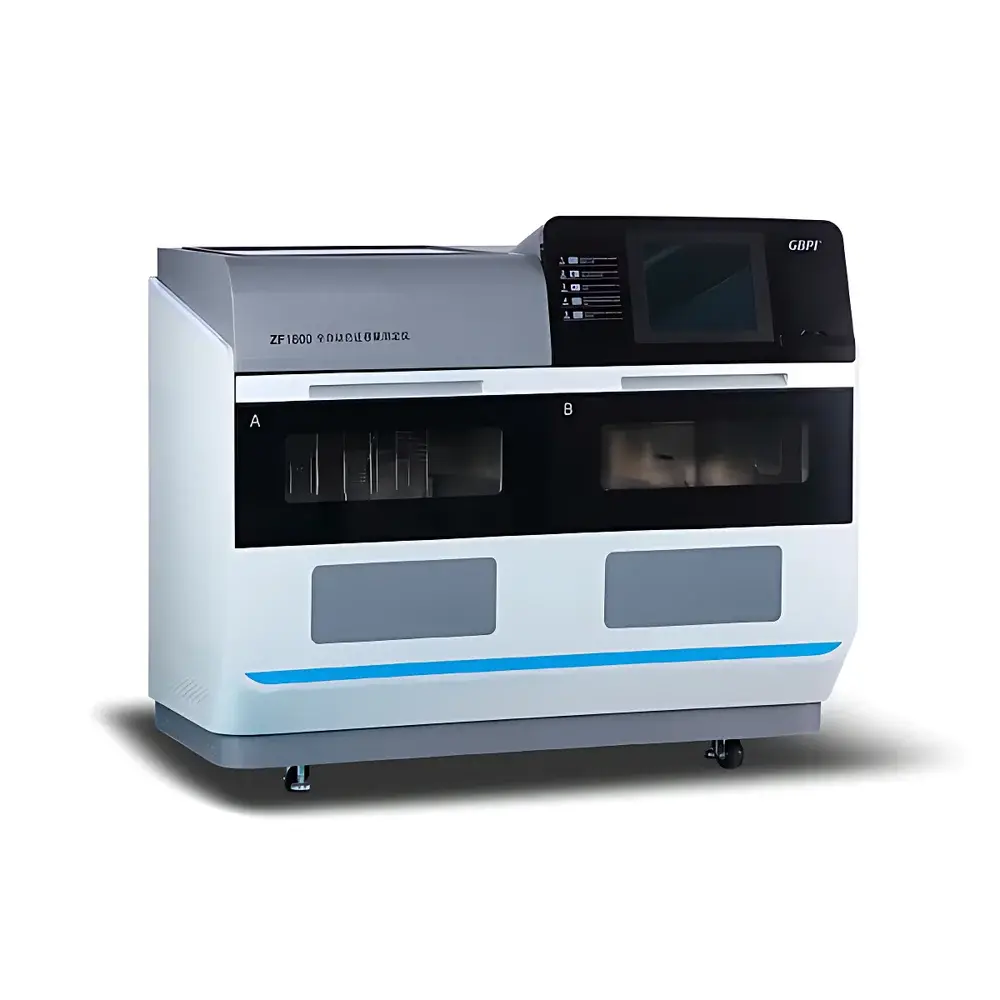
GBPI ZF-1800Q Automated Total Migration Tester for Food Contact Materials
| Brand | GBPI |
|---|---|
| Model | ZF-1800Q |
| Origin | Guangdong, China |
| Manufacturer Type | Direct Manufacturer |
| Country of Origin | China |
| Measurement Range | 0.2–167,000 mg/dm² |
| Resolution | 0.0001 g/dm² |
| Balance Capacity | 0–200 g |
| Balance Resolution | 0.1 mg |
| Water Bath Temp Control | Ambient to 100 °C |
| Heating Chamber Temp Control | Ambient to 120 °C |
| Cooling Chamber Temp Control | Ambient |
| Temp Accuracy | ±0.5 °C |
| Chamber Temp Uniformity | ±5 °C |
| Sample Capacity | 1–18 independent test positions |
| Gravimetric Constant-Weight Duration | 2.5 h (standard) |
| Evaporating Dish Volume | 0–200 mL |
| Dimensions (L×W×H) | 180 × 90 × 120 cm |
| Power Supply | 220 V, 50 Hz |
| Rated Power | 5000 W |
| Solvent Recovery | Fully enclosed, nitrogen-compatible, negative-pressure controlled |
| Software Compliance | Designed per Annex 11 of EU GMP & FDA 21 CFR Part 11 requirements |
Overview
The GBPI ZF-1800Q Automated Total Migration Tester is an integrated gravimetric system engineered for precise, reproducible quantification of total migration from food contact materials (FCMs) into standardized food simulants—per ISO 10993-12, EN 1186, and Regulation (EU) No. 10/2011. It operates on the principle of solvent evaporation followed by residue gravimetry: samples are immersed in regulated simulants (e.g., 3% acetic acid, 10% ethanol, olive oil), subjected to defined time–temperature conditions, and then transferred to a controlled environment where the simulant is fully evaporated under inert (N₂) or ambient atmosphere. The residual non-volatile fraction is weighed using high-resolution analytical balance modules (0.1 mg resolution), and migration is calculated as mass per unit surface area (mg/dm²). Its architecture eliminates manual handling variability—critical for GLP-compliant laboratories performing routine regulatory testing for packaging manufacturers, third-party certification labs, and food safety QA/QC departments.
Key Features
- Independent dual-zone thermal management: Separated water bath, heating chamber, and cooling chamber enable concurrent heating and cooling cycles—reducing inter-test downtime and improving throughput.
- Automated water bath subsystem with level sensing, auto-fill, temperature regulation (ambient to 100 °C), timed evaporation, and drain control—minimizing operator intervention and ensuring repeatability across immersion phases.
- Hermetically sealed solvent recovery loop: All evaporation occurs within a closed-loop chamber; vapors are condensed and collected without atmospheric release—meeting OSHA PEL and EU Directive 2004/42/EC occupational exposure limits.
- Nitrogen purge capability: Integrated gas inlet supports inert-atmosphere drying, essential for oxygen-sensitive simulants (e.g., ethanol, isooctane) and volatile residue stabilization.
- Negative-pressure test chamber: Maintains sub-atmospheric pressure during evaporation to suppress boiling point elevation and enhance solvent removal efficiency at lower temperatures.
- ARM-based embedded control system with 10.1″ capacitive touchscreen: Hosts preconfigured test methods, real-time weight monitoring, and automated decision logic for endpoint detection (e.g., constant weight criteria per ISO 3696).
- Eighteen independent test positions: Each station features isolated thermal zones, individual dish holders, and autonomous gravimetric tracking—enabling heterogeneous sample sets (e.g., PET trays, PP lids, aluminum laminates) in a single run.
Sample Compatibility & Compliance
The ZF-1800Q accommodates flat, rigid, and semi-rigid FCMs—including polyolefin films (PE, PP), polystyrene containers, PVC-coated papers, metalized laminates, and silicone rubber gaskets—provided surface area is determinable per EN 1186-1. It supports all standard food simulants defined in Regulation (EU) No. 10/2011 Annex I and ISO 21602: aqueous (3% acetic acid, 10% ethanol), fatty (olive oil, synthetic triglyceride), and dry simulants (ethanol 95%). Temperature profiles comply with migration test conditions up to 120 °C (heating chamber) and 100 °C (water bath), satisfying accelerated testing protocols under EN 13130-1. System design meets mechanical safety requirements per IEC 61010-1 and electrical insulation class I.
Software & Data Management
The embedded software platform conforms to EU GMP Annex 11 and FDA 21 CFR Part 11 for computerized systems used in regulated environments. Access control enforces role-based permissions (Administrator, Operator, Reviewer), with configurable audit trails covering system events, method edits, result modifications, and user logins. All weight readings, chamber temperatures, humidity logs, and migration calculations are timestamped and digitally signed. Reports—exportable in PDF, XLSX, and CSV—include raw gravimetric data, intermediate weights, constant-weight verification timestamps, and final mg/dm² values with uncertainty estimates. Electronic signatures support 21 CFR Part 11-compliant approval workflows.
Applications
- Regulatory compliance testing for plastic, paper, and multilayer packaging intended for direct food contact.
- Migration screening during formulation development of barrier coatings and adhesives.
- Stability assessment of printed inks and metallization layers under thermal stress.
- Validation of cleaning efficacy in reusable food processing equipment (e.g., stainless-steel pipelines).
- Supporting Declaration of Compliance (DoC) documentation per EU Framework Regulation 1935/2004.
FAQ
Does the ZF-1800Q support testing with olive oil as a simulant?
Yes—it includes a dedicated high-temperature heating chamber (up to 120 °C) and optimized evaporation kinetics for fatty simulants, with automatic solvent recovery preventing oil aerosol dispersion.
Can test parameters be customized per sample type?
Yes—users define immersion time/temperature, evaporation ramp rates, N₂ flow rate, and constant-weight criteria via the touchscreen interface; each of the 18 positions may execute distinct methods simultaneously.
Is calibration traceable to national standards?
The integrated balance modules accept external calibration weights (e.g., 200 g Class E2); GBPI provides calibration certificates traceable to CNAS-accredited metrology institutes.
What maintenance is required for the solvent recovery system?
Condenser coils require quarterly inspection; collection flasks must be emptied after every 10–15 runs depending on solvent volume; no consumables beyond standard lab-grade solvents and nitrogen supply.
How is data integrity ensured during power interruption?
The ARM controller maintains volatile memory backup via supercapacitor; all active test states and weight logs are preserved and resumed automatically upon power restoration.






