
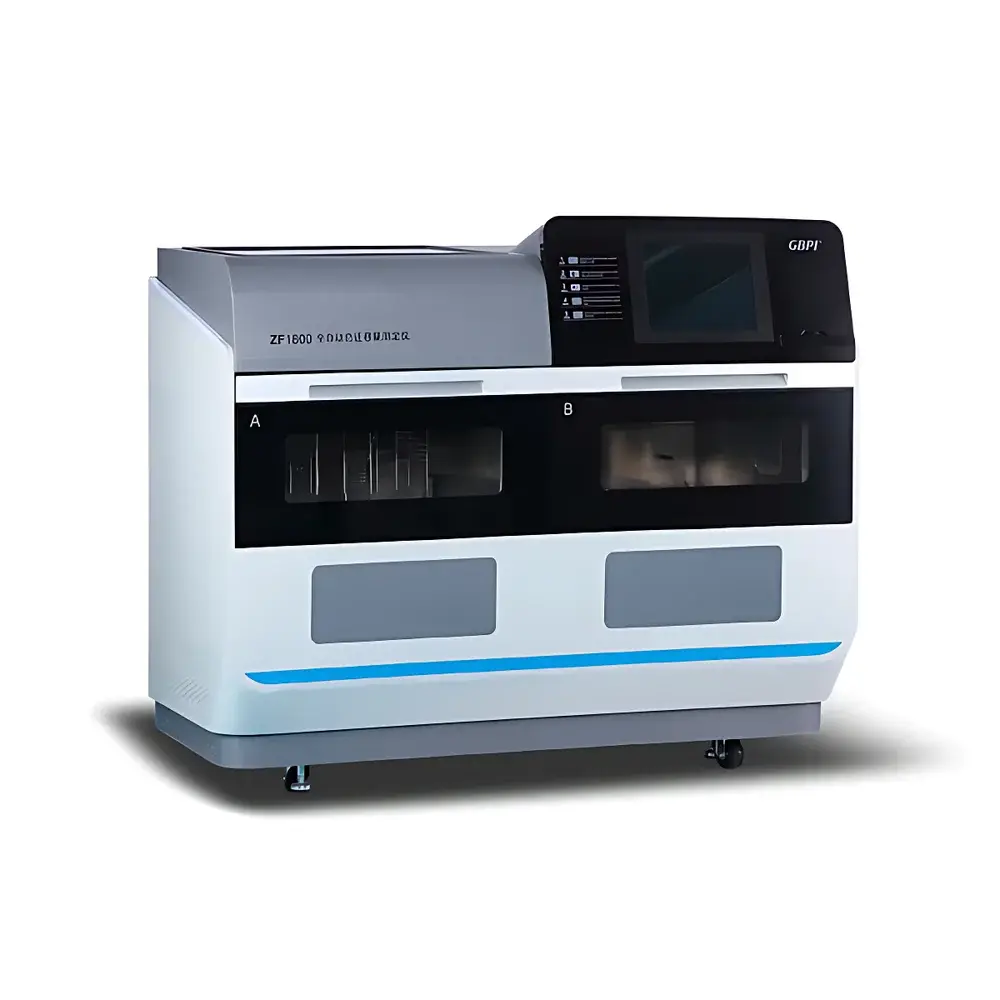
GBPI ZF1800-T 18-Position Evaporative Residue Tester
| Brand | GBPI |
|---|---|
| Origin | Guangdong, China |
| Manufacturer Type | Manufacturer |
| Origin Category | Domestic |
| Model | ZF1800-T |
| Quotation | Upon Request |
| Measurement Range | 0.2–167,000 mg/dm² |
| Resolution | 0.0001 g/dm² |
| Balance Capacity | 0–200 g |
| Balance Resolution | 0.1 mg |
| Water Bath Temp Control | Ambient to 100 °C |
| Heating Chamber Temp Control | Ambient to 117.9 °C |
| Cooling Chamber Temp Control | 10–35 °C |
| Temperature Accuracy | ±5 °C |
| Sample Positions | 1–18 (independent) |
| Evaporating Dish Volume | 0–200 mL |
| Dimensions (Main Unit) | 178 × 93 × 145 cm (L×W×H) |
| Solvent Recovery System Dimensions | 120 × 88 × 170 cm (L×W×H) |
| Power Supply | 220 V, 50 Hz |
| Rated Power | 5000 W |
Overview
The GBPI ZF1800-T 18-Position Evaporative Residue Tester is an integrated, fully automated analytical platform engineered for precise quantification of non-volatile residues following solvent extraction—commonly referred to as “total migration” testing in food contact materials (FCM) compliance. It operates on the gravimetric principle: test specimens are immersed in standardized simulants (e.g., 3% acetic acid, 10% ethanol, olive oil), extracted under controlled thermal conditions, and the resulting solution is evaporated to dryness. The residual mass—expressed per unit surface area (mg/dm²)—is determined via high-resolution microbalance measurement after controlled drying, cooling, and desiccation cycles. Designed specifically for regulatory evaluation of polyolefin, polystyrene, polypropylene, and chlorinated vinyl-based food packaging, utensils, piping, and processing equipment, the ZF1800-T meets core methodological requirements outlined in ISO 10993-12, FDA 21 CFR §170–189, EU Regulation (EC) No. 10/2011, and Chinese GB 31604 series standards.
Key Features
- Independent Dual-Chamber Thermal Architecture: Separated heating and cooling zones enable concurrent evaporation and post-evaporation conditioning—eliminating cross-thermal interference and reducing cycle time by up to 40% compared to sequential single-chamber systems.
- Automated Water Bath Subsystem: Integrated water bath with auto-fill, real-time water level sensing, PID-controlled temperature regulation (ambient to 100 °C), timed drainage, and dual-safety interlocks (overtemperature + dry-run detection).
- Closed-Solvent Recovery Loop: All evaporation occurs within a sealed chamber; vapors are condensed and collected via an external recovery unit, preventing atmospheric release of organic solvents (e.g., chloroform, hexane, ethanol) and ensuring operator safety and environmental compliance.
- Nitrogen Purge Capability: Optional inert gas inlet supports accelerated solvent removal under low-oxygen conditions—critical for oxidation-sensitive analytes or thermally labile matrices.
- Negative-Pressure Test Chamber: Vacuum-assisted sealing maintains consistent sub-atmospheric pressure during evaporation, minimizing boiling point elevation and enhancing residue uniformity across replicate samples.
- ARM-Based Embedded Control System: Touchscreen HMI unifies instrument operation, method programming, data acquisition, and reporting—no external PC required. Supports customizable test sequences, automatic dish taring, scheduled pre-drying, and real-time weight stabilization logic.
Sample Compatibility & Compliance
The ZF1800-T accommodates flat, rigid, or flexible specimens—including films, laminates, molded containers, gaskets, and tubing—within standardized surface area constraints (per ISO 10993-12 and GB 31604.8). Each of the 18 independent test positions accepts evaporating dishes (0–200 mL capacity), allowing heterogeneous sample sets (e.g., varying polymer types, simulant formulations, or exposure durations) to be processed simultaneously without cross-contamination. All thermal profiles comply with mandated extraction temperatures and times specified in USP , ASTM D5279, and EN 1186-1. The system’s ±5 °C temperature uniformity across chambers satisfies GLP validation criteria for thermal stability and reproducibility.
Software & Data Management
The embedded software conforms to Annex 11 (EU GMP) and FDA 21 CFR Part 11 requirements for computerized systems. Access control enforces role-based permissions (Administrator, Operator, Reviewer, Auditor), with configurable privilege mapping per function (e.g., method editing, report generation, audit log access). Comprehensive audit trails record all user actions—including login/logout events, parameter modifications, weight readings, and report exports—with immutable timestamps and operator IDs. Real-time dashboards display live weight trends, migration values, chamber temperatures, and solvent recovery status per position. Final reports—exportable in PDF, Excel, or Word formats—include raw weights, net residue mass, surface area normalization, statistical summaries (n=18), and digital signatures compliant with ALCOA+ principles.
Applications
- Regulatory testing of food-grade plastics, coatings, adhesives, and printing inks per EU 10/2011 and FDA CFR Title 21.
- Migration assessment of reusable food contact articles (e.g., silicone bakeware, stainless steel containers with polymer linings).
- QC/QA verification of batch-to-batch consistency in packaging manufacturing facilities.
- Developmental screening of novel barrier materials during R&D phase.
- Third-party laboratory accreditation (ISO/IEC 17025) for total migration testing services.
FAQ
Does the ZF1800-T support multi-solvent testing in a single run?
Yes—each of the 18 positions can be assigned an independent simulant (aqueous, alcoholic, or fatty) and corresponding temperature/time profile.
Is calibration traceable to national standards?
The integrated balance is factory-calibrated against NIST-traceable weights; users may perform routine verification using certified reference masses per ISO 9001 and ISO/IEC 17025.
Can the system interface with LIMS?
Data export via CSV/XML and optional OPC UA integration enables bidirectional communication with laboratory information management systems.
What maintenance is required for the solvent recovery module?
Condenser coils require quarterly inspection; collection flasks must be emptied and cleaned after each batch; no consumables beyond standard lab glassware are needed.
How is data integrity ensured during power interruption?
The ARM controller retains active method state and weight logs in non-volatile memory; upon restart, it resumes from last validated checkpoint without data loss.





