
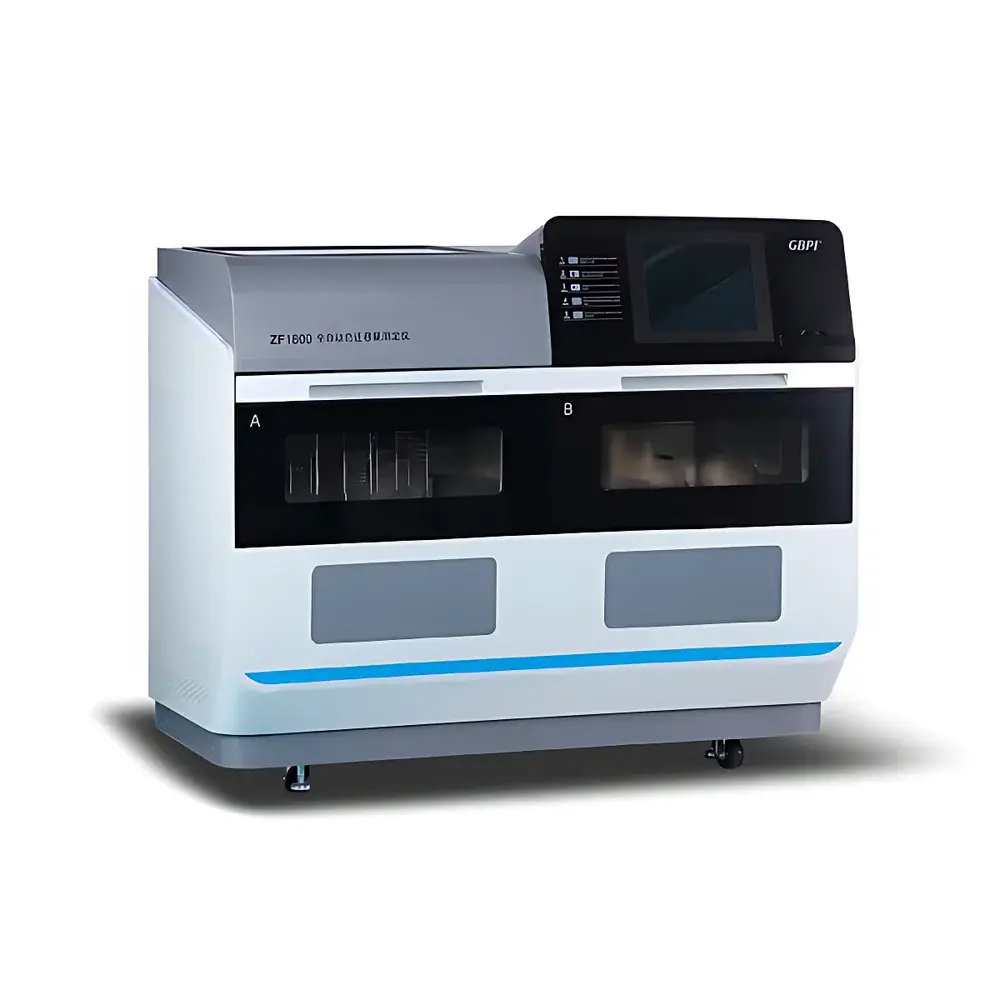
GBPI ZF1800-2A Total Migration Tester for Food Contact Materials
| Brand | GBPI |
|---|---|
| Model | ZF1800-2A |
| Origin | Guangdong, China |
| Manufacturer Type | Manufacturer |
| Category | Other General Analytical Instruments |
| Measuring Range | 0.2–167,000 mg/dm² |
| Resolution | 0.0001 g/dm² |
| Balance Capacity | 0–200 g |
| Balance Resolution | 0.1 mg |
| Water Bath Temp Control | RT–100 °C |
| Heating Chamber Temp Control | RT–117.9 °C |
| Cooling Chamber Temp Control | 10–35 °C |
| Temperature Uniformity | ±5 °C |
| Sample Capacity | 1–18 independent stations |
| Evaporating Dish Volume | 0–200 mL |
| Dimensions (Main Unit) | 178 × 93 × 145 cm (L×W×H) |
| Solvent Recovery System Dimensions | 120 × 88 × 170 cm (L×W×H) |
| Power Supply | 220 V, 50 Hz |
| Rated Power | 5000 W |
Overview
The GBPI ZF1800-2A Total Migration Tester is an integrated, fully automated analytical system engineered for precise quantification of total migration from food contact materials (FCMs) into food simulants—per regulatory requirements defined in EU Regulation (EC) No. 10/2011, ISO 17715:2017, and national standards such as GB 31604.8–2023. It operates on the principle of solvent extraction followed by controlled evaporation and gravimetric determination of non-volatile residues. The instrument subjects FCM specimens—including polyethylene (PE), polypropylene (PP), polystyrene (PS), and chlorinated vinyl-based packaging films, containers, utensils, and piping—to standardized food simulants (e.g., 3% acetic acid, 10% ethanol, olive oil, or isooctane) under regulated temperature and time conditions. Residual mass after evaporation is measured with a high-resolution analytical balance (0.1 mg resolution), enabling accurate calculation of migration expressed in mg/dm²—directly traceable to SI units and compliant with metrological best practices.
Key Features
- Dual-Independent Climate Chambers: Separate heating and cooling chambers operate concurrently—enabling simultaneous thermal conditioning and post-evaporation stabilization without cross-interference. This architecture eliminates thermal lag between cycles and ensures consistent ambient conditions during critical weighing phases.
- Automated Water Bath System: Integrated water bath features auto-fill, real-time water level sensing, PID-controlled temperature regulation (RT–100 °C), timed evaporation, and fail-safe dry-run detection with audible/visual alerts. Overtemperature cutoff prevents simulant degradation and maintains method fidelity.
- Closed-Loop Solvent Recovery: All evaporation occurs within a hermetically sealed chamber. Volatile organic compounds are captured via a dedicated condensation and collection subsystem, eliminating atmospheric release and meeting OSHA and REACH occupational exposure limits.
- Nitrogen Purge Capability: Optional inert gas inlet supports accelerated solvent removal under low-oxygen conditions—critical for oxidation-sensitive simulants (e.g., olive oil) and thermally labile migrants.
- Negative-Pressure Test Environment: The test chamber maintains stable sub-atmospheric pressure throughout operation via continuous vacuum control, minimizing airborne contamination and ensuring reproducible vapor-phase kinetics.
- 18-Station Independent Processing: Each of the 18 test positions includes individual temperature monitoring, mass tracking, and programmable timing—allowing parallel analysis of heterogeneous samples under distinct protocols without data crosstalk.
- ARM-Based Embedded Control: A unified touchscreen interface hosts the full control stack—from method setup and real-time parameter logging to automatic endpoint detection (e.g., constant mass criterion per ISO 17715 Annex B). No external PC is required for routine operation.
Sample Compatibility & Compliance
The ZF1800-2A accommodates flat, rigid, and flexible FCMs up to 200 cm² surface area, including laminated structures, coated metals, and multilayer films. Its modular chamber design supports both immersion and pouch-type exposure configurations. Regulatory alignment includes full support for EU Commission Regulation (EU) No. 10/2011 Annex I–IV testing protocols, ISO 17715:2017 gravimetric methodology, and Chinese national standard GB 31604.8–2023. Instrument qualification documentation includes IQ/OQ protocols, and system validation packages are available for GLP and GMP environments requiring adherence to FDA 21 CFR Part 11 and EU Annex 11 for computerized systems.
Software & Data Management
The embedded software complies with Annex 11 (EU GMP) and 21 CFR Part 11 requirements for electronic records and signatures. Access control enforces role-based permissions (Administrator, Operator, Reviewer), with configurable rights over method editing, report generation, and audit log access. Comprehensive audit trails capture all user actions—including login/logout events, parameter modifications, weight readings, and report exports—with immutable timestamps and operator IDs. Real-time dashboards display live mass trends, migration accumulation curves, and chamber-specific temperature/humidity profiles. Final reports—exportable in PDF, XLSX, and CSV formats—include metadata (sample ID, simulant type, exposure time/temp, balance calibration certificate ID) and full traceability to raw gravimetric data points.
Applications
- Regulatory compliance testing for plastic packaging suppliers seeking EU market access
- QC/QA verification of migration performance across production batches
- R&D evaluation of novel barrier coatings or polymer blends
- Migration profiling under accelerated aging conditions (e.g., 40 °C/10 days, 70 °C/2 hr)
- Validation of cleaning efficacy for reusable food processing equipment
- Supporting toxicological risk assessment through quantitative residue characterization
FAQ
What food simulants are compatible with the ZF1800-2A?
The system supports aqueous simulants (3% acetic acid, 10% ethanol), fatty simulants (olive oil, isooctane), and dry food simulants (ethanol 95% for specific applications), per ISO 17715 and EU 10/2011 Annex IV.
Does the instrument meet GLP/GMP data integrity requirements?
Yes—audit trail functionality, electronic signature support, user-level permission management, and immutable record retention comply with FDA 21 CFR Part 11 and EU Annex 11.
Can test parameters be customized per sample station?
Yes—each of the 18 independent stations allows unique exposure duration, temperature setpoint, and simulant volume configuration.
How is balance calibration maintained during extended operation?
The integrated balance supports internal calibration routines triggered manually or scheduled automatically; calibration certificates and logs are stored within the audit trail.
Is external ventilation required for solvent recovery operation?
No—the closed-loop recovery system contains all vapors internally; no fume hood or external ducting is necessary for safe operation.






