
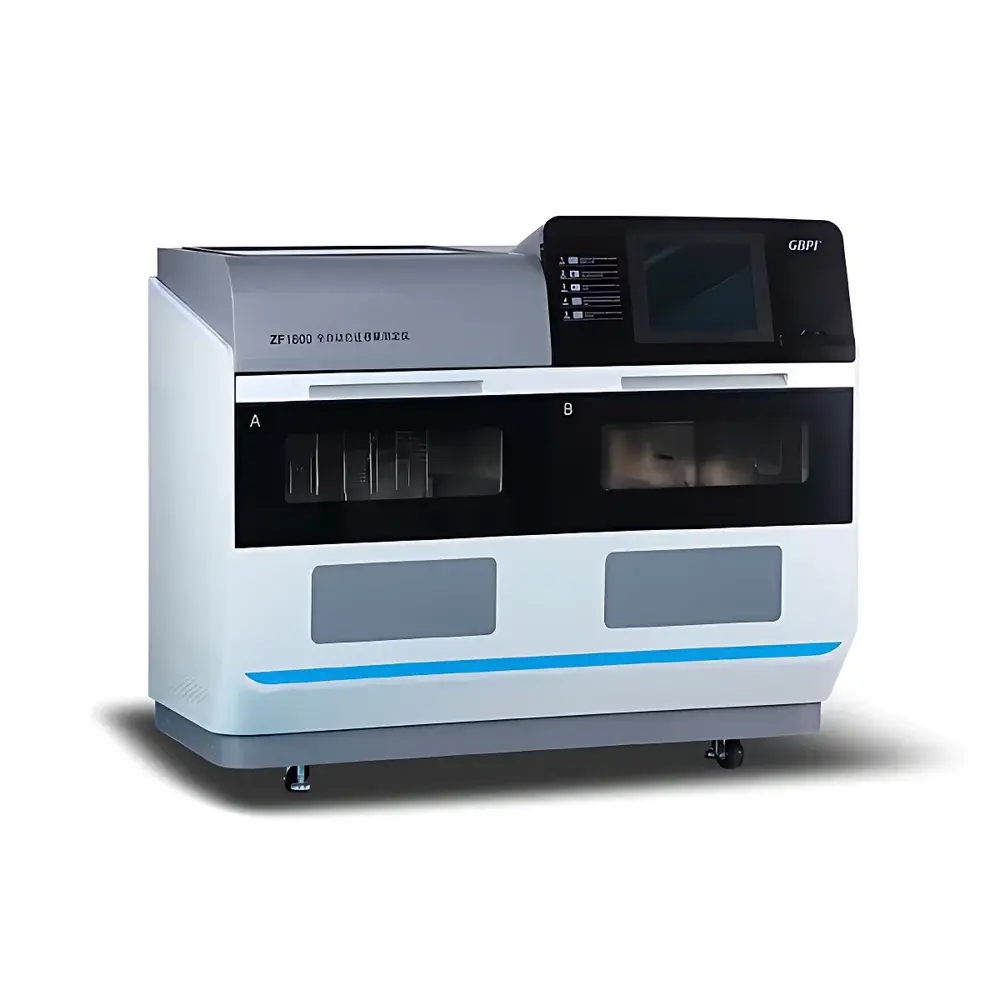
GBPI ZF1800-A1 Total Migration Tester with Evaporative Residue Measurement System
| Brand | GBPI |
|---|---|
| Origin | Guangdong, China |
| Manufacturer Type | Manufacturer |
| Model | ZF1800-A1 |
| Measuring Range | 0.2–167,000 mg/dm² |
| Resolution | 0.0001 g/dm² |
| Balance Capacity | 0–200 g |
| Balance Resolution | 0.1 mg |
| Water Bath Temp Control | RT–100 °C |
| Heating Chamber Temp Control | RT–117.9 °C |
| Cooling Chamber Temp Control | 10–35 °C |
| Temperature Uniformity | ±5 °C |
| Sample Capacity | 1–18 independent stations |
| Evaporating Dish Volume | 0–200 mL |
| Dimensions (Main Unit) | 178 × 93 × 145 cm (L×W×H) |
| Dimensions (Solvent Recovery Unit) | 120 × 88 × 170 cm (L×W×H) |
| Power Supply | 220 V, 50 Hz |
| Rated Power | 5000 W |
Overview
The GBPI ZF1800-A1 Total Migration Tester is a fully automated, integrated analytical system engineered for precise quantification of total migration—defined as the sum of all non-volatile substances released from food contact materials (FCMs) into food simulants under standardized conditions. It operates in strict accordance with international regulatory frameworks including EU Regulation (EC) No. 10/2011, ISO 17989:2014, and Chinese national standard GB 31604.8–2023. The instrument employs gravimetric analysis based on evaporative residue determination: after controlled extraction using specified food simulants (e.g., 3% acetic acid, 10% ethanol, olive oil), the extract is evaporated under regulated thermal conditions, and the residual mass is measured via high-resolution microbalance. This method provides trace-level accuracy essential for compliance verification across packaging films, containers, utensils, piping, and processing equipment made from polyolefins (PE, PP), polystyrene (PS), and chlorinated polymers such as PVC.
Key Features
- Dual-Independent Thermal Chambers: Separated heating and cooling zones enable simultaneous evaporation and desiccation—eliminating thermal cross-interference and reducing cycle time by up to 40% versus single-chamber systems.
- Automated Water Bath Subsystem: Integrated water bath with auto-fill, level sensing, temperature regulation (RT–100 °C), timed evaporation, and fail-safe dry-run detection; includes overtemperature and low-water alarms compliant with IEC 61000-6-2 EMC standards.
- Closed-Solvent Recovery Architecture: All solvent vapor pathways remain hermetically sealed during evaporation; vapors are condensed and collected within an integrated recovery unit, preventing atmospheric release and meeting OSHA PEL and EU Directive 2004/42/EC occupational exposure limits.
- Nitrogen Purge Capability: Optional inert gas inlet supports accelerated evaporation of heat-sensitive or volatile simulants while minimizing oxidation artifacts—critical for accurate migration assessment of unsaturated lipids or aldehydes.
- Negative-Pressure Test Chamber: Maintains consistent sub-atmospheric pressure (–5 to –15 kPa) throughout extraction and drying phases to suppress boiling point elevation and ensure reproducible solvent removal kinetics.
- ARM-Based Embedded Control: Touchscreen HMI runs real-time Linux OS with deterministic scheduling; no external PC required. Supports unattended operation including pre-scheduled crucible conditioning, multi-step weight stabilization, and auto-termination upon mass drift convergence (<0.1 mg over 30 min).
Sample Compatibility & Compliance
The ZF1800-A1 accommodates diverse FCM geometries—including flat films (≤300 mm × 300 mm), molded containers (up to 5 L volume), and irregular tools—via adjustable sample holders and 18 independent test stations. Each station maintains full data autonomy: individual simulant volume control, thermal profile assignment, and timestamped weight logging. Regulatory alignment includes full traceability to ISO/IEC 17025:2017 calibration requirements, GLP-compliant audit trails per OECD Series 1, and electronic signature support aligned with FDA 21 CFR Part 11 Annex 11 validation criteria. All hardware components meet IP54 ingress protection ratings; electrical safety complies with GB 4793.1–2019 (equivalent to IEC 61010-1).
Software & Data Management
The embedded software suite implements computerized system validation principles per EU GMP Annex 11 and USP . Role-based access control enforces separation of duties: Administrator, Analyst, Reviewer, and Auditor profiles with granular permission sets (e.g., method editing, report export, audit log deletion). Comprehensive audit trail records all user actions—including login/logout events, parameter modifications, weight corrections, and report generation—with immutable timestamps and digital signatures. Real-time dashboards display live weight trends, chamber temperatures, migration rates (mg/dm²), and statistical process control (SPC) charts. Export formats include PDF/A-2b, XLSX, and CSV with embedded metadata (ISO 8601 timestamps, operator ID, instrument serial number, calibration certificate IDs).
Applications
- Regulatory testing of plastic packaging for infant formula, dairy products, and acidic beverages
- Migration profiling of multilayer coextruded films containing EVOH or PVDC barriers
- Validation of cleaning-in-place (CIP) residue limits for stainless-steel food processing lines
- Stability studies assessing long-term leaching behavior under accelerated aging protocols
- Supplier qualification audits requiring full data lineage from raw material to final report
FAQ
What food simulants are supported by the ZF1800-A1?
The system is validated for aqueous simulants (3% acetic acid, 10% ethanol, distilled water), fatty simulants (olive oil, synthetic mixtures per CEN/TS 13130-1), and dry/solid simulants (Tenax®). Simulant selection follows EU Regulation (EC) No. 10/2011 Annex IV.
Does the instrument comply with FDA 21 CFR Part 11 requirements?
Yes—the software implements electronic signatures, audit trail immutability, role-based access, and secure authentication mechanisms fully aligned with Part 11 Subpart B for closed systems.
How is temperature uniformity verified across the 18 test stations?
Each chamber undergoes factory calibration using NIST-traceable PT100 sensors at nine spatial points; uniformity is certified at ±5 °C per ISO 17025-accredited calibration report included with shipment.
Can the system be integrated into a LIMS environment?
Yes—via optional OPC UA server module supporting structured data exchange (OPC UA PubSub over MQTT) with common LIMS platforms including LabWare, STARLIMS, and Thermo Fisher SampleManager.
What maintenance intervals are recommended for the solvent recovery system?
Condenser coils require quarterly inspection; activated carbon filters must be replaced every 200 operational hours or per solvent type-specific saturation thresholds documented in the maintenance logbook.







