
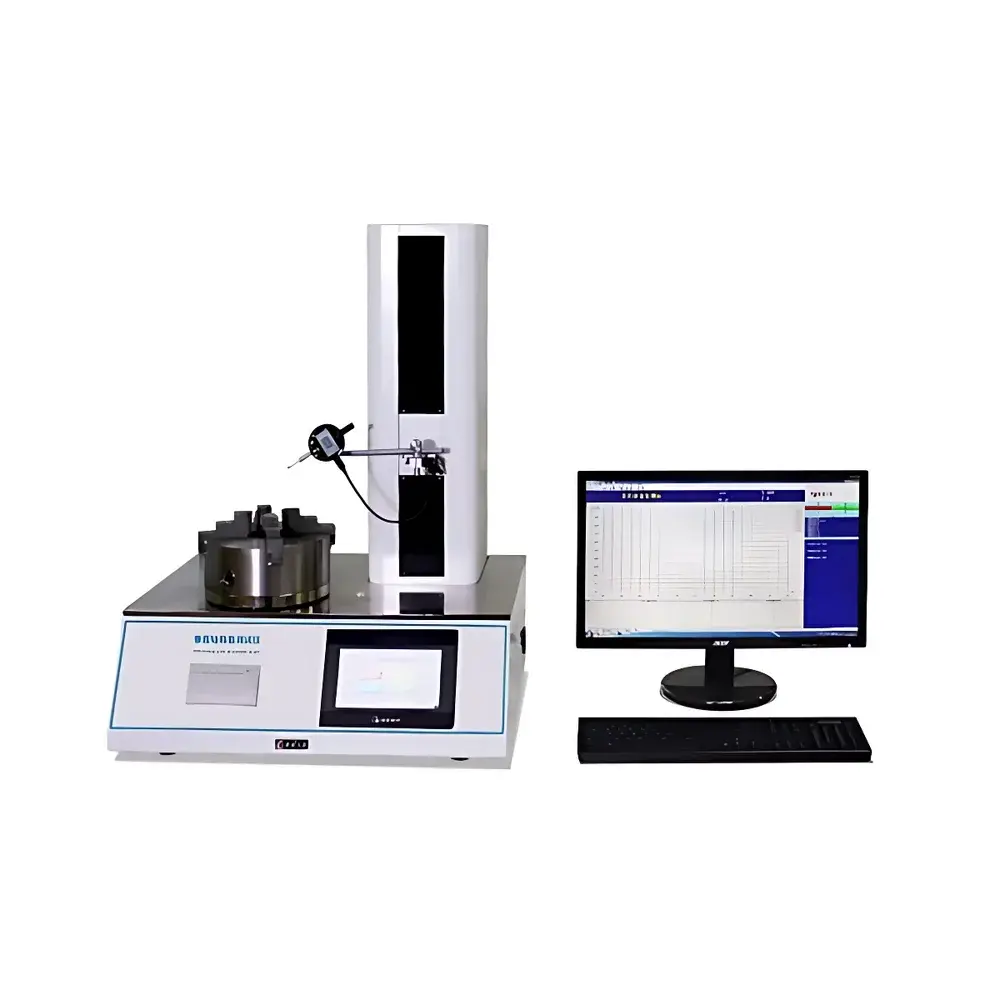
GBPI ZPY-G Electronic Vertical Axis Deviation Tester
| Brand | GBPI |
|---|---|
| Origin | Guangdong, China |
| Manufacturer Type | Manufacturer |
| Origin Category | Domestic |
| Model | ZPY-G |
| Price | Upon Request |
Overview
The GBPI ZPY-G Electronic Vertical Axis Deviation Tester is a precision metrology instrument engineered for quantitative assessment of vertical axis deviation (VAD) and radial runout in rigid cylindrical containers—primarily glass and plastic bottles used across pharmaceutical, food, cosmetic, and beverage industries. It operates on the principle of rotational contact measurement: a specimen is securely clamped at its base on a motorized horizontal turntable; a high-resolution digital indicator probe contacts the bottle’s upper rim or neck; the turntable rotates the sample through a full 360° revolution at a controlled speed of 2 r/min; the system continuously records axial displacement data; and VAD is calculated as half the difference between the maximum and minimum measured values (i.e., VAD = (Max − Min)/2), per ISO 8452:2008 and YBB00332002–2015. This deterministic mechanical-electronic methodology ensures traceable, repeatable, and operator-independent results essential for regulatory compliance and process validation.
Key Features
- 7-inch capacitive color touchscreen interface with embedded microcomputer control, enabling intuitive navigation, real-time parameter adjustment, and on-device statistical analysis (max/min/mean)
- Dual-mode operation: seamless switching between vertical axis deviation measurement and radial runout evaluation—eliminating need for separate instrumentation
- Full 360° angular compensation algorithm integrated into firmware, correcting for minor mechanical eccentricities to enhance measurement fidelity
- Motorized precision chuck with adjustable height range (5–400 mm) and sample diameter capacity (5–190 mm), accommodating vials, ampoules, infusion bottles, PET carbonated drink containers, and wine bottles
- Automated probe lift mechanism (300 mm/min) synchronized with rotation start/stop, minimizing manual intervention and ensuring consistent probe engagement force
- Integrated thermal mini-printer for immediate hard-copy output of test records including date/time stamp, sample ID, and raw deviation values
Sample Compatibility & Compliance
The ZPY-G is validated for use with glass containers—including low-borosilicate ampoules (YBB00332002–2015), sodium-calcium glass tubular and molded injection vials (YBB00332003–2015, YBB00032004–2015), oral liquid bottles, and infusion containers—as well as polymer-based packaging such as PET water and carbonated beverage bottles. Its mechanical design conforms to the dimensional and operational requirements specified in GB/T 8452–2008, GB 2639, QB 2357, and QB/T 1868. The instrument supports Good Manufacturing Practice (GMP) and Good Laboratory Practice (GLP) workflows through hardware-level audit trail capabilities, user-access tiering, and electronic record integrity features aligned with FDA 21 CFR Part 11 principles.
Software & Data Management
The proprietary PC-based control software provides comprehensive data acquisition, visualization, and reporting functionality. Real-time plotting displays axial displacement waveforms over rotation angle, facilitating diagnostic interpretation of asymmetry patterns. All raw and processed data are stored in a relational database with timestamped metadata. Export options include native .CSV, Excel-compatible .XLSX, and printable A4-format reports compliant with internal QA documentation standards. Role-based user permissions (administrator, technician, reviewer) enforce data governance; modification logs track all changes to test parameters or result annotations. Data retention is unlimited, scalable to enterprise laboratory information management systems (LIMS) via USB 2.0 interface.
Applications
Primary applications include routine quality control testing of pharmaceutical primary packaging: vertical axis deviation verification of glass ampoules and lyophilization vials per pharmacopoeial specifications; radial runout assessment of neck geometry for capping integrity assurance. Extended use cases span food-grade glass jars, cosmetic serum bottles, aluminum beverage cans (base-mounted), and HDPE milk containers. In R&D environments, the ZPY-G supports mold qualification, blow-molding process optimization, and container design validation—particularly where stacking stability, label alignment, or automated filling line compatibility is critical. Its adaptability to both rigid and semi-rigid substrates makes it suitable for comparative studies across material families and manufacturing methods.
FAQ
What standards does the ZPY-G comply with?
The instrument meets GB/T 8452–2008, YBB00332002–2015, YBB00332003–2015, YBB00032004–2015, GB 2639, QB 2357, and QB/T 1868.
Can the ZPY-G measure plastic bottles?
Yes—it accommodates PET, HDPE, PP, and other rigid or semi-rigid polymer containers within the specified height (5–400 mm) and diameter (5–190 mm) ranges.
Is audit trail functionality available?
Yes—the software implements electronic signatures, user-level access control, and immutable change logs meeting GLP/GMP and FDA 21 CFR Part 11 requirements.
What is the resolution and measurement range?
Resolution: 0.001 mm (0.00005 in); Full scale range: 0–12.7 mm (0.5 in).
Does the system support networked data export?
Data export is performed via USB interface; integration with LIMS or ERP systems requires custom middleware configuration by end-user IT infrastructure.





