
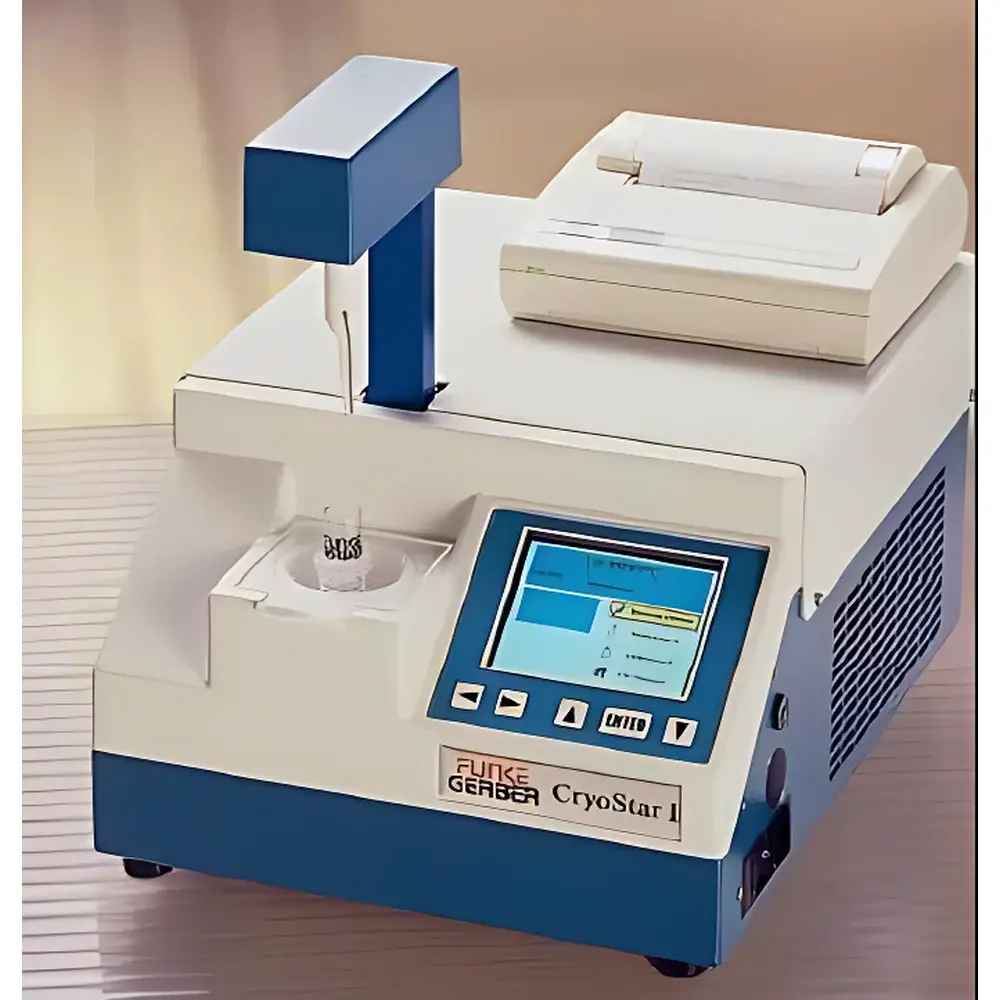
Gerber CryoStar Milk Cryoscope
| Brand | Funke |
|---|---|
| Origin | Germany |
| Model | CryoStar |
| Measurement Range | 0.000 to −1.5000 °C |
| Accuracy | ±0.0001 °C |
| Repeatability | ±0.002 °C |
| Sample Throughput | 40 samples/hour |
| Sample Volume | 2.0–2.5 mL |
| Display | Color LCD with graphical interface |
| Output | Ice point curve, ice point value (°C), water adulteration percentage, timestamp, date |
| Interfaces | RS-232 serial port, parallel printer port |
| Power Supply | 220 V / 50 Hz, 180 W |
| Dimensions | 29 × 38 × 24 cm |
| Weight | 12 kg |
| Compliance | AOAC Official Method 972.16, GB 5413.38–2016 |
Overview
The Gerber CryoStar Milk Cryoscope is a precision differential thermal analysis instrument engineered for the accurate and rapid determination of the freezing point depression in raw and processed bovine milk. Based on the colligative property principle—where solute concentration (primarily lactose, salts, and minerals) linearly correlates with freezing point depression—the CryoStar employs high-stability thermistor-based temperature sensing coupled with controlled Peltier cooling to resolve ice nucleation events at sub-millikelvin resolution. This method provides direct, non-destructive quantification of natural milk composition integrity and serves as the internationally recognized reference technique for detecting water adulteration. Designed for routine quality control laboratories in dairy processing plants, regulatory testing facilities, and accredited reference labs, the CryoStar delivers traceable, GLP-compliant results aligned with ISO 5725 (accuracy and precision) and validated against AOAC Official Method 972.16 and China’s GB 5413.38–2016.
Key Features
- Integrated Peltier-based refrigeration system enabling stable sub-zero operation even in ambient temperatures up to 35 °C, eliminating dependency on external coolant or compressed air
- High-resolution thermometry with ±0.0001 °C absolute accuracy and ≤0.002 °C intra-instrument repeatability over 24-hour continuous operation
- Automated freeze-point detection algorithm that identifies the characteristic plateau in the cooling curve using dynamic derivative thresholding, minimizing operator bias
- Onboard calculation engine compliant with the International Dairy Federation (IDF) standard formula for water adulteration quantification (expressed as % v/v)
- Multi-language user interface supporting English, German, French, Italian, Spanish, and Greek—fully configurable per lab workflow requirements
- Self-calibrating thermal path with NIST-traceable reference standards; calibration data—including date, operator ID, and deviation logs—is automatically archived with audit trail capability
Sample Compatibility & Compliance
The CryoStar accepts homogenized, unfiltered liquid milk samples (2.0–2.5 mL) without pre-treatment. It accommodates variations in fat content (0.5–6.0% w/w), total solids (11–14% w/w), and somatic cell count up to 1 × 10⁶/mL without signal interference. Validation studies confirm linearity across the full measurement range (0.000 to −1.5000 °C) with R² > 0.9999 against certified reference materials (CRMs) from LGC (UK) and BAM (Germany). The instrument meets essential requirements of IEC 61010-1 for laboratory electrical safety and electromagnetic compatibility (EMC). Its software architecture supports 21 CFR Part 11 readiness when deployed with optional secure login and electronic signature modules, enabling compliance with FDA-regulated dairy inspection programs and EU Regulation (EC) No 853/2004 Annex III.
Software & Data Management
Data acquisition, analysis, and reporting are managed via the embedded CryoControl firmware v4.2, featuring real-time curve visualization, automatic baseline correction, and configurable pass/fail limits per sample batch. All measurements are time-stamped with ISO 8601 formatting and stored locally in CSV and XML formats with embedded metadata (operator, calibration status, environmental temperature, sample ID). RS-232 output supports bidirectional communication with LIMS platforms (e.g., LabWare, STARLIMS) using ASTM E1384-compliant message structures. Audit trails record all parameter modifications, result overrides, and calibration events with immutable timestamps—enabling full traceability during internal audits or accreditation assessments (ISO/IEC 17025).
Applications
- Regulatory verification of milk authenticity at intake stations and export certification laboratories
- Process monitoring during raw milk reception to trigger automatic rejection of adulterated batches
- Stability assessment of ultra-high-temperature (UHT) and pasteurized products during shelf-life studies
- Method transfer and cross-validation between national reference labs under Codex Alimentarius guidelines
- Training and proficiency testing in food chemistry curricula accredited by EFSA and AOAC INTERNATIONAL
FAQ
What freezing point value indicates adulteration in cow’s milk?
The typical freezing point of authentic bovine milk ranges from −0.512 °C to −0.530 °C. A measured value above −0.500 °C strongly suggests dilution with potable water; the CryoStar calculates the exact % v/v adulteration using the IDF-recommended equation.
Is sample centrifugation or filtration required before analysis?
No. The CryoStar is validated for direct analysis of homogenized raw milk. Particulates and fat globules do not interfere with thermal nucleation detection due to optimized sensor geometry and signal averaging algorithms.
Can the instrument be integrated into an existing LIMS environment?
Yes. RS-232 serial output supports ASCII-based data streaming compatible with ASTM E1384 and HL7 v2.x message protocols. Optional USB-to-serial adapters and middleware drivers are available for seamless ingestion into major LIMS architectures.
How frequently must calibration be performed?
Initial calibration is performed at factory using triple-point cells. Field recalibration is recommended every 90 days or after 500 measurements—whichever occurs first—and is fully automated using certified glycerol/water reference solutions.
Does the CryoStar comply with ISO/IEC 17025 documentation requirements?
Yes. All measurement records include embedded uncertainty budgets (k=2), equipment identification, environmental conditions, and operator credentials—satisfying clause 7.8.2 of ISO/IEC 17025:2017 for result reporting.



