
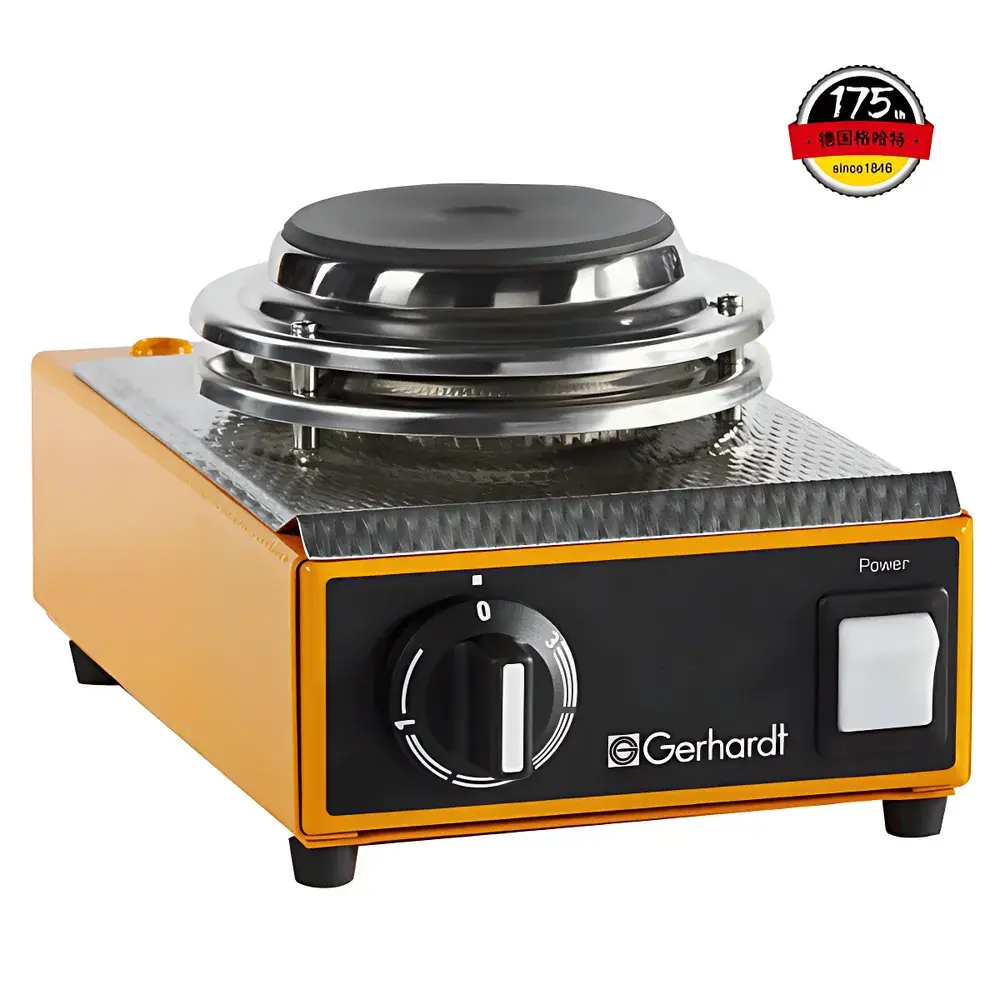
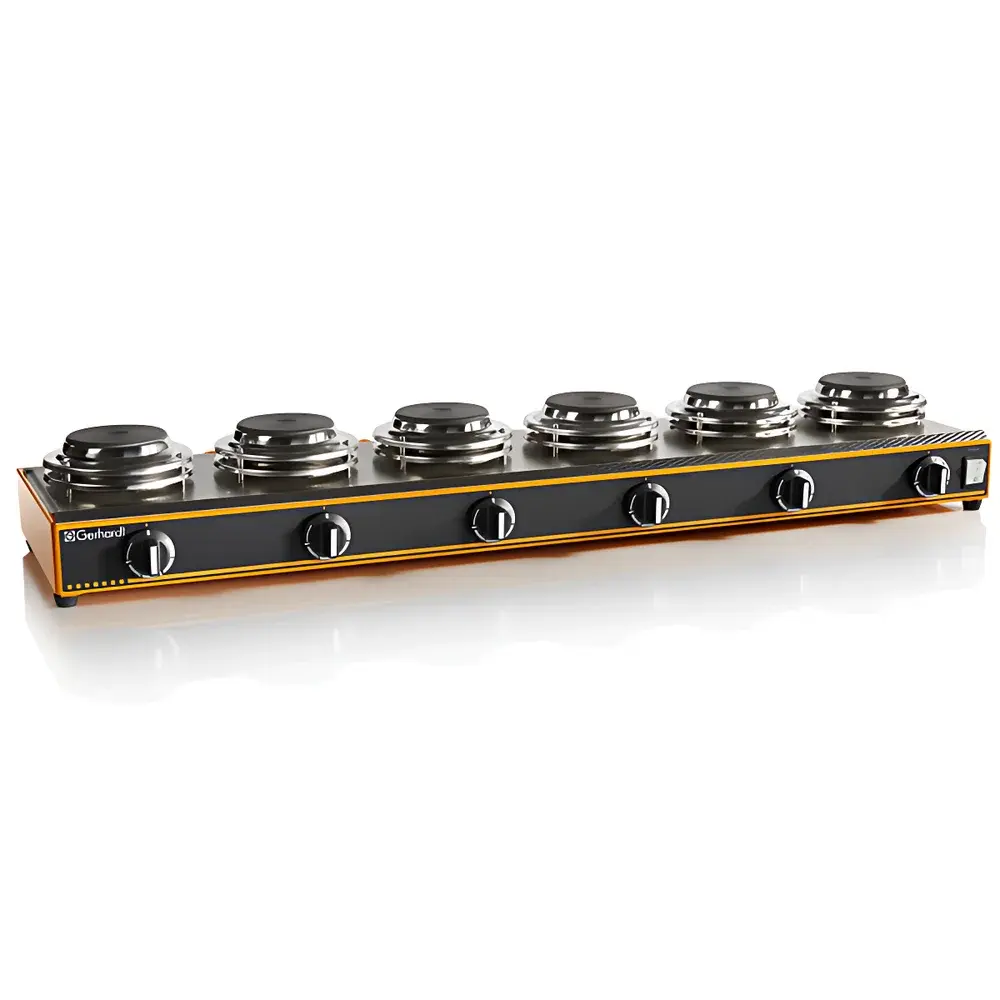
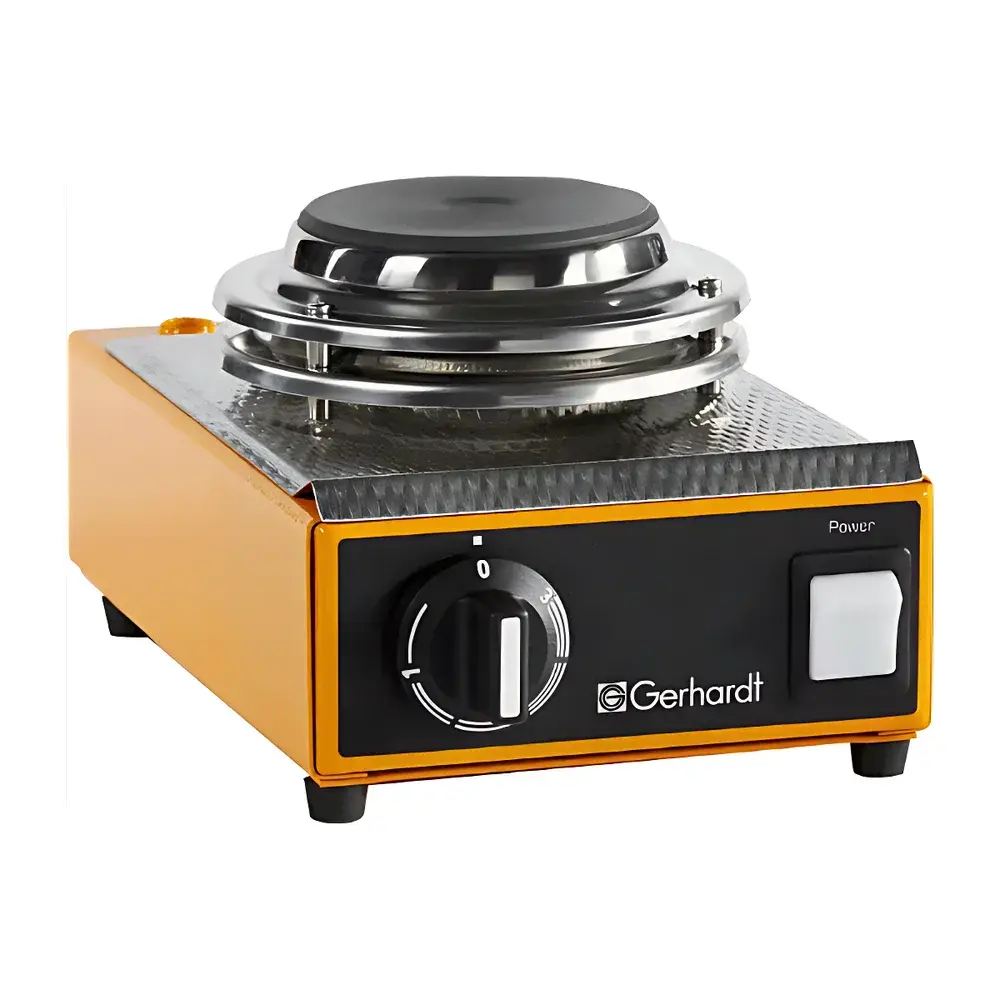
Gerhardt EV1 Flat-Bottom High-Temperature Heating Block Metal Bath
| Brand | Gerhardt |
|---|---|
| Origin | Germany |
| Manufacturer | C. Gerhardt GmbH & Co. KG |
| Model | EV1 |
| Order No. | 10-0001 |
| Max Temperature | 425 °C |
| Heating Position | 1 |
| Power | 450 W |
| Voltage | 230 V AC, 50/60 Hz |
| Temperature Control Range | 0–425 °C (adjustable in 1 °C increments) |
| Temperature Stability | ±1 °C at 425 °C (typical, after thermal equilibrium) |
| Heating Time (RT → 425 °C) | ≤5 min |
| Dimensions (W×D×H) | 150 × 225 × 110 mm |
| Net Weight | 2.0 kg |
| Compliance | CE, IEC 61010-1, RoHS |
Overview
The Gerhardt EV1 Flat-Bottom High-Temperature Heating Block Metal Bath is a precision-engineered single-position heating platform designed for reproducible, stable thermal control in analytical and preparatory laboratory workflows. Unlike conventional hotplates with ceramic or coil-based surfaces, the EV1 employs a solid aluminum heating block with machined flat-bottom wells—optimized for direct, uniform conductive heat transfer to reaction vessels, digestion tubes, and distillation receivers. Its operational principle relies on resistive heating elements embedded within a thermally homogeneous metal mass, coupled with a PID-controlled digital thermostat that continuously monitors and adjusts power output to maintain setpoint stability within ±1 °C across its full 0–425 °C range. This architecture ensures minimal thermal gradients, high repeatability between runs, and compatibility with standardized sample containers used in official methods—including AOAC, ISO, and DIN protocols for fiber analysis, acid digestion, and solvent extraction.
Key Features
- Single-position flat-bottom aluminum heating block (150 × 225 mm surface area) engineered for optimal contact with round-bottom flasks, Kjeldahl digestion tubes, and Soxhlet thimbles
- Digital PID temperature controller with intuitive push-button interface and LED display; resolution: 1 °C, setpoint accuracy: ±0.5 °C (calibrated)
- Robust thermal design: reaches 425 °C in ≤5 minutes from ambient and maintains stability under continuous load without drift
- 450 W rated power output with 0–100% adjustable power modulation—enabling fine-tuned ramping and low-temperature holding (e.g., 40–80 °C for enzymatic hydrolysis)
- CE-marked and compliant with IEC 61010-1 for electrical safety in laboratory environments; RoHS-conformant materials throughout
- Compact footprint (150 × 225 × 110 mm) and lightweight construction (2.0 kg) facilitate integration into fume hoods, digestion workstations, or modular analytical platforms
Sample Compatibility & Compliance
The EV1 accommodates standard laboratory glassware and metal vessels with flat or gently curved bases up to Ø80 mm diameter. It is routinely deployed in accredited laboratories performing AOAC 978.10 (crude fiber), ISO 5986 (detergent fiber), DIN 10772 (Kjeldahl digestion), and EN 15510 (Soxhlet fat extraction). Its temperature performance meets the thermal stability requirements outlined in USP for heating steps in dissolution and extractables testing. While the unit itself does not include data logging, its analog control architecture supports external validation via calibrated RTD probes per GLP documentation standards. The absence of open coils or exposed heating elements eliminates contamination risk—critical for trace-metal analysis and regulatory-compliant sample preparation.
Software & Data Management
The EV1 operates as a standalone analog-digital hybrid instrument with no embedded software or network interface. All parameter settings—including setpoint, ramp rate (via manual power adjustment), and hold time—are configured directly on the front panel. For laboratories requiring audit trails, the device is compatible with third-party temperature validation systems (e.g., Fluke 1524 with probe mapping) and can be integrated into LIMS via external relay modules triggered by auxiliary contacts (optional accessory). Though it lacks native 21 CFR Part 11 functionality, its mechanical simplicity and deterministic behavior make it suitable for GMP environments where procedural controls—not electronic records—are the primary compliance mechanism for heating steps.
Applications
- Kjeldahl nitrogen digestion: precise 400–425 °C heating for complete organic matrix decomposition in food, feed, and environmental samples
- Soxhlet and Randall fat extraction: stable 70–100 °C operation for controlled solvent reflux without bumping or thermal shock
- Crude and detergent fiber analysis (AOAC 978.10, ISO 5986): reproducible 100 °C hydrolysis and 550 °C ashing pre-step conditioning
- Acid and alkaline hydrolysis for carbohydrate profiling: programmable low-power ramping to minimize sugar degradation
- Pre-heating of GC vials, HPLC autosampler trays, and calibration standards prior to injection
- Controlled evaporation of solvents in open-vessel concentration workflows
FAQ
Is the EV1 suitable for use under a fume hood?
Yes—the compact dimensions, sealed aluminum housing, and absence of volatile coatings or fans make it fully compatible with fume hood installation. Ensure adequate clearance (≥50 mm) around ventilation slots.
Can the EV1 accommodate borosilicate glass digestion tubes with conical bases?
It is optimized for flat-bottom or low-radius curvature vessels. Conical tubes require optional adapter inserts (Gerhardt Art. No. 10-0002) to ensure full surface contact and thermal uniformity.
Does the EV1 support external temperature feedback for closed-loop control?
No—it uses an internal sensor only. For external probe integration, a separate programmable temperature controller (e.g., Omega CN7800 series) must be used in cascade mode.
What maintenance is required for long-term accuracy?
Annual verification using a NIST-traceable RTD probe is recommended. Clean the block surface with non-abrasive ethanol wipes after each use; avoid water ingress into control electronics.
Is replacement firmware or calibration certificate available from Gerhardt?
As a Class I analog-digital instrument, the EV1 does not contain field-upgradable firmware. Calibration certificates are issued upon request at time of purchase or during service visits (traceable to DKD/DAkkS-accredited labs).



