
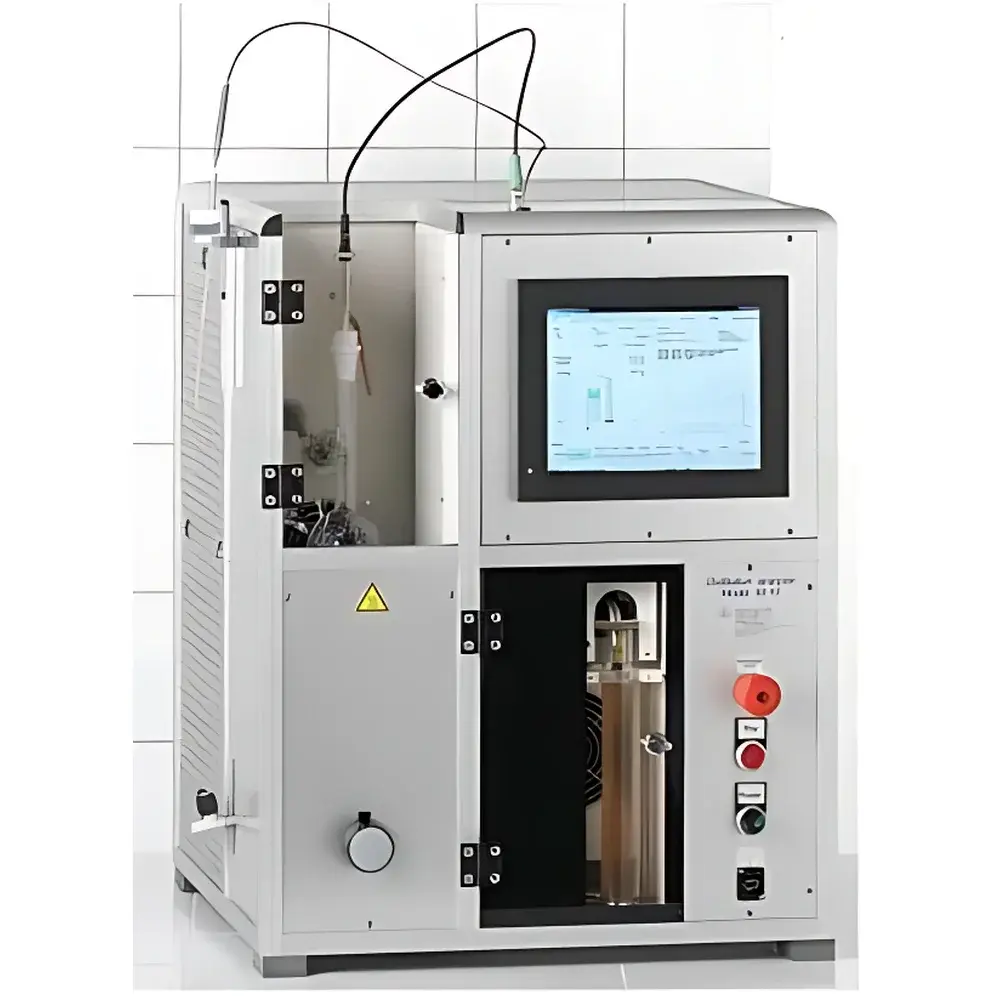
German-made 40.10 Automatic Petroleum Distillation Apparatus
| Origin | Germany |
|---|---|
| Manufacturer Type | Authorized Distributor |
| Origin Category | Imported |
| Model | 40.10 |
| Price Range | USD 13,500 – 68,000 |
Overview
The German-made 40.10 Automatic Petroleum Distillation Apparatus is a fully automated, benchtop distillation system engineered for precise, repeatable determination of boiling point distributions in petroleum products and related volatile organic liquids. It operates in strict accordance with standardized distillation methodologies—including ASTM D86 (Standard Test Method for Distillation of Petroleum Products at Atmospheric Pressure), ASTM D1078 (Volatility of Volatile Organic Liquids), ASTM D850 (Distillation of Industrial Aromatic Hydrocarbons), ISO 3405, and DIN 51751—enabling laboratories to meet regulatory, quality assurance, and product specification requirements across refining, petrochemical, fuel blending, and independent testing facilities. The instrument employs a calibrated atmospheric distillation principle: controlled heating of the sample in a standardized 125 mL or 200 mL distillation flask, real-time vapor temperature monitoring via Pt-100 RTD sensors, condensation in a water-cooled or Peltier-assisted condenser, and volumetric collection in graduated receiving cylinders—all under continuous microprocessor supervision. Its architecture integrates safety-critical subsystems—including optical flame detection and an automatic halon-free fire suppression module—ensuring compliance with laboratory safety protocols (e.g., OSHA 1910.106, NFPA 30) without compromising analytical integrity.
Key Features
- Integrated Peltier-based thermoelectric cooling/heating system enables rapid thermal transition between distillation cycles—reducing cooldown time by up to 65% versus conventional air- or water-cooled units.
- 24 VAC low-voltage heating element with closed-loop PID control ensures stable, reproducible heating rates (±0.5 °C/min) across the full 0–400 °C range.
- Dual Pt-100 RTD temperature sensors: one immersed in vapor phase above the flask (ASTM D86-compliant positioning), the second mounted at the condenser outlet—both traceable to NIST standards with ±0.01 °C accuracy.
- Embedded industrial PC with 10.4″ color TFT-LCD touchscreen interface, onboard keyboard, and pre-installed distillation control software—no external computer required for routine operation.
- Configurable receiver heating zone (up to 60 °C) prevents wax or high-boiling residue solidification during distillation of paraffinic fractions, naphthenic oils, or heavy solvents.
- Real-time graphical display of multiple synchronized curves: temperature vs. volume % distilled, heating power profile, pressure-compensated curve (with optional barometric sensor), and rate-of-evaporation derivative.
- Automated dry point detection per ASTM D850/D1078 using optional thermocouple probe and 200 mL flask assembly—validated against certified reference materials (CRMs).
- Comprehensive safety architecture: optical flame detector (response < 100 ms), integrated fire suppression unit, overtemperature cut-off, and door-interlocked emergency shutdown.
Sample Compatibility & Compliance
The 40.10 is validated for use with gasoline, jet fuel (Jet A-1, JP-8), diesel fuel, kerosene, naphtha, light cycle oil, aromatic hydrocarbon blends (e.g., BTX), solvent naphthas, white spirit, and other hydrocarbon mixtures with initial boiling points ≥ 30 °C and final boiling points ≤ 400 °C. All hardware configurations—including flasks, condensers, adapters, and receivers—conform to dimensional and material specifications outlined in ASTM D86 Annex A1 and ISO 3405 Clause 6. Instrument calibration and performance verification are supported by traceable reference standards (e.g., NIST SRM 1840a, 1841a) and include documented uncertainty budgets compliant with ISO/IEC 17025:2017. Full audit trail functionality satisfies GLP and GMP documentation requirements, including electronic signatures and 21 CFR Part 11–compliant data archiving when paired with optional networked server deployment.
Software & Data Management
The proprietary distillation control software provides method-driven workflow management: users define multi-step distillation protocols (e.g., ASTM D86 Steps 0–4), set pressure compensation parameters, configure reporting templates (PDF/CSV/XLSX), and assign operator IDs with role-based access control. Raw data—including timestamped temperature/volume pairs, heating power logs, and alarm events—are stored locally on the embedded SSD with SHA-256 hashing for integrity verification. Software calculates repeatability (r) and reproducibility (R) per ASTM D86 Annex B and generates comparative overlay plots for inter-laboratory validation. All reports include metadata: instrument ID, calibration date, analyst signature, environmental conditions (ambient T/P), and uncertainty statements aligned with EURACHEM/CITAC Guide CG4.
Applications
- Refinery QC/QA labs performing routine distillation analysis on crude cuts, reformulated gasoline, and aviation turbine fuels.
- Petrochemical R&D evaluating volatility profiles of bio-derived hydrocarbons and synthetic blendstocks.
- Independent testing laboratories accredited to ISO/IEC 17025 delivering certified test reports for regulatory submission (EPA, EN 228, GB 17930).
- Fuel additive compatibility studies requiring precise fraction recovery quantification (e.g., ethanol-blended gasoline stability assessment).
- Technical service centers supporting ASTM D86 method transfer, instrument qualification (IQ/OQ/PQ), and method validation per ICH Q2(R2).
FAQ
Does the 40.10 support ASTM D86 Step 4 (residue and loss determination)?
Yes—the system includes dedicated residue weighing mode, calibrated evaporation loss calculation, and integrated balance interface (optional) for full Step 4 compliance.
Can the instrument be integrated into a LIMS environment?
Yes—via standard OPC UA or TCP/IP protocol; raw data export supports ASTM E1384 and ASTM E1467-compliant structured formats.
Is third-party calibration certification available?
Yes—factory-certified calibration with NIST-traceable Pt-100 verification and as-found/as-left reports is provided upon request.
What maintenance intervals are recommended?
Preventive maintenance every 12 months or 500 runs; includes sensor recalibration, condenser cleaning, firmware update, and safety system functional check.
Are replacement parts and consumables stocked regionally?
Yes—critical spares (flasks, gaskets, RTD probes, Peltier modules) are held in EU and North American distribution hubs with 48-hour dispatch.




