
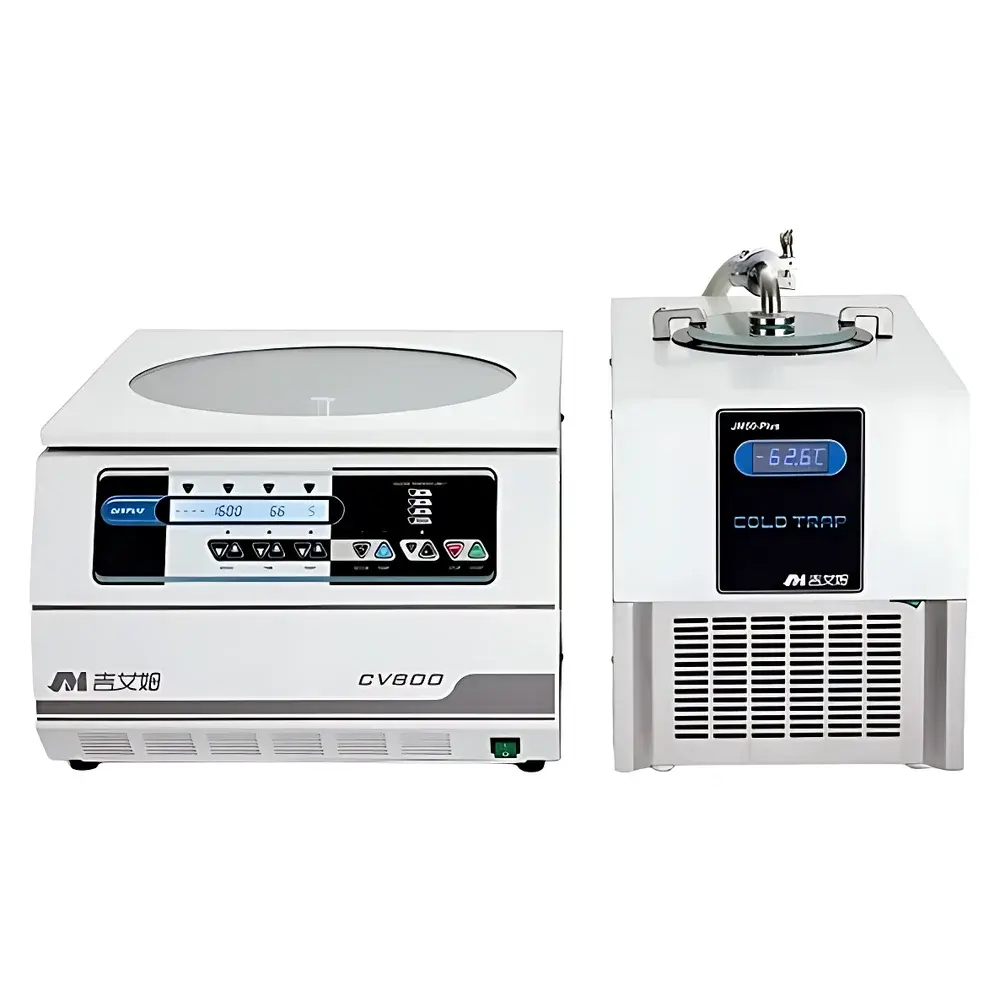
GiAim CV800 High-Throughput Vacuum Centrifugal Concentrator with Ultra-Low-Temperature Cold Trap
| Brand | GiAim |
|---|---|
| Origin | Beijing, China |
| Model | CV800 |
| Instrument Type | Vacuum Centrifugal Concentrator |
| Temperature Range | Ambient +5°C to 80°C |
| Sample Capacity | 200 × 1.5 mL tubes (2000 mL total) |
| Rotational Speed | 300–1800 rpm |
| Max RCF | 630 × g |
| Timer Range | 0–9999 min |
| Cold Trap Temperature | ≤ −60°C |
| Cold Trap Capacity | 2000 mL |
| Ultimate Vacuum | ≤ 30 Pa |
| Noise Level | ≤ 60 dB(A) |
| Power Supply | AC 220 V, 50/60 Hz, 10 A |
| Dimensions (L×D×H) | 590 × 445 × 292 mm |
| Weight | 42 kg |
Overview
The GiAim CV800 is a high-throughput vacuum centrifugal concentrator engineered for laboratories requiring robust, scalable sample concentration of biological and chemical analytes under controlled thermal and vacuum conditions. It operates on the principle of simultaneous rotational evaporation and vacuum-assisted solvent removal: centrifugal force prevents boiling over and maintains sample integrity, while reduced pressure lowers the boiling point of solvents—enabling gentle, efficient concentration of heat-sensitive compounds such as nucleic acids, proteins, peptides, and small-molecule pharmaceuticals. Integrated ultra-low-temperature cold trapping (≤ −60°C) ensures high-efficiency condensation of volatile solvents—including ethanol, methanol, acetone, and acetonitrile—minimizing vapor load on the vacuum pump and extending its service life. Designed for walk-away operation in QC, genomics, proteomics, and analytical chemistry workflows, the CV800 supports reproducible, GLP-compliant processing across batch sizes up to 200 × 1.5 mL microcentrifuge tubes (2000 mL total volume).
Key Features
- High-throughput capacity: accommodates up to 200 × 1.5 mL conical or round-bottom microcentrifuge tubes in a single run—optimized for high-volume sample preparation in biobanking, NGS library prep, and clinical assay development.
- Ultra-low-temperature cold trap: stainless-steel cold trap with Teflon-coated interior achieves ≤ −60°C operating temperature, delivering >95% solvent capture efficiency for common organic solvents and aqueous buffers.
- Vacuum delay logic: vacuum initiation is automatically deferred until rotor reaches preset speed—preventing tube tipping, foaming, or aerosol formation during acceleration.
- Fail-safe sample protection: integrated power-failure vacuum release mechanism evacuates chamber pressure immediately upon mains interruption, preventing sample warming or cross-contamination.
- Corrosion-resistant chamber: 304 stainless-steel rotor chamber with electropolished Teflon coating resists aggressive solvents (e.g., HCl, TFA, DCM) and facilitates cleaning and validation per ISO 13485 or FDA 21 CFR Part 11 requirements.
- Stable drive architecture: brushless DC motor coupled with electromagnetic direct-drive system ensures consistent RCF delivery across full speed range (300–1800 rpm; max 630 × g), with <±1% speed accuracy and low mechanical drift.
- Automated post-run venting: programmable inert gas (N₂) or ambient air purge initiates automatically after completion, eliminating manual venting errors and ensuring operator safety.
Sample Compatibility & Compliance
The CV800 accepts standard 1.5 mL microcentrifuge tubes (including PCR-grade, low-bind, and skirted variants), as well as 0.5 mL and 2.0 mL formats via optional adapters. Compatible with aqueous, alcoholic, and moderately volatile organic solvents. Not intended for use with highly corrosive halogenated solvents (e.g., chloroform, carbon tetrachloride) without dedicated condenser retrofitting. Meets IEC 61010-1:2010 safety standards for laboratory equipment. Vacuum control and timer functions support audit-ready operation under GLP and GMP environments; event logs—including speed, temperature, vacuum level, and runtime—are timestamped and exportable for regulatory review.
Software & Data Management
The CV800 features an embedded 4.3-inch capacitive touchscreen interface with multilingual support (English, German, French, Spanish, Chinese). All parameters—including ramp profiles, hold steps, vacuum setpoints, and cooling cycles—are programmable and storable in ≥100 user-defined methods. Real-time monitoring displays actual RCF, chamber temperature, cold trap temperature, and absolute vacuum pressure (mbar/Pa). Data export via USB-C supports CSV format for integration into LIMS or ELN platforms. Optional RS-485 or Ethernet module enables remote monitoring and centralized fleet management in core facilities.
Applications
- Concentration and desalting of DNA/RNA extracts prior to sequencing or qPCR
- Lyophilization pre-concentration of monoclonal antibody formulations
- Removal of residual solvents from synthetic intermediates in medicinal chemistry
- Preparative cleanup of LC-MS fractions in metabolomics studies
- High-throughput sample archival in biorepositories (−80°C compatible tube storage post-concentration)
- Buffer exchange and solvent replacement in protein purification workflows
FAQ
What vacuum pumps are compatible with the CV800?
The CV800 is optimized for use with oil-free diaphragm vacuum pumps rated ≥25 L/min at ≤30 Pa ultimate vacuum. Recommended models include KNF NP series, Agilent Vacuubrand PC series, and Welch DuoSeal units.
Can the CV800 be used for lyophilization?
No—it is not a freeze dryer. The CV800 performs vacuum centrifugation only; it lacks shelf cooling, primary drying control, or pressure modulation required for true lyophilization.
Is the cold trap removable for cleaning?
Yes—the 2000 mL stainless-steel cold trap is tool-free detachable and autoclavable (up to 121°C, 20 min), supporting routine decontamination and solvent residue verification.
Does the CV800 support 21 CFR Part 11 compliance?
With optional software upgrade and networked authentication module, electronic signatures, audit trails, and role-based access control can be enabled to meet FDA 21 CFR Part 11 requirements.
What maintenance intervals are recommended?
Cold trap cleaning every 50 operational hours; vacuum hose inspection quarterly; rotor balance verification semiannually; full calibration (speed, temperature, vacuum) annually by authorized service technician.



