
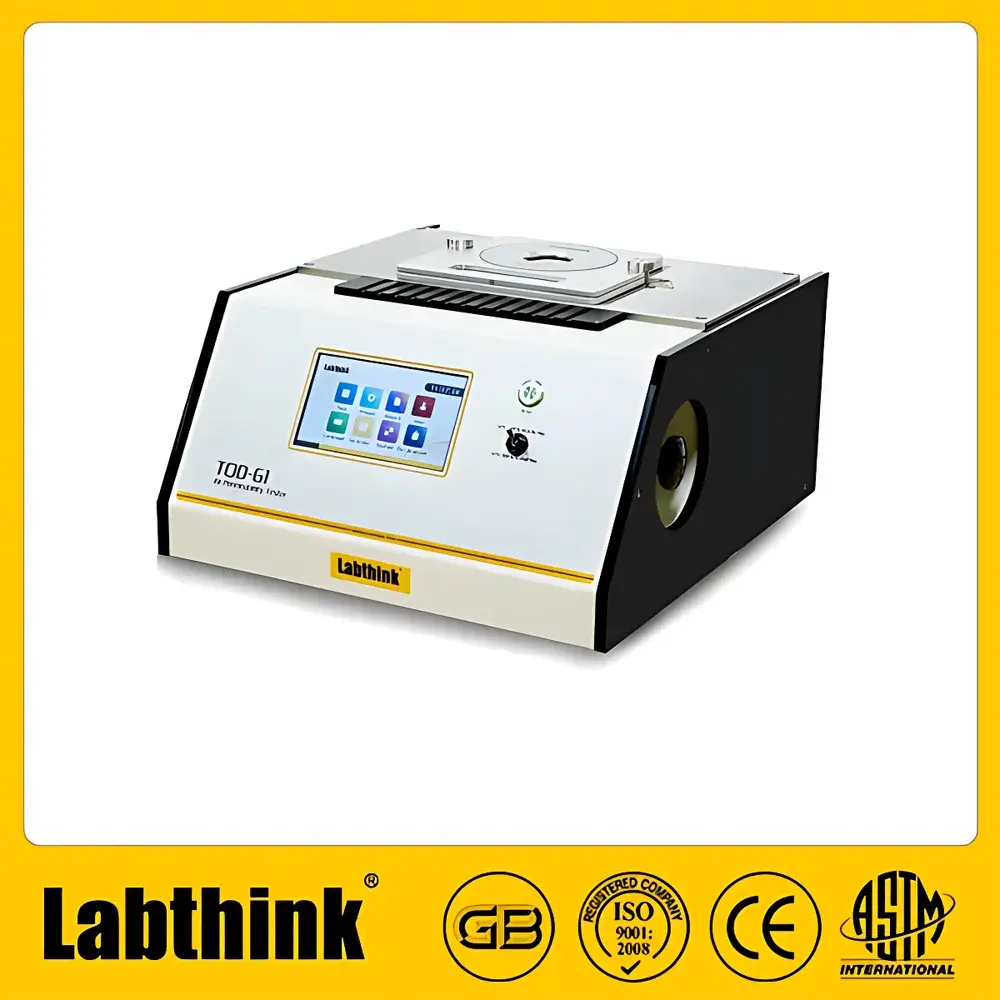
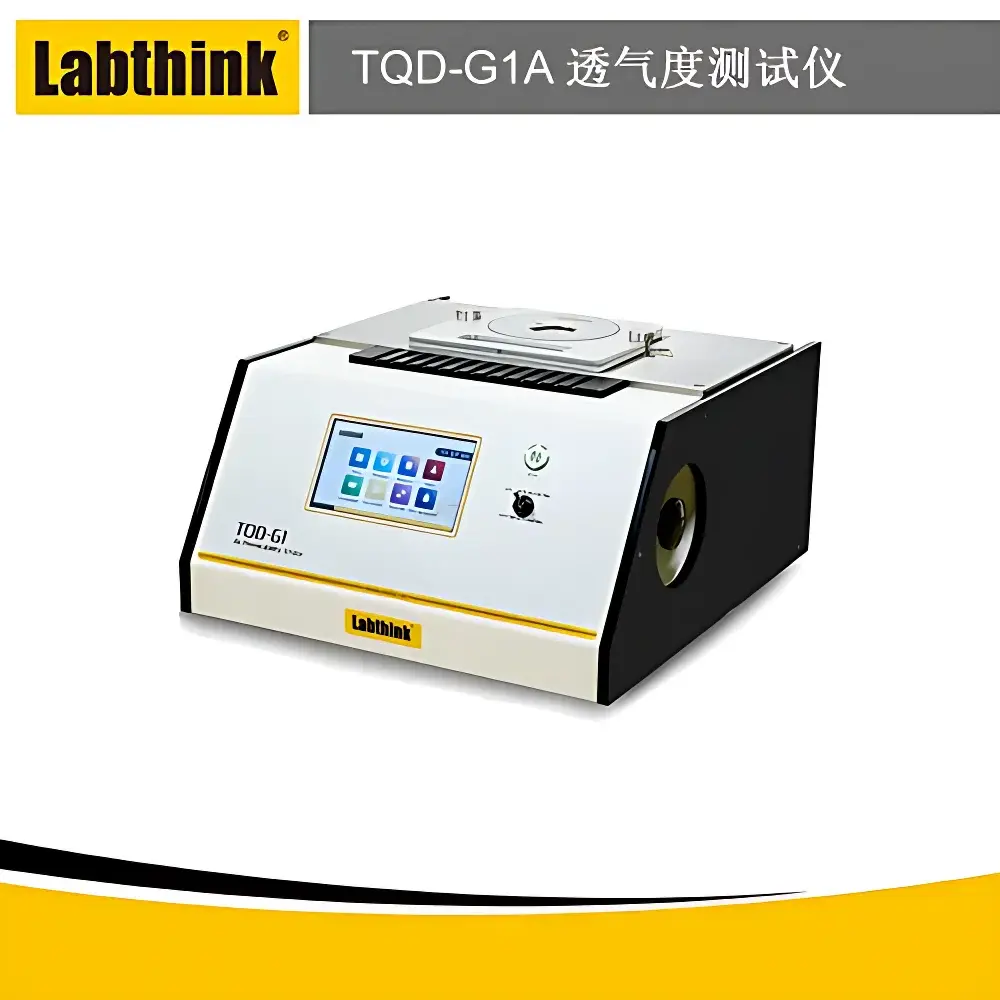
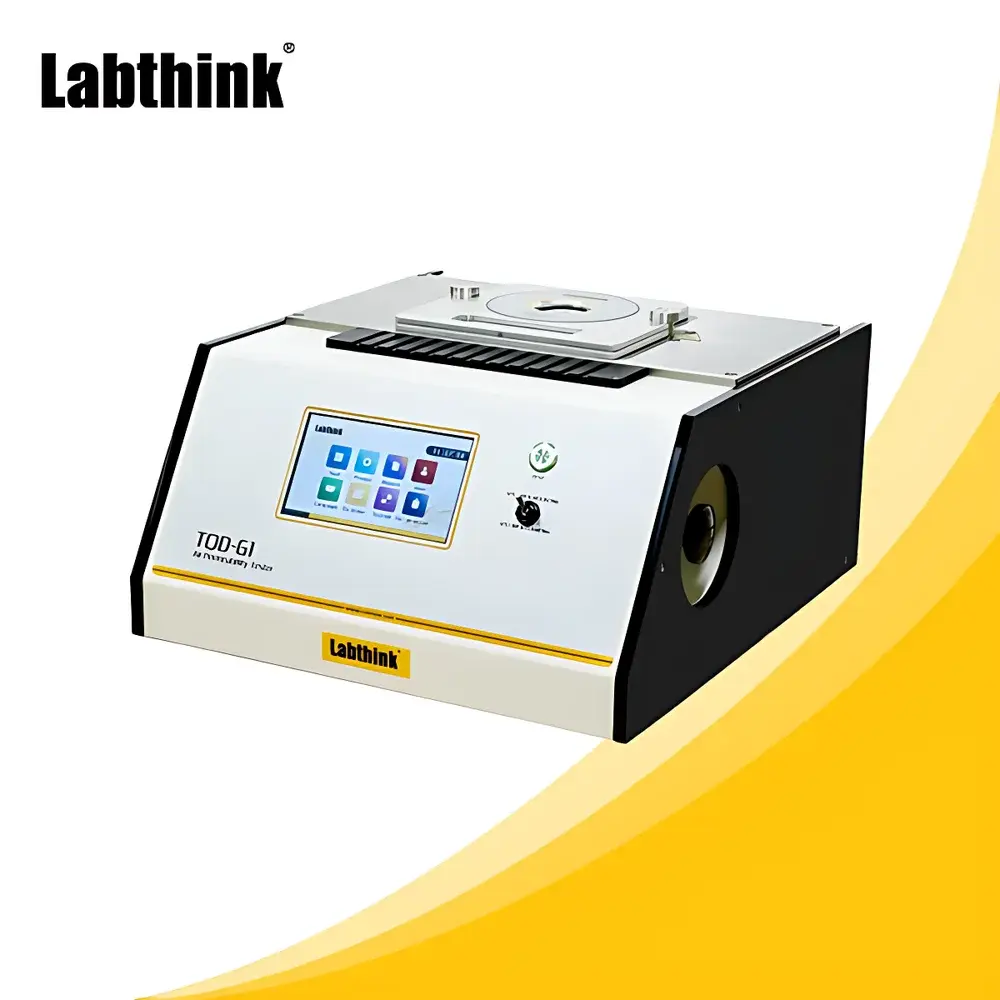
Labthink TQD-G1A Air Permeability Tester for Textiles and Industrial Materials
| Brand | Labthink |
|---|---|
| Origin | Shandong, China |
| Manufacturer Type | Direct Manufacturer |
| Country of Origin | China |
| Model | TQD-G1A |
| Price Range | USD 14,000 – 42,000 |
| Pressure Drop Range | 0–1000 Pa |
| Pressure Resolution | 0.1 Pa |
| Pressure Accuracy | ±0.25% FS |
| Airflow Range | 0–30 L/min |
| Airflow Resolution | 0.1 L/min |
| Airflow Accuracy | ±2% FS |
| Test Area | 20 cm² (standard, customizable) |
| Sample Size | 5 cm × 5 cm |
| Max Sample Thickness | 1 mm |
| Gas Supply | Clean compressed air (user-supplied, ≥550 kPa, >120 L/min) |
| Power | 120 VAC ±10%, 60 Hz or 220 VAC ±10%, 50 Hz (selectable) |
| Dimensions (W×D×H) | 300 × 460 × 520 mm |
| Net Weight | 25 kg |
| Compliance Standards | ISO 9237, ISO 4638, ISO 5636, GB/T 5453, GB/T 10655, ASTM D737, TAPPI T460, JIS P8117 |
Overview
The Labthink TQD-G1A Air Permeability Tester is a precision-engineered instrument designed for quantitative evaluation of gas transmission behavior in porous and fibrous sheet materials under controlled differential pressure or constant airflow conditions. It operates on two standardized physical principles: Method A (constant airflow mode), where a fixed volumetric flow rate is imposed across the specimen and the resulting pressure differential is measured; and Method B (constant pressure mode), where a defined pressure gradient is applied and the volumetric airflow through a specified test area is quantified over time. These dual-mode capabilities enable rigorous determination of key material performance indicators—including air permeability (in µm/Pa·s or L/m²·s·Pa), air resistance (in Pa·min/L), and Gurley-type resistance—critical for functional validation in automotive interiors, personal protective equipment (PPE), filtration media, and packaging substrates.
Key Features
- Dual measurement modes compliant with ISO 9237 and ASTM D737: selectable constant-flow or constant-pressure operation via intuitive touch interface
- High-stability pneumatic clamping system ensures uniform sample compression and eliminates edge leakage—critical for reproducible results across heterogeneous textiles and nonwovens
- Integrated maintenance-free vacuum generation module delivers stable, pulse-free airflow with minimized thermal drift and long-term calibration stability
- 7-inch industrial-grade color touchscreen with embedded real-time clock, multi-language UI (English, Chinese, Spanish, German), and three-tier user permission management (Operator, Supervisor, Administrator)
- High-accuracy digital differential pressure transducer (0–1000 Pa, 0.1 Pa resolution, ±0.25% FS) and thermal mass airflow sensor (0–30 L/min, 0.1 L/min resolution, ±2% FS)
- Standardized 20 cm² test area (5 cm × 5 cm specimen aperture); optional custom test areas available upon request to support specialized regulatory testing protocols
- RS232 serial interface for bidirectional communication with external PCs; optional Labthink proprietary software enables automated report generation, statistical process control (SPC), and audit-ready data export (CSV, PDF)
Sample Compatibility & Compliance
The TQD-G1A accommodates a broad spectrum of flexible, planar, and compressible materials up to 1 mm thickness, including but not limited to: polyurethane foams, PVC-coated fabrics, synthetic leathers, woven and knitted textiles, spunbond/meltblown nonwovens, technical filter papers, medical-grade mask layers (e.g., meltblown polypropylene), carpet backings, and corrugated board facing sheets. Its mechanical design conforms to ISO/IEC 17025 general requirements for testing laboratories and supports full traceability per GLP/GMP guidelines. All test methods implemented align with internationally recognized standards—including ISO 9237 (textiles), ASTM D737 (fabrics), TAPPI T460 (paper), JIS P8117 (Japanese paper), and GB/T 5453 (Chinese textile standard)—ensuring cross-laboratory comparability and regulatory acceptance in global supply chains.
Software & Data Management
When paired with optional Labthink PermeaSoft™ software, the TQD-G1A supports comprehensive data lifecycle management: automatic timestamped test logging, user-defined test templates, batch result trending, outlier detection via Grubbs’ test, and compliance-ready audit trails. Data files include operator ID, environmental conditions (ambient temperature/humidity logged externally), calibration certificate IDs, and raw sensor outputs—fully satisfying FDA 21 CFR Part 11 requirements for electronic records and signatures when deployed in regulated environments. Export formats include CSV for statistical analysis in JMP or Minitab, and PDF with embedded digital signatures for QA documentation and customer submissions.
Applications
- Automotive Interior Validation: Quantifying airflow resistance of headliner substrates, seat foam laminates, and door panel acoustical barriers to meet OEM acoustic comfort and climate control specifications
- PPE Performance Assessment: Measuring pressure drop across surgical mask and respirator filter media at specified face velocity (e.g., 8 L/min per ASTM F2100), supporting ISO 13485-certified manufacturing
- Nonwoven Process Control: Monitoring breathability consistency of diaper leg cuffs, feminine hygiene topsheets, and wound dressing carriers during high-speed roll-to-roll production
- Packaging Barrier Optimization: Evaluating air permeance of metallized PET laminates and breathable pouch films used in fresh-cut produce packaging
- Academic & R&D Use: Supporting structure–property correlation studies between fiber morphology (SEM-imaged pore distribution), bulk density, and macroscopic permeability coefficients
FAQ
What compressed air specifications are required for reliable operation?
Supply must be oil-free, dry, and filtered to ISO 8573-1 Class 2:2:2. Minimum inlet pressure: 550 kPa (79.7 psi); minimum flow capacity: 120 L/min at regulated test pressure. A dedicated refrigerated dryer and coalescing filter are recommended upstream of the instrument.
Can the TQD-G1A perform tests at elevated temperatures or humidity levels?
No. The base configuration operates under ambient laboratory conditions (15–30°C, 30–70% RH). Environmental chamber integration is not supported; for conditioned testing, specimens must be pre-equilibrated per ISO 139 prior to insertion.
Is calibration traceable to national metrology institutes?
Yes. Primary sensors are factory-calibrated using NIST-traceable pressure and flow standards. A full calibration certificate—including uncertainty budgets per ISO/IEC 17025—is supplied with each unit. Annual recalibration service is available through Labthink’s ISO 17025-accredited service centers.
How does the instrument handle irregular or low-tension fabrics that may deform under clamping?
The pneumatically actuated clamp applies consistent, programmable force (default: 200 kPa contact pressure) across the full 5 cm × 5 cm aperture. Optional low-force fixtures (100 kPa) and perimeter-seal gaskets are available for delicate membranes and ultra-thin electrospun nanofibers.
Are test reports compliant with ISO/IEC 17025 documentation requirements?
Yes—when used with PermeaSoft™ and configured with audit trail enabled, all reports contain mandatory elements: instrument ID, sensor calibration status, operator credentials, environmental metadata, raw data plots, statistical summaries (n≥5 replicates), and pass/fail flags against user-defined specification limits.




