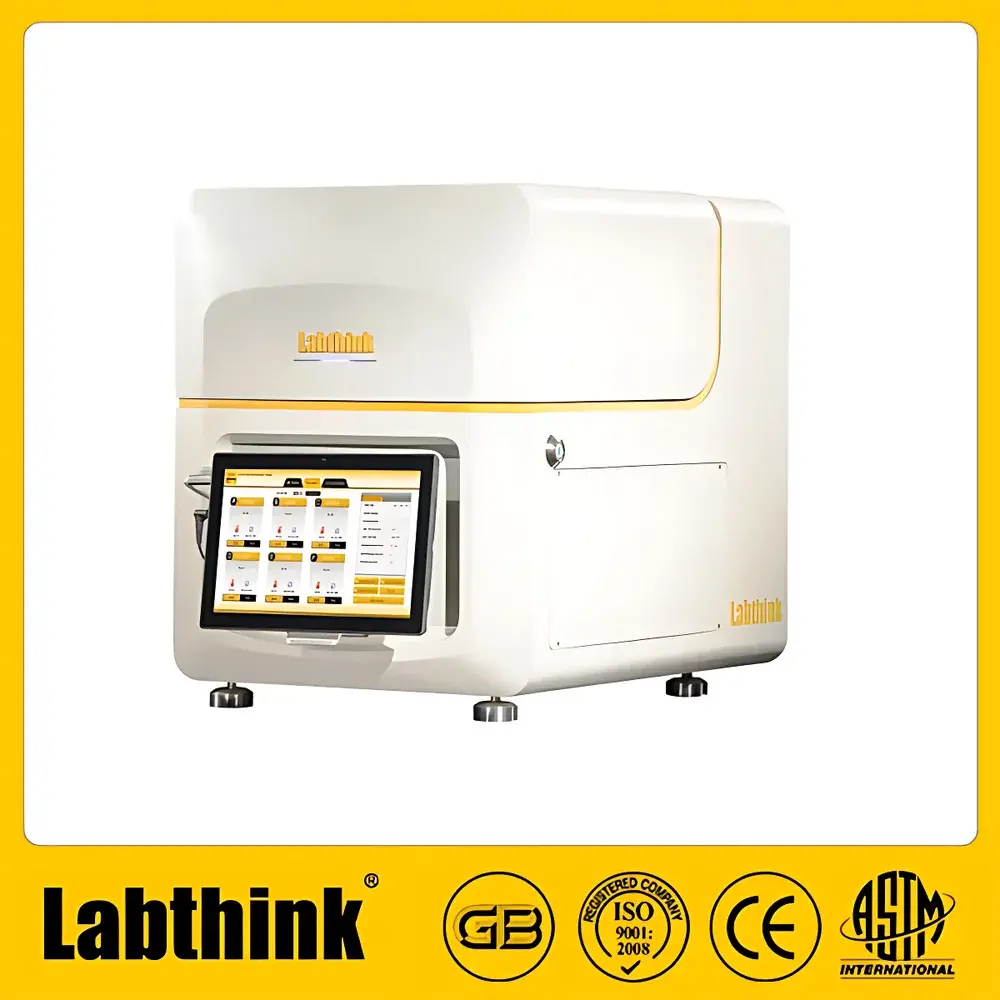
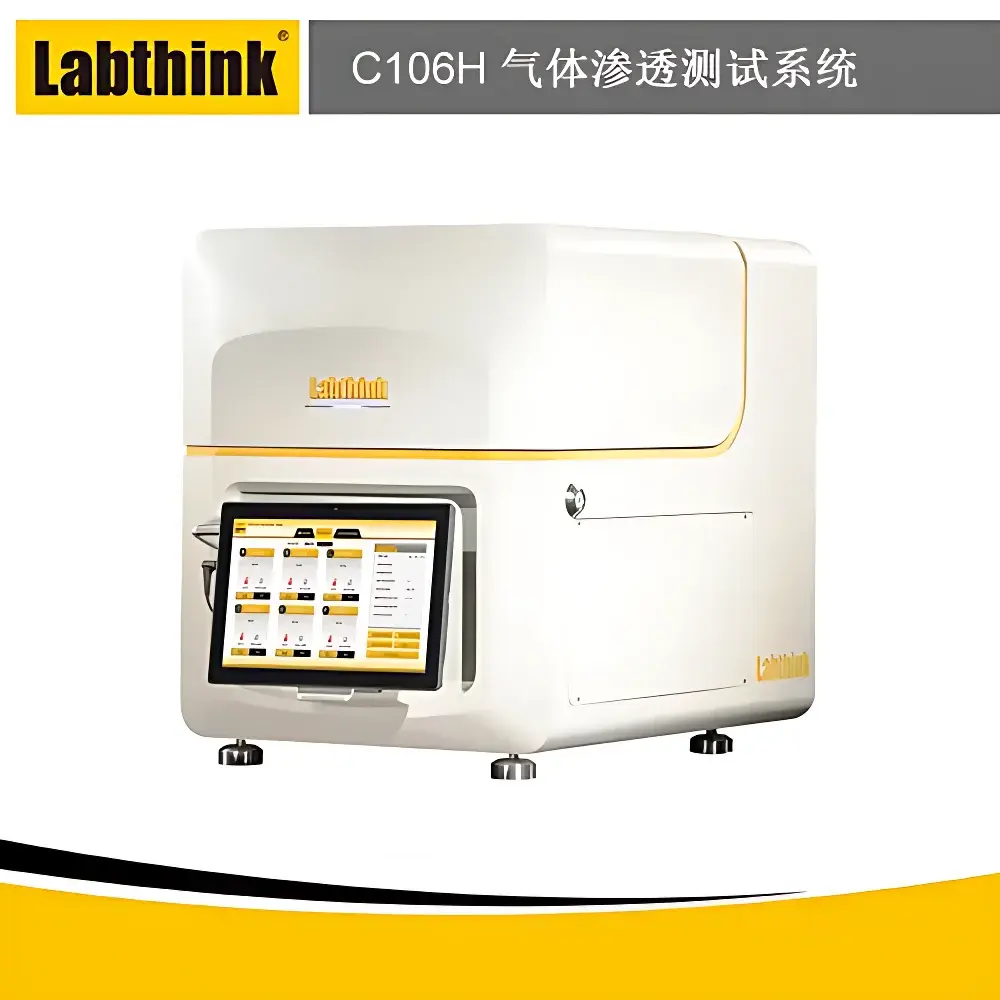
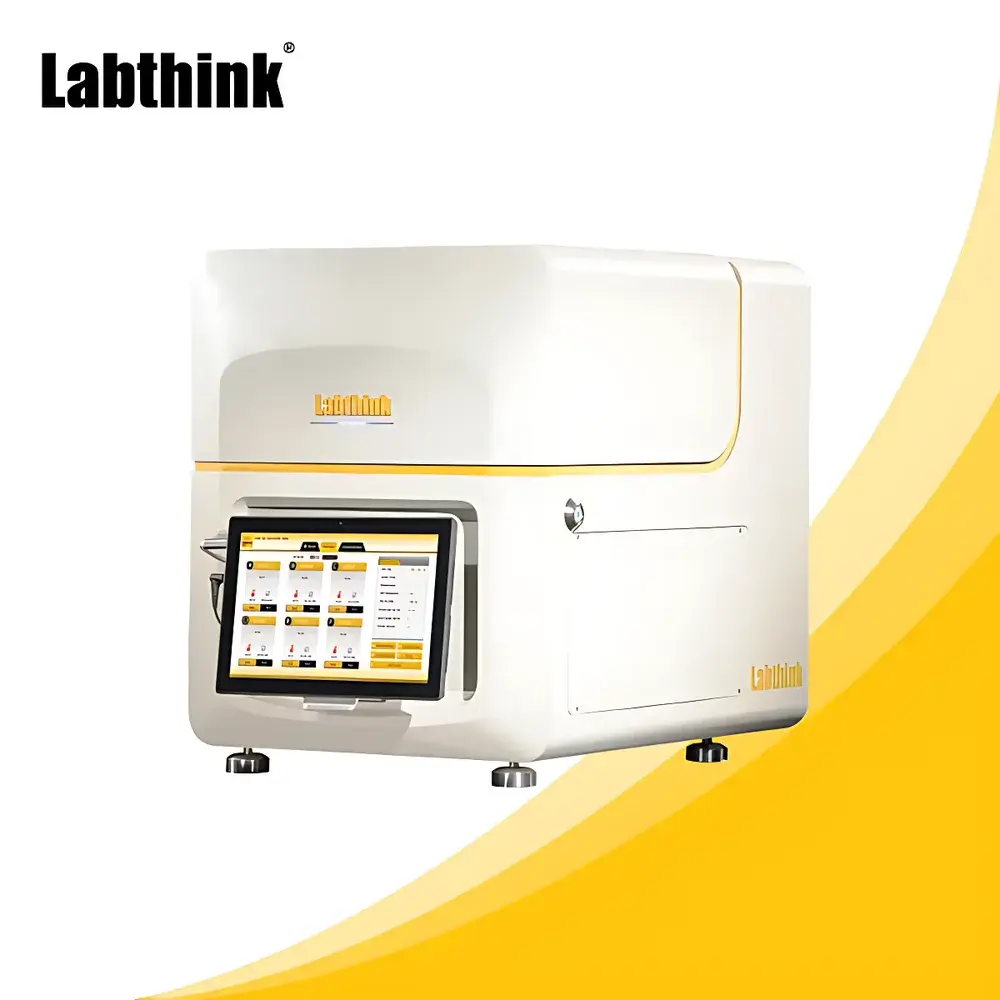
Labthink C106H Differential-Pressure Gas Permeability Analyzer
| Brand | Labthink |
|---|---|
| Origin | Shandong, China |
| Manufacturer Type | Direct Manufacturer |
| Country of Origin | China |
| Model | Labthink-C106H |
| Price Range | USD 14,000 – 98,000 |
| Test Principle | Differential-Pressure (Manometric) Method |
| Test Gases | O₂, N₂, CO₂ (H₂, CH₄ available on custom configuration) |
| Test Range | 0.01–50,000 cm³/m²·24h·0.1MPa |
| Resolution | 0.001 cm³/m²·24h·0.1MPa |
| Temperature Range | 15–50 °C (5–60 °C optional) |
| Temp. Stability | ±0.15 °C |
| Vacuum Resolution | 0.01 Pa |
| Vacuum Accuracy | ±0.2% of reading (1–100% of sensor span) |
| Max. Vacuum Level | ≤10 Pa in test chamber |
| Pressure Control Range | 10–150 kPa (adjustable), stability ±0.2 kPa |
| Sample Area | 38.48 cm² (11.2 cm × 11.2 cm) |
| Max. Sample Thickness | 3 mm |
| Number of Test Cells | 6 independent chambers |
| Humidity Range | 0% RH |
| Power Supply | 120 VAC ±10%, 60 Hz / 220 VAC ±10%, 50 Hz |
| Net Weight | 100 kg |
| Dimensions | 600 × 490 × 660 mm |
Overview
The Labthink C106H Differential-Pressure Gas Permeability Analyzer is an engineered solution for precise, high-reproducibility measurement of gas transmission rates (GTR), permeability coefficients (P), diffusion coefficients (D), and solubility coefficients (S) in packaging and barrier materials. It operates on the standardized differential-pressure (manometric) principle: a conditioned specimen is sealed between two chambers; the low-pressure side (downstream) is evacuated to a defined vacuum level (≤10 Pa), while the high-pressure side (upstream) is pressurized with test gas (O₂, N₂, CO₂, or optionally H₂/CH₄). The resulting transmembrane gas flux induces a measurable pressure rise in the downstream chamber, which—when monitored over time using high-stability vacuum transducers—enables calculation of all four fundamental permeation parameters per ISO 15105-1, ASTM D1434, GB/T 1038-2000, and JIS K7126-1. Designed for R&D laboratories and QC departments in packaging, pharmaceutical, food, and advanced materials sectors, the C106H delivers traceable, GLP-compliant data under controlled thermal conditions across a wide operational envelope.
Key Features
- Six independent, parallel test chambers—triple the capacity of conventional single- or dual-cell instruments—enabling statistically robust multi-sample comparison under identical environmental conditions.
- Rainbow-bridge test cavity architecture with 360° circumferential air circulation ensures uniform thermal distribution and temperature stability of ±0.15 °C across all chambers, critical for reproducible kinetic measurements.
- Imported high-precision capacitance vacuum sensors (0.01 Pa resolution, ±0.2% accuracy) enable reliable quantification of ultra-low transmission rates down to 0.01 cm³/m²·24h·0.1MPa—suitable for evaluating next-generation high-barrier metallized films and oxide-coated substrates.
- Integrated pneumatic actuation system (imported) eliminates mechanical wear, reduces maintenance intervals, and maintains long-term seal integrity—essential for maintaining pressure differentials within ±0.2 kPa during extended tests.
- Automated vacuum management: dual-stage imported vacuum pump (ultimate vacuum ≤0.2 Pa) is intelligently sequenced—no manual valve operation required—reducing operator dependency and energy consumption.
- Patented auto-compensation pressure control actively adjusts upstream gas supply to maintain constant differential pressure throughout the test cycle, minimizing drift-induced error in diffusion-limited regimes.
- 12-inch industrial-grade Windows touch panel with intuitive UI supports both fully automated mode (single-parameter input → start) and advanced manual protocol editing for method development and regulatory validation.
Sample Compatibility & Compliance
The C106H accommodates rigid and flexible planar specimens up to 3 mm thick—including monolayer polymer films (PET, PE, PP), coextrusions, aluminum foil laminates, metallized BOPP, PVDC-coated sheets, rubber gaskets, and silicon wafers—with standard test area fixed at 38.48 cm² (11.2 cm × 11.2 cm). Its modular design permits customization for hazardous gas testing (e.g., H₂, CH₄) via explosion-proof components and dedicated gas-handling protocols. All hardware and firmware comply with electromagnetic compatibility (EMC) and electrical safety standards (IEC 61000, IEC 61010). Data acquisition meets ALCOA+ principles: audit trails, electronic signatures, and user-access controls are available via optional CFR 21 Part 11 and GMP-compliant software modules. Calibration certificates are traceable to NIM (National Institute of Metrology, China) and support ISO/IEC 17025 laboratory accreditation requirements.
Software & Data Management
The embedded Windows-based software provides real-time visualization of pressure vs. time curves, automatic derivation of linear regression slopes for steady-state GTR, and post-processing generation of Arrhenius plots (log P vs. 1/T) for activation energy analysis. Raw data export is supported in CSV, XML, and PDF formats with embedded metadata (operator ID, timestamp, calibration status, environmental logs). Optional DataShield™ module adds cryptographic hashing, immutable storage logging, and role-based access control—fulfilling FDA 21 CFR Part 11 requirements for electronic records in regulated environments. Batch reporting templates align with ISO 2556 and YBB 00082003 documentation structures, facilitating audit readiness and cross-laboratory data exchange.
Applications
- Pharmaceutical packaging: Quantifying O₂ ingress into blister packs and cold-form foil to ensure shelf-life prediction per USP and ICH Q5C guidelines.
- Food packaging R&D: Evaluating barrier performance of multilayer pouches under accelerated aging conditions (e.g., 40 °C/75% RH).
- Flexible electronics encapsulation: Measuring water vapor and oxygen transmission through thin-film barriers used in OLED and perovskite solar cell encapsulation.
- Medical device packaging: Validating seal integrity and material permeability for sterile barrier systems per ISO 11607-1.
- Automotive interior materials: Assessing VOC permeation resistance of trim laminates exposed to elevated cabin temperatures.
FAQ
What gases can be tested on the C106H?
Standard configurations support O₂, N₂, and CO₂. Custom versions with certified gas-handling components and safety interlocks are available for H₂ and CH₄.
Is humidity control integrated into the base model?
Relative humidity control (5–90% ±2% RH) is optional and requires additional humidification/dehumidification modules; the standard system operates at 0% RH unless specified.
How does the six-chamber design improve measurement reliability?
Independent chambers eliminate cross-talk, allow simultaneous replicate testing, and enable intra-batch variability assessment—critical for ISO 5725-2 precision studies and DOE-based material screening.
Can the instrument be validated for GMP compliance?
Yes—when equipped with CFR 21 Part 11 software, IQ/OQ documentation packages, and third-party calibration services, the C106H supports full GMP validation per Annex 11 and EU GMP guidelines.
What is the minimum detectable gas transmission rate?
The system achieves a lower detection limit of 0.01 cm³/m²·24h·0.1MPa when operated under optimal vacuum stability and temperature control conditions.