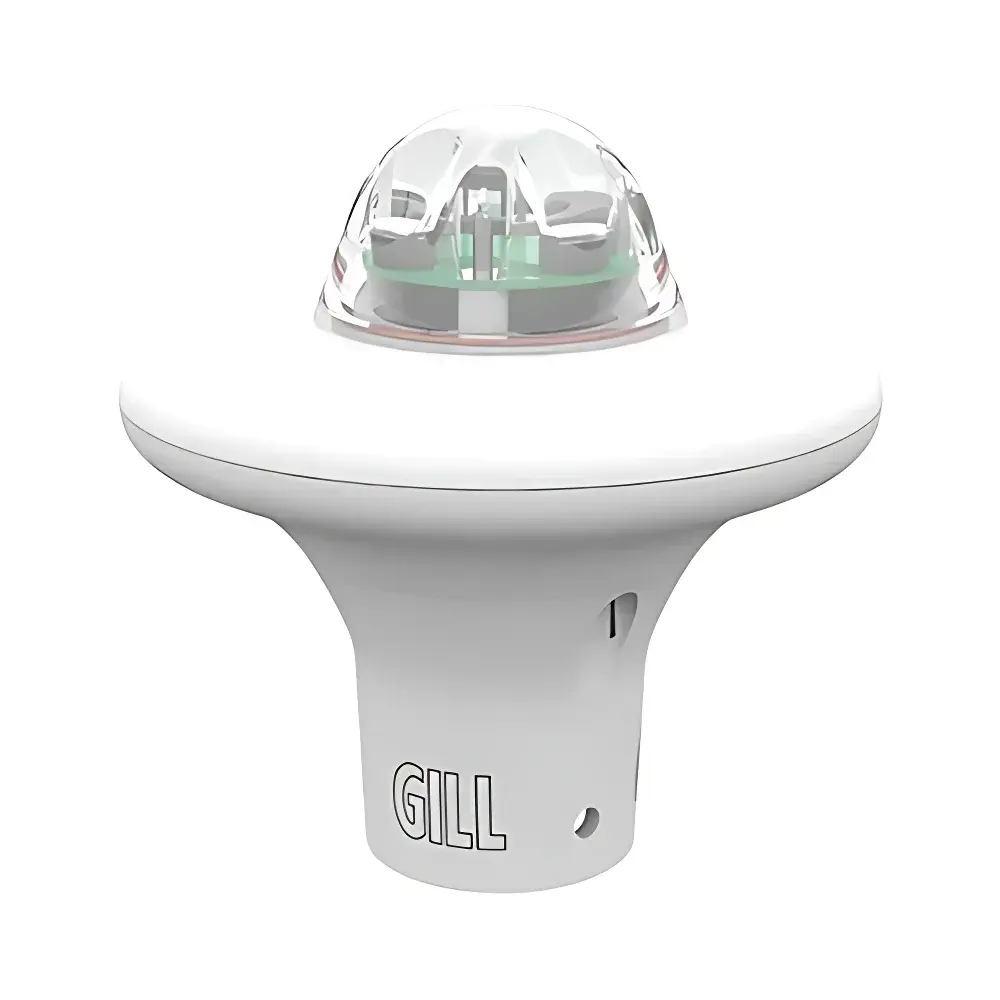
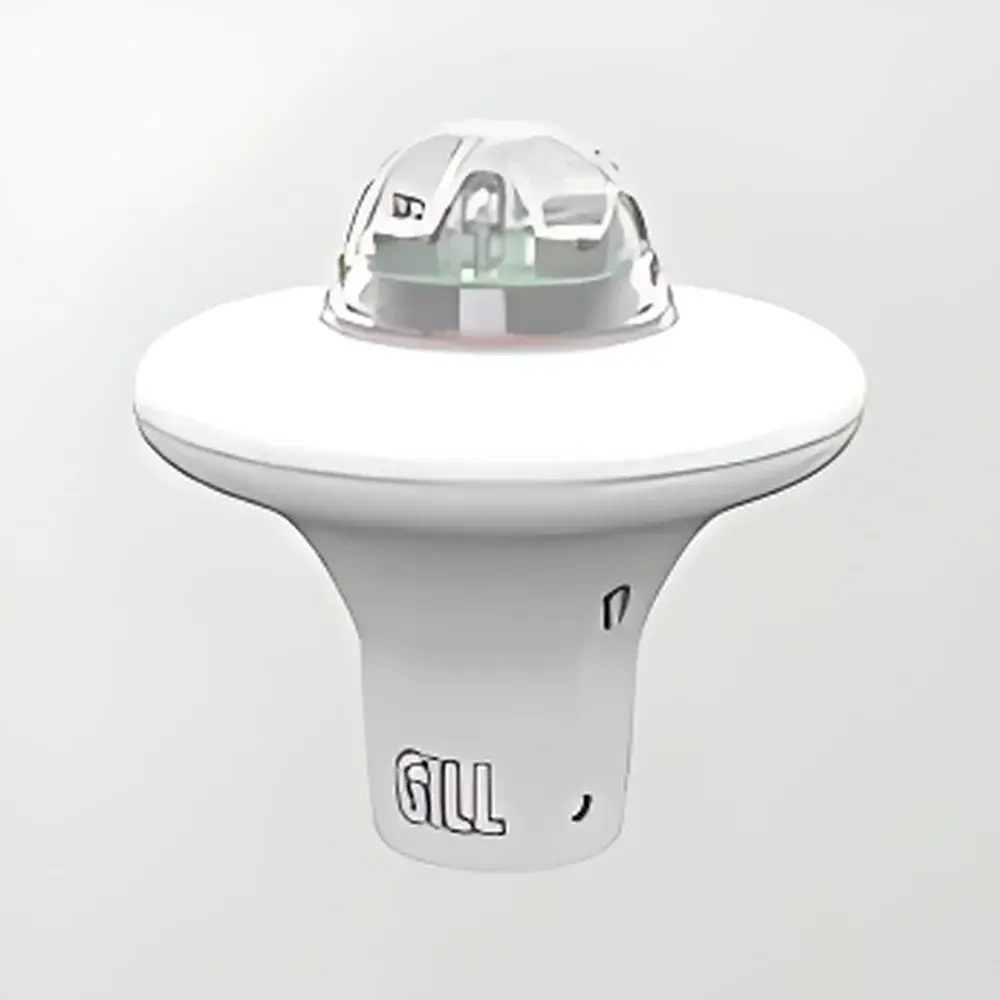
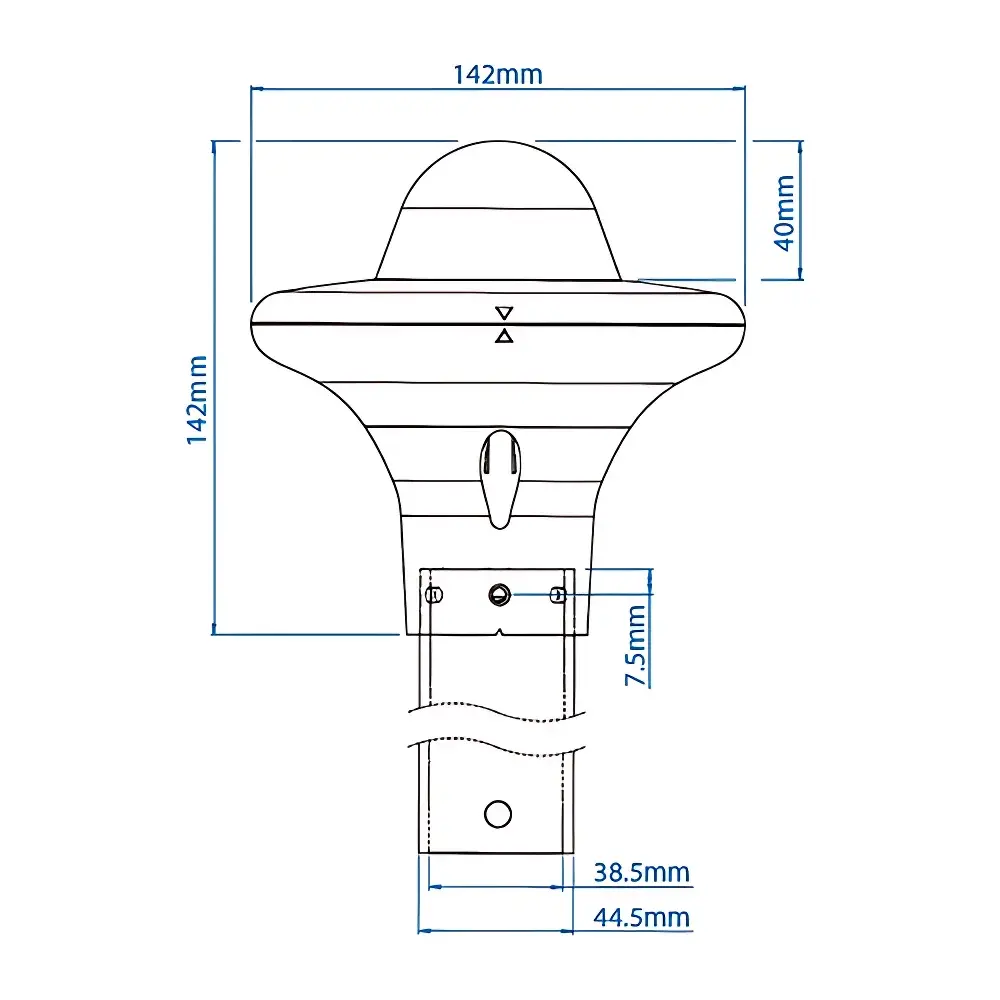
Gill GMX100 Optical Rain Gauge
| Brand | Gill |
|---|---|
| Origin | United Kingdom |
| Model | GMX100 |
| Measurement Principle | Optical Infrared Beam Attenuation |
| Range | 0–>300 mm/hr |
| Resolution | 0.2 mm |
| Accuracy | ±2% |
| Sampling Frequency | 1 Hz |
| Output Options | RS232, RS422, RS485, SDI-12, NMEA 0183, MODBUS RTU, ASCII |
| Heating | Integrated Resistive Heater |
| Power Supply | 5–30 VDC |
| Current Consumption | 80 mA (continuous, 12 VDC), 0.7 mA (low-power polling mode) |
| IP Rating | IP66 |
| Operating Temperature | −40 °C to +70 °C |
| EMC Compliance | BS EN 61326:2013 |
| CE Marked | Yes |
| RoHS Compliant | Yes |
| Weight | 0.3 kg |
Overview
The Gill GMX100 Optical Rain Gauge is a solid-state precipitation sensor engineered for high-reliability environmental monitoring in demanding operational environments. Unlike mechanical tipping-bucket rain gauges, the GMX100 employs an optical infrared beam attenuation principle: an internal collimated infrared light path traverses a sensing chamber between emitter and detector. As raindrops intersect the beam, they scatter and absorb photons proportionally to their size, velocity, and density. An onboard digital signal processor analyzes real-time variations in received light intensity—calibrated against empirical drop-size distribution models—to compute rainfall rate (mm/hr), cumulative depth (mm/total), and event timing (start/stop detection) with metrological traceability. This non-contact, physics-based measurement eliminates mechanical hysteresis, inertia-related undercatch, and false triggering induced by vibration or platform motion—making it especially suited for marine platforms, offshore buoys, mobile assets, and locations where traditional mechanical gauges suffer from wind-induced undercatch, snow clogging, or mechanical wear.
Key Features
- Solid-state design with zero moving parts—eliminates mechanical failure modes associated with tipping buckets, including miscounting during intermittent rain, delayed initiation after dry periods, and wind-induced underestimation.
- Integrated resistive heater maintains optical window temperature above dew point, preventing condensation, frost, or snow accumulation on the sensing surface—critical for year-round operation across arctic, maritime, and humid subtropical climates.
- Multi-protocol digital interface support (RS232/RS422/RS485, SDI-12, NMEA 0183, MODBUS RTU, ASCII) enables seamless integration into legacy SCADA systems, modern IoT telemetry networks, and autonomous weather stations without protocol translation hardware.
- Low-power operating modes—including configurable polling intervals down to hourly cycles—extend battery life in remote deployments; nominal current draw is 80 mA at 12 VDC in continuous operation, dropping to 0.7 mA in deep-sleep polling mode.
- IP66-rated enclosure ensures protection against powerful water jets and dust ingress, validated for permanent outdoor mounting on masts, towers, vessels, and industrial rooftops without additional housing.
- Compact form factor (0.3 kg) and standardized 44.45 mm (1.75″) pole-mount interface simplify field installation and retrofitting into existing meteorological infrastructure.
Sample Compatibility & Compliance
The GMX100 is validated for measurement of liquid precipitation across diverse hydrometeorological conditions—including drizzle, convective showers, and prolonged stratiform rain—without performance degradation due to drop size distribution shifts. It does not measure solid-phase precipitation (e.g., snow, sleet) directly; however, its rapid response time (<1 s latency) and high temporal resolution (1 Hz sampling) enable correlation with co-located temperature and humidity sensors to infer phase transitions. The device complies with BS EN 61326:2013 for electromagnetic compatibility in industrial environments, carries CE marking per EU Directive 2014/30/EU (EMC) and 2011/65/EU (RoHS), and meets IEC 60529 requirements for IP66 ingress protection. While not certified to ISO 9060:2018 Class A/B/C for solar irradiance sensors, its optical rain measurement methodology aligns with WMO Guide to Meteorological Instruments and Methods of Observation (CIMO Guide, Chapter 10) recommendations for solid-state precipitation instrumentation.
Software & Data Management
The GMX100 is supported by Gill’s proprietary MetSet configuration utility and MetView data visualization software—both compatible with Windows OS and deployable on local workstations or networked servers. MetSet allows full parameterization of output format (e.g., mm/hr vs. in/total), reporting interval (1 s to 1 hr), and communication settings (baud rate, parity, protocol framing). MetView provides time-series plotting, event-based rainfall statistics (intensity-duration-frequency analysis), and export to CSV, NetCDF, or XML for ingestion into third-party environmental modeling tools (e.g., HEC-RAS, SWAT, WRF). All firmware updates are delivered via serial interface; no cloud dependency or internet connectivity is required for operation or calibration verification. Audit trails for configuration changes are retained locally within device memory, supporting GLP-aligned data integrity workflows where required.
Applications
- Oceanographic buoys and autonomous surface vehicles requiring motion-insensitive precipitation measurement unaffected by pitch/roll dynamics.
- Aviation weather observation systems (AWOS/ASOS) where rapid detection of precipitation onset/cessation supports low-visibility decision thresholds.
- Smart city infrastructure monitoring—integrated with flood warning systems, stormwater management controllers, and green roof irrigation logic.
- Agricultural research networks measuring localized rainfall partitioning, canopy interception, and evapotranspiration modeling inputs.
- Energy sector applications including solar farm soiling prediction, wind turbine icing risk assessment, and hydroelectric inflow forecasting.
- Educational meteorology labs emphasizing comparative instrumentation studies between optical, weighing, and mechanical rain gauge technologies.
FAQ
Does the GMX100 measure snowfall?
No—the GMX100 is optimized for liquid precipitation detection only. Snowflakes do not produce consistent optical attenuation signatures due to variable crystalline structure and air gaps; therefore, snow accumulation must be measured using complementary instruments such as heated weighing gauges or ultrasonic snow depth sensors.
Can the GMX100 be used in high-wind environments?
Yes—its solid-state optical architecture eliminates wind-induced mechanical error sources inherent in tipping-bucket designs. Field validation shows <±3% deviation at sustained winds up to 25 m/s when mounted according to Gill’s recommended orientation and shielding guidelines.
Is firmware upgrade capability available in-field?
Yes—firmware updates are distributed as binary files and applied via serial connection using MetSet. No hardware modification or factory return is required.
What is the minimum detectable rainfall rate?
The GMX100 reliably detects rainfall events ≥0.2 mm/hr with >95% probability of detection (POD) at 1 Hz sampling; lower intensities may be inferred through statistical aggregation over longer intervals but are not specified in the manufacturer’s metrological validation report.
Does the device support time-synchronized data logging?
The GMX100 itself does not include an internal real-time clock (RTC); timestamping must be performed by the host data logger or telemetry system. However, all digital protocols support frame-aligned data transmission to preserve temporal fidelity when integrated with GPS-synchronized acquisition hardware.